

If you’ve ever typed this word and paused — wait, is it one “m” or two? — you’re not alone. Thousands of people search this question every month. Whether you’re writing a resume, a blog post, or a technical document, spelling this word correctly matters. Let’s settle it once and for all.
Programing or Programming – Quick Answer
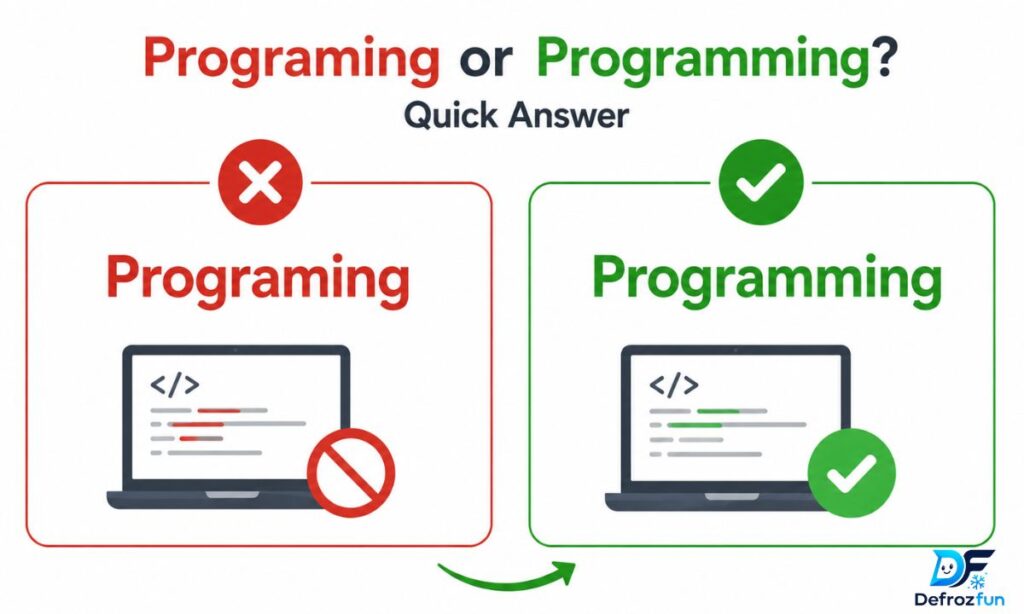
Programming (with double “m”) is the correct spelling.
Programing (with single “m”) is considered a misspelling or an outdated variant in modern English. You should always use programming in professional, academic, and technical writing — no exceptions.
Simple rule to remember: Program + m + ing = Programming. Double the “m,” always.
The Origin of Programing or Programming
Understanding why there are two spellings helps you remember the right one.
The word program traces back to the Greek word programma, meaning “a written public notice.” It entered English through Latin and French in the 17th century. The French spelling was programme — with a double “m” built right in.
When English speakers began turning the verb program into its present participle form by adding -ing, a standard consonant-doubling rule kicked in:
English Spelling Rule: When a verb ends in a single vowel + consonant (like run, stop, program), you double the final consonant before adding -ing.
- run → running
- stop → stopping
- program → programming
This is why programming emerged as the dominant and accepted form. According to the Oxford English Dictionary, the single-“m” version (programing) appeared in some early British texts, but both forms have been used interchangeably since the 1960s — and today, the double-“m” version has completely won out.
British English vs American English Spelling
One of the most common questions people ask is whether programing is the British English version. The short answer: no.
Here’s how it actually breaks down:
| Region | Noun (non-tech) | Noun (computing) | Present Participle |
| American English | program | program | programming |
| British English | programme | program | programming |
| Australian/Canadian | programme | program | programming |
As Merriam-Webster confirms, when the verb program is shown in its -ing form, the final consonant is doubled. And when the British programme drops its final -e before adding -ing, the result is the same word: programming.
So whether you write in US English or UK English, the present participle is always programming — with two “m”s.
The only difference between British and American English is the base noun:
- US: program (used for all meanings)
- UK: programme (for events, schedules) vs program (for computing)
But the -ing form? Always programming, everywhere.
Which Spelling Should You Use?
Always use programming. Here’s a quick guide by context:
- Resume / CV → programming
- Technical documentation → programming
- Academic writing → programming
- Blog posts and articles → programming
- Social media → programming
- Informal texts → programming (still recommended)
Using programing in professional contexts signals carelessness to editors, recruiters, and readers. Modern spell-checkers in tools like Microsoft Word, Google Docs, and Grammarly will flag programing as incorrect.
Bottom line: There is no situation in 2026 where choosing programing over programming benefits you.
Common Mistakes with Programing or Programming
Even experienced writers make errors with this word. Here are the most frequent ones:
- Writing “programing” instead of “programming” — the most common mistake, often from typing fast or autocorrect issues.
- Using “programing” as the British English form — it’s not. Both dialects use programming.
- Inconsistency within the same document — switching between programing and programming looks unprofessional and confuses readers.
- Assuming spell-check will always catch it — some older or basic spell-checkers may not flag programing, which leads writers to assume it’s correct.
- Confusing “program” and “programme” — remember, programme is only the British noun for non-computing contexts (like a concert programme). The -ing form is always programming.
Also Read This: Fiend or Feen: Which Spelling Is Correct? Full Guide (2026)
Programming in Everyday Examples
Here’s how programming is correctly used in different real-world contexts:
Computer Science / Tech:
- “She spent three years learning programming before landing her first software job.”
- “Python is one of the most beginner-friendly programming languages available today.”
- “The programming team worked overnight to fix the critical bug before launch.”
Broadcast / Media:
- “The network changed its programming schedule to accommodate the live sports event.”
- “Saturday morning programming used to be dominated by cartoons.”
Neuroscience / Psychology:
- “Breaking years of mental programming takes consistent effort and self-awareness.”
Event Planning:
- “The conference programming includes keynote speakers, workshops, and networking sessions.”
Notice that across all these contexts, the spelling is consistent: programming, never programing.
Programming – Google Trends & Usage Data
Search data tells a clear story about which spelling dominates:
| Metric | Programming | Programing |
| Google monthly searches | ~1,000,000+ | Mostly misspelling queries |
| Merriam-Webster primary listing | ✅ Yes | ❌ No (redirects to programming) |
| Oxford English Dictionary | ✅ Standard | ⚠️ Variant/outdated |
| Google Docs spell-check | ✅ Accepted | ❌ Flagged as error |
| Grammarly | ✅ Accepted | ❌ Flagged as error |
| Use in academic papers (2020–2026) | Dominant | Rare / near-zero |
Searches for programing mostly come from people asking whether it’s correct — not people actually using it. This alone shows that programming is the universal standard.
Comparison Table: Programing vs Programming
| Feature | Programing | Programming |
| Correct spelling? | ❌ No (outdated) | ✅ Yes |
| Accepted by Merriam-Webster? | As rare variant only | ✅ Primary listing |
| Used in US English? | ❌ Not recommended | ✅ Always |
| Used in UK English? | ❌ Not recommended | ✅ Always |
| Passes spell-check? | ❌ Usually flagged | ✅ Yes |
| Safe for resumes? | ❌ No | ✅ Yes |
| Safe for academic writing? | ❌ No | ✅ Yes |
| Historical usage? | Rare, pre-1960s | Dominant since 1960s |
Conclusion
The debate between programing and programming has a clear winner: programming — with two m’s — every time, in every context, in every dialect of English.
The double “m” follows a consistent English spelling rule, is supported by every major dictionary, and is the only form recognized in professional, academic, and technical writing worldwide. Using programing risks looking unprofessional and is almost universally flagged as an error by modern writing tools.
The takeaway is simple: Program + m + ing = Programming. Memorize this once and you’ll never second-guess it again.

Daniel Brooks is a passionate writer and digital content creator dedicated to sharing insightful, engaging, and informative articles across multiple niches. With a strong interest in technology, lifestyle, trending topics, and online media, Daniel Brooks focuses on delivering well-researched and reader-friendly content that inspires and informs audiences worldwide.