

Confused about loses or losses? Learn the correct meaning, grammar rules, pronunciation, real-life examples, and common mistakes — explained simply for 2026.
Loses or Losses – Quick Answer
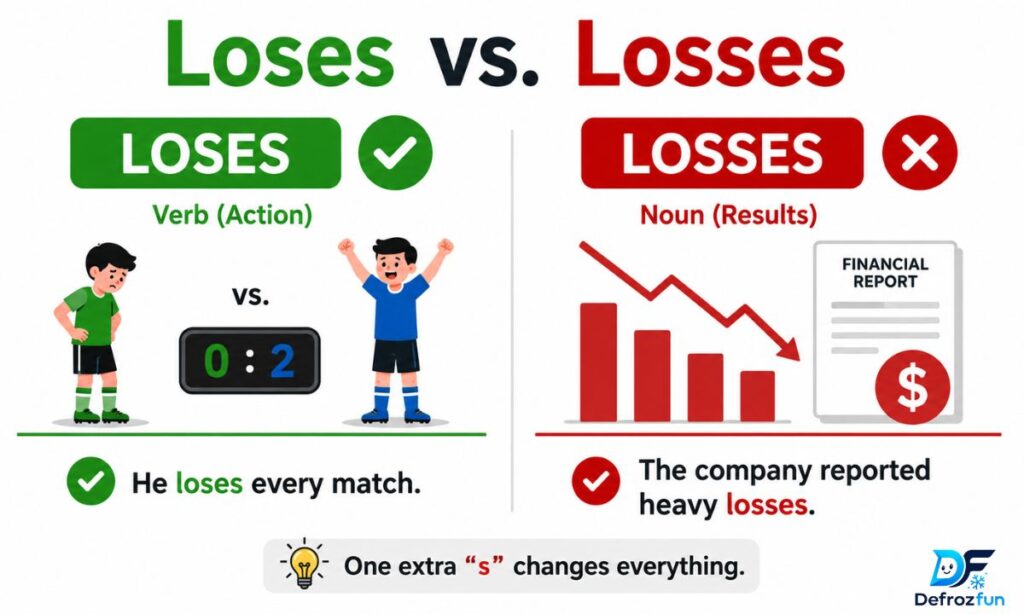
Both loses and losses are correct English words — but they are NOT interchangeable.
| Word | Part of Speech | Use When… |
| Loses | Verb (action word) | Someone is doing the act of losing |
| Losses | Noun (plural) | Referring to results, damage, or defeats |
✅ He loses every match. (verb — action) ✅ The company reported heavy losses. (noun — results)
That one extra “s” changes everything. Keep reading to understand exactly why.
The Origin of Loses / Losses
To understand the confusion, it helps to look at where these words come from.
The verb “lose” traces back to Old English losian, meaning “to perish” or “to be destroyed.” It carried the idea of something being gone, ruined, or beyond reach.
The noun “loss” comes from Old English los, meaning “destruction” or “ruin.” It was rooted in the Proto-Germanic lausa-, and it shared roots with words in Old Norse and Old High German — all tied to the idea of something dissolving or breaking apart.
Over time, English evolved the two forms differently:
- The verb stayed as → lose → loses (third-person singular present)
- The noun became → loss → losses (plural)
That’s why they look so similar — they literally share the same ancient root. But English grammar kept them apart, and that separation matters in modern writing.
British English vs American English Spelling
Here’s some welcome news: there is no spelling difference between British and American English for these words.
| Context | British English | American English |
| Verb form | He loses the match | He loses the match |
| Plural noun | The team suffered losses | The team suffered losses |
Unlike words such as colour/color or realise/realize, loses and losses are spelled identically on both sides of the Atlantic. So wherever you’re writing — a UK business report or a US news article — the rules are exactly the same.
What matters is grammar, not geography.
Which Form Should You Use?
The answer is simple. Ask yourself one question before you write:
Do I need a verb (action) or a noun (thing/result)?
Use “Loses” when:
- The subject is he, she, or it (third-person singular)
- You are describing an ongoing action in the present tense
- The word is doing the work of a verb in the sentence
Examples:
- She loses her phone at least once a week.
- The investor loses money whenever the market dips.
- Our team loses confidence when the coach shouts.
Use “Losses” when:
- You need a plural noun
- You are talking about results, damage, defeats, or amounts lost
- The word follows articles like the, many, huge, financial
Examples:
- The company’s losses this quarter shocked investors.
- After three consecutive losses, the coach was fired.
- War always brings enormous losses on both sides.
A quick mental trick: If you can replace the word with “defeats” or “damages,” use losses. If you can replace it with “fails to keep,” use loses.
Common Mistakes with Loses / Losses
These are the errors that appear most often — even in professional writing.
❌ Mistake 1: Using “losses” as a verb
❌ He losses the argument every time. ✅ He loses the argument every time.
Losses can never be a verb. This is the most common error.
❌ Mistake 2: Using “loses” as a plural noun
❌ The business had three loses last year. ✅ The business had three losses last year.
Loses is always a verb. When you need the plural noun, it must be losses.
❌ Mistake 3: Confusing “loses” with “looses”
❌ She looses her temper quickly. ✅ She loses her temper quickly.
Looses is a real word (meaning to release or set free), but it is almost never what writers intend here.
❌ Mistake 4: Double-counting
❌ The company loses millions in losses. ✅ The company reported millions in losses. ✅ The company loses millions each quarter.
Mixing both forms in one clause creates redundancy and confusion.
Loses / Losses in Everyday Examples
Seeing these words in real-world contexts is the fastest way to remember the difference.
In Sports Writing
- “He loses his focus during high-pressure games.” (verb)
- “The team’s three consecutive losses dropped them to last place.” (noun)
In Finance & Business
- “The startup loses approximately $50,000 per month.” (verb — ongoing action)
- “Quarterly losses reached a record high in Q3.” (noun — reported results)
In Everyday Conversation
- “She always loses her train of thought mid-sentence.” (verb)
- “His losses at poker have become a running joke among friends.” (noun)
In Emotional Contexts
- “He loses sleep over the smallest problems.” (verb)
- “The family is still processing their losses after the flood.” (noun — multiple things lost)
Loses or Losses – Google Trends & Usage Data
Search interest in “loses or losses” has grown consistently, particularly among non-native English speakers and professional writers who want to avoid grammatical errors in formal documents.
The highest search volume comes from the United States, United Kingdom, India, and Canada — countries where English is used heavily in business, education, and media.
In terms of written usage, losses appears far more frequently in published text because it covers financial reports, sports journalism, and news coverage — all high-volume writing categories. Loses, while equally correct, appears more in fiction, personal essays, and direct reporting.
Keyword Comparison Table
| Feature | Loses | Losses |
| Part of speech | Verb | Noun (plural) |
| Base word | Lose | Loss |
| Used with he/she/it? | ✅ Yes | ❌ No |
| Can follow “the”? | ❌ No | ✅ Yes |
| Describes an action? | ✅ Yes | ❌ No |
| Describes results/damage? | ❌ No | ✅ Yes |
| Common in finance? | Sometimes | ✅ Very common |
| Common in sports? | ✅ Yes | ✅ Yes |
| British vs American spelling? | Same | Same |
| Example | She loses focus | Three heavy losses |
FAQs – Loses or Losses
Q: Is “loses” a word?
Yes. Loses is the third-person singular present tense of the verb “lose” — as in “he loses.”
Q: Is “losses” just the plural of “loss”?
Exactly right. Losses is simply the plural noun form of loss.
Q: Can I use “loses” and “losses” in the same sentence?
Yes, but carefully — for example: “He loses the deals that cause the biggest losses for the firm.”
Q: Which is correct: “cut loses” or “cut losses”?
Always “cut losses” — it’s a noun phrase meaning to stop further damage or spending.
Q: Is there a difference in pronunciation?
Slightly — loses is pronounced “LOO-zez” and losses is “LAW-sez.” The vowel sound in the first syllable differs.
Q: Can “losses” refer to people?
Yes — in contexts like grief or war, “losses” can refer to lives lost (e.g., “The battle resulted in heavy losses”).
Q: Which is more common in formal writing?
Losses appears more in formal writing such as financial reports, legal documents, and news articles.
Q: Why do people confuse these two words?
Because they look nearly identical and share the same historical root — both come from the Old English word los.
Conclusion
The difference between loses and losses is not complicated once you see it clearly:
- Loses = verb. It shows an action. Someone is actively failing to win or keep something.
- Losses = noun. It refers to results, damage, or multiple instances of losing.
There is no British or American spelling variation to worry about. The only thing that matters is whether your sentence needs an action word or a result word.
Next time you pause while typing — stop and ask: Am I describing what someone does, or what happened? That single question will point you to the right word every time.
Good grammar is not about memorizing rules. It’s about understanding how language works — and now you do.

Daniel Brooks is a passionate writer and digital content creator dedicated to sharing insightful, engaging, and informative articles across multiple niches. With a strong interest in technology, lifestyle, trending topics, and online media, Daniel Brooks focuses on delivering well-researched and reader-friendly content that inspires and informs audiences worldwide.