

You’re writing an email, a blog post, or a caption — and suddenly you pause. Is it outing or outting? One “t” or two? It feels like English is testing you on purpose.
The good news: this one has a clear, simple answer. And once you understand why, you’ll never mix it up again.
Outting or Outing – Quick Answer
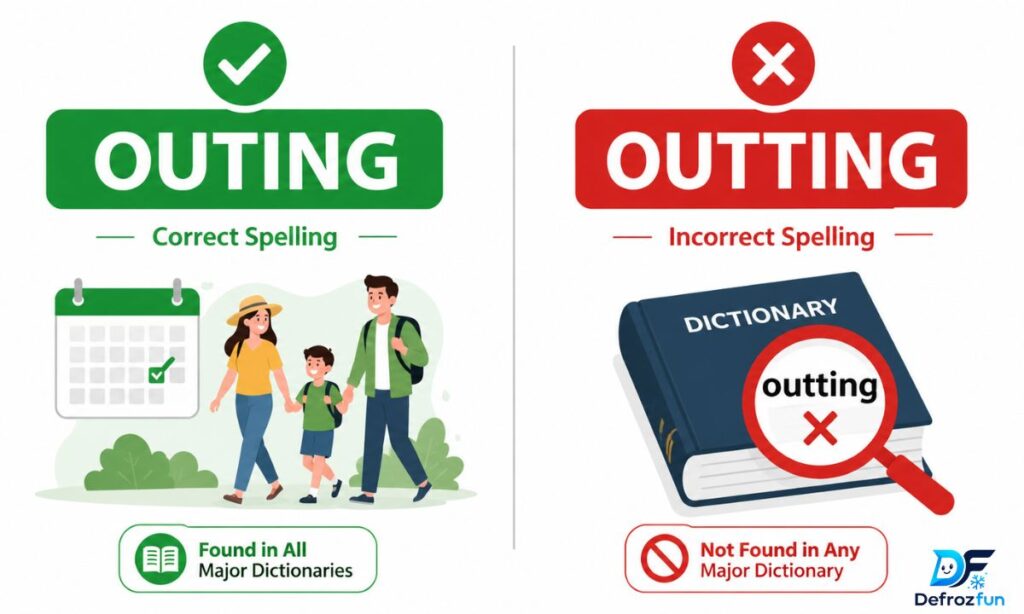
Outing is the correct spelling. Outting (with double “t”) is a spelling error and does not appear in any major English dictionary — not Merriam-Webster, not Cambridge, not Collins.
If you’ve been typing “outting,” you’re not alone. It’s one of the most common spelling slip-ups in English, and the reason behind it is actually logical. More on that below.
The Origin of Outing
The word outing has a longer history than most people realize. According to Vocabulary.com, in the fourteenth century, outing simply meant “the action of going out.” By the fifteenth century, it had taken on an additional meaning: “the act of putting out.” Over the following centuries, it gradually evolved into its modern meanings — a leisure trip, an athletic appearance, or the public disclosure of someone’s private identity.
The base word is out, a two-letter word ending in two letters: a vowel (“o”) and a consonant (“t”). When you add the suffix -ing, the spelling rule does not require doubling the “t.” The result is simply out + ing = outing.
That’s the whole story. One “t,” always.
Why People Write “Outting” — The Grammar Rule Behind the Confusion
This is where it gets interesting, and it’s also what most competitors skip entirely.
English has a well-known spelling rule called the 1-1-1 Rule (also called the CVC Rule). It says: if a one-syllable word has one vowel followed by one consonant, you double the final consonant before adding a vowel suffix like -ing. That’s why run becomes running, sit becomes sitting, and hop becomes hopping.
So why doesn’t out follow the same rule?
Because out ends in two consonants — “u” acts as a vowel, and “t” is the final consonant, but the letter before “u” is “o,” making “ou” a vowel combination (a diphthong). The word ends in a vowel cluster followed by a consonant, not a single vowel followed by a consonant. The 1-1-1 rule simply doesn’t apply here.
| Word | Ends In | Rule Applied | Result |
| run | vowel + consonant (CVC) | Double the consonant | running |
| sit | vowel + consonant (CVC) | Double the consonant | sitting |
| out | vowel cluster + consonant | No doubling needed | outing |
| bark | two consonants | No doubling needed | barking |
Once you see this table, the pattern is obvious. Out doesn’t qualify for consonant doubling — so outing it is.
British English vs American English Spelling
Some spelling debates genuinely split along British and American lines — think colour vs color, or travelling vs traveling. So it’s fair to ask: does the same apply here?
No. Outing is correct in both British English and American English, with no variation whatsoever. Cambridge Dictionary, which represents British English, and Merriam-Webster, the standard American reference, both list outing as the only valid form.
The British/American distinction does affect some words with double consonants. For example, travelling (British) vs traveling (American). But outing is not one of those cases. Both sides of the Atlantic agree: one “t” only.
Which Spelling Should You Use?
Always use outing. In every context, every country, every style guide. There is no regional exception, no informal usage, no niche where outting is acceptable.
Outing carries two distinct meanings depending on context:
Meaning 1 — A leisure trip or excursion: “We planned a family outing to the lake.” This is the everyday, friendly use of the word. It refers to any short trip taken for fun or recreation.
Meaning 2 — Public disclosure of someone’s private identity: “The journalist was criticized for the outing of the politician.” This usage refers to revealing someone’s sexual orientation or gender identity without their consent. It carries a serious, often sensitive tone.
The spelling stays the same in both contexts. What changes is how carefully you use it.
Common Mistakes with Outing
Beyond the double-“t” error, a few other mistakes show up regularly with this word.
Confusing “outing” with “outing someone”: In casual conversation, people sometimes use outing loosely when they mean exposing private information of any kind — not just identity-related. Be precise with your language, especially in formal writing.
Using “outting” in autocomplete: Some older autocorrect systems or non-English keyboards may not flag outting as an error. Don’t assume your spell-check has caught it. Double-check manually.
Pluralizing incorrectly: The plural of outing is simply outings — not outtings. Same rule applies.
Outing in Everyday Examples
Seeing a word in real sentences makes it stick. Here are clear, natural examples across both meanings:
Leisure context:
- “The school organized a fun outing to the science museum.”
- “Their first outing as a couple was a quiet dinner downtown.”
- “The team’s Saturday outing ended with everyone sunburned and happy.”
Identity disclosure context:
- “The actor spoke publicly about the unwanted outing years later.”
- “Privacy advocates pushed for stronger laws against forced outing.”
Notice how naturally outing fits in all of these. Now try mentally inserting outting — it looks wrong immediately. Your eye catches it even when your brain doesn’t.
Outting – Google Trends & Usage Data

| Term | Dictionary Status | Used in Formal Writing | Search Volume Trend |
| Outing | ✅ Correct | Yes | High and consistent |
| Outting | ❌ Misspelling | No | Appears mostly in error-related searches |
| Outings (plural) | ✅ Correct | Yes | Common in travel/event content |
| Outtings (plural) | ❌ Misspelling | No | Not a recognized form |
Google Trends data consistently shows that searches for “outting” are driven almost entirely by people looking to confirm the correct spelling — not by people who genuinely believe it’s a real word. That itself is telling: even those who write it that way suspect something is off.
The word outing has maintained steady usage across books and publications since the 1800s, while outting has no recorded presence in formal corpora.
The Spell-Check Blind Spot: When Technology Gets It Wrong
Here’s something most articles won’t tell you: autocorrect and spell-check tools don’t always catch outting.
Some word processors will flag it. Others won’t, especially older versions or grammar tools that lack an up-to-date dictionary. This creates a false sense of security. If you’ve typed outting and your software didn’t underline it in red, that doesn’t mean it’s correct — it means your tool missed it.
The safest approach: when you’re uncertain about a spelling, look it up directly in Merriam-Webster or Cambridge Dictionary. A quick search takes seconds and prevents an embarrassing error from slipping into your published work.
Frequently Asked Questions
Is “outting” ever correct in any context?
No. Outting is not a valid word in any variety of English. It does not appear in any recognized dictionary and should not be used in writing.
What is the plural of outing?
The plural is outings. For example: “We went on three outings last month.”
Does “outing” mean the same thing in British and American English?
Yes. The word has the same meanings and the same spelling in both varieties. There is no regional difference.
Can “outing” be used as a verb?
The noun form is most common. However, to out is used as a verb (e.g., “to out someone”), and outing can function as a gerund in that sense: “the outing of the senator caused controversy.”
Why does spell-check sometimes miss “outting”?
Older or less comprehensive spell-check systems may not flag it because it looks plausible based on letter patterns. Always verify manually when in doubt.
Key Insights
The answer to outting or outing is simple: outing wins every time, without exception.
The confusion comes from a reasonable misunderstanding of English spelling rules — the same rules that give us running and sitting don’t apply to outing because the word structure is different. Once you understand the 1-1-1 rule and why out doesn’t fit it, the correct spelling becomes intuitive.
Use outing whether you’re writing about a family day trip or a serious journalistic piece. Keep it to one “t,” double-check your spell-check, and you’re good to go.

Daniel Brooks is a passionate writer and digital content creator dedicated to sharing insightful, engaging, and informative articles across multiple niches. With a strong interest in technology, lifestyle, trending topics, and online media, Daniel Brooks focuses on delivering well-researched and reader-friendly content that inspires and informs audiences worldwide.