

If you’ve ever typed “lillies” and paused to wonder whether it looks right — you’re not alone. This is one of the most common spelling slip-ups in English, and it trips up native speakers, students, and writers every day. The good news? The answer is clear, the rule is simple, and after reading this guide, you’ll never second-guess it again.
Lilies or Lillies – Quick Answer
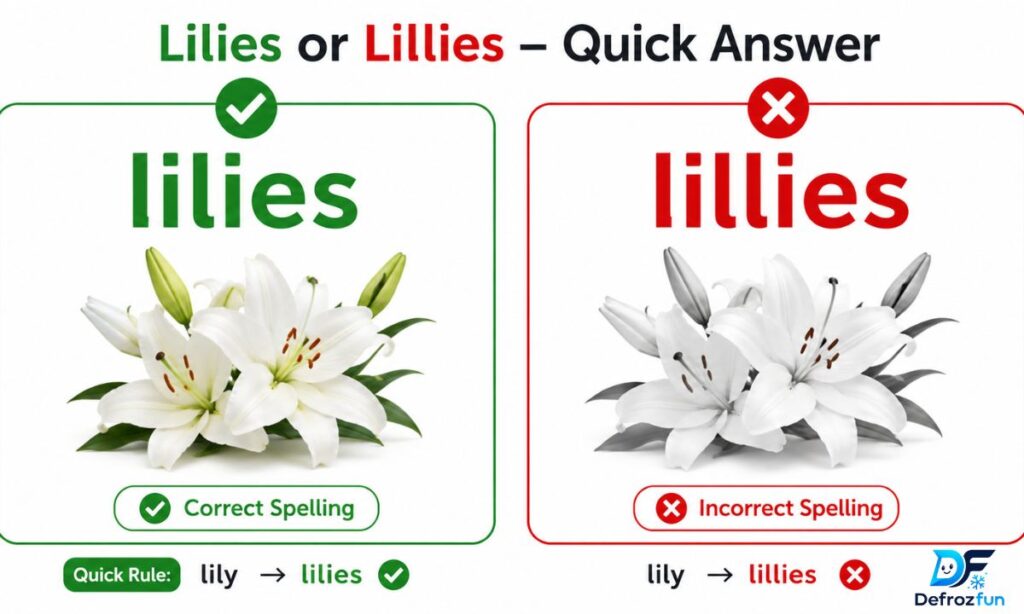
The correct spelling is “lilies.”
“Lillies” (with double-L) is a misspelling. It does not exist as a valid word in any standard English dictionary — not British, not American, not any other variety. Every major dictionary, grammar authority, and spell-checker confirms the same thing: lilies is the one and only correct plural form of the word lily.
Quick Rule: lily → lilies ✅ | lily → lillies ❌
The Origin of Lilies
Understanding where the word comes from makes the spelling much easier to remember.
The word lily traces back to the Latin word lilium, which referred to the same elegant, trumpet-shaped flower we know today. From Latin, it passed into Old English as lilie and gradually evolved into the modern spelling lily over centuries of language change.
Because the Latin root lilium uses only a single “L” before the vowel, the English word never developed a double-L form. The spelling was stabilized as lily long before modern dictionaries existed, and it has remained consistent ever since.
As Collins English Dictionary notes, lily comes directly from the Old English, derived from Latin līlium, which is itself related to the Greek leirion. There is no etymological basis for the double-L spelling “lillies” at any point in this history.
British English vs American English Spelling
One of the most common assumptions people make is that “lillies” might be the British spelling while “lilies” is American — or vice versa. This is completely incorrect.
Both British English and American English use the same spelling: lilies.
Unlike words such as colour/color or favour/favor, where British and American English genuinely differ, lily and its plural lilies follow the same spelling in every English-speaking country — the UK, USA, Canada, Australia, and beyond.
There is no regional exception. No dialect uses “lillies” as a standard form. If you see “lillies” in print, it is a typo or error — regardless of where the writer is from.
Which Spelling Should You Use?
Always use lilies.
Here is a simple guide based on context:
| Situation | Correct Spelling |
| Referring to more than one lily flower | lilies |
| Writing an essay or formal document | lilies |
| Casual text or social media post | lilies |
| British English writing | lilies |
| American English writing | lilies |
| Botanical or scientific reference | lilies |
There is no situation — formal, informal, British, American — where “lillies” is correct. The answer is always lilies.
The Grammar Rule Behind the Spelling
The spelling of lilies follows a standard and very common English pluralization rule:
When a noun ends in a consonant + “y”, change the “y” to “i” and add “-es”.
Lily ends in the consonant L followed by Y — so the rule applies directly:
- lily → lili + es = lilies
- daisy → daisi + es = daisies
- city → citi + es = cities
- baby → babi + es = babies
- country → countri + es = countries
Notice that none of these words double the final consonant before adding “-ies.” The doubling rule in English applies in a different context — specifically when you add a vowel suffix (like -ing or -ed) to a short-vowel word ending in a single consonant (e.g., run → running). That rule simply does not apply when forming plurals with “-ies.”
This is why “lillies” is incorrect — it combines two different spelling patterns that don’t belong together.
Common Mistakes with Lilies or Lillies
Writers make this mistake for a few understandable reasons:
- Double-letter habit: English has many words with double-L (bell, hill, full, spell), so doubling the L in “lily” feels natural by association.
- Autocorrect confusion: Some devices have contact names or brand names spelled “Lilly,” which can bleed into regular writing.
- Overapplying spelling rules: Writers who know that English sometimes doubles letters before suffixes incorrectly apply that logic here.
- Visual similarity: “Lillies” doesn’t look obviously wrong at a quick glance, especially in handwriting or casual reading.
Common Errors to Avoid
❌ “I ordered a bouquet of fresh lillies.”
✅ “I ordered a bouquet of fresh lilies.”
❌ “The garden was full of white lillies.”
✅ “The garden was full of white lilies.”
❌ “Lillies bloom in early summer.”
✅ “Lilies bloom in early summer.”
❌ “She loves tiger lillies most of all.”
✅ “She loves tiger lilies most of all.”
Lilies in Everyday Examples

Seeing the correct spelling used in real sentences helps reinforce the right form. Here are practical examples across different writing contexts:
In everyday conversation:
- “Can you pick up some lilies on your way home?”
- “The lilies in our garden are finally blooming.”
In formal or descriptive writing:
- “The ceremony hall was adorned with white calla lilies and soft candlelight.”
- “Easter lilies have long been associated with themes of purity and renewal.”
In botanical or educational contexts:
- “Lilies belong to the genus Lilium and the family Liliaceae.”
- “Many species of lilies are native to the temperate regions of the Northern Hemisphere.”
In literature and poetry:
- “The valley was carpeted with tiger lilies, their orange blooms swaying in the breeze.”
- “Water lilies drifted silently across the still pond.”
In all of these contexts — casual, formal, scientific, or creative — the spelling is always lilies.
How Do You Spell Lilies?
Here is the exact letter-by-letter breakdown:
L – I – L – I – E – S
Pronunciation: /ˈlɪlɪz/
- Singular: lily
- Plural: lilies
- Incorrect plural: ~~lillies~~ (not a word)
- Another incorrect form: ~~lilys~~ (not a word)
A helpful memory trick: think of the word as built from two parts — lili (the modified root) + es (the plural ending). No doubling, no extra letters.
Lilies – Google Trends & Usage Data
Search data strongly confirms which spelling people recognize as correct.
- The term “lilies” generates millions of search results across all major search engines.
- The misspelling “lillies” appears far less frequently and mostly in the context of people asking which version is correct — not as standard usage.
- Grammar tools, spell-checkers, and writing assistants all flag “lillies” as an error and suggest “lilies” as the correction.
- The Collins English Dictionary, Merriam-Webster, and Oxford English Dictionary all list lilies as the only accepted plural form.
This pattern is consistent across years of search data and across multiple English-speaking countries. Writers and speakers worldwide default to lilies — which is exactly what the grammar rules require.
Comparison Table: Lilies vs Lillies
| Feature | Lilies ✅ | Lillies ❌ |
| Correct English spelling | Yes | No |
| Found in dictionaries | Yes | No |
| Follows grammar rules | Yes | No |
| Used in British English | Yes | No |
| Used in American English | Yes | No |
| Accepted by spell-checkers | Yes | No (flagged as error) |
| Proper plural of “lily” | Yes | No |
| Etymologically grounded | Yes | No |
Frequently Asked Questions
Q: Is it lilies or lillies?
A: It’s lilies — “lillies” is a misspelling with no basis in standard English grammar.
Q: Why do people spell it “lillies”?
A: Because English has many double-L words, people habitually add an extra L — but lily doesn’t follow that pattern.
Q: Is “lillies” ever correct?
A: No. There is no context — formal, informal, British, or American — where “lillies” is correct.
Q: What is the plural of lily?
A: The plural of lily is lilies, formed by changing the Y to I and adding -ES.
Q: Is the spelling different in British English?
A: No. Both British and American English use lilies — there is no regional variation here.
Q: How do you spell water lilies?
A: Water lilies — two words, with “lilies” spelled the standard way.
Q: What is the correct spelling of tiger lilies?
A: Tiger lilies — again, “lilies” with a single L.
Conclusion
The answer to “lilies or lillies” is as clear as it gets: lilies is always correct, and lillies is always wrong. The plural form follows a standard English rule — change the Y to I, add -ES — and that rule produces lilies, not lillies.
No double L. No exceptions. No regional variations.
Whether you’re writing a birthday card, a school essay, a garden blog, or a botanical report, the correct word is lilies. Keep the grammar rule in mind, and you’ll spell it right every time without hesitation.

Daniel Brooks is a passionate writer and digital content creator dedicated to sharing insightful, engaging, and informative articles across multiple niches. With a strong interest in technology, lifestyle, trending topics, and online media, Daniel Brooks focuses on delivering well-researched and reader-friendly content that inspires and informs audiences worldwide.