

If you’ve ever stopped mid-sentence wondering whether to write bellow or below, you’re not alone. These two words look almost identical, but they mean completely different things. One wrong letter can change your entire message — and spell-checkers won’t always catch it.
This guide gives you a clear, no-fluff breakdown of both words: what they mean, where they came from, how they’re used, and how to never mix them up again.
Bellow or Below – Quick Answer
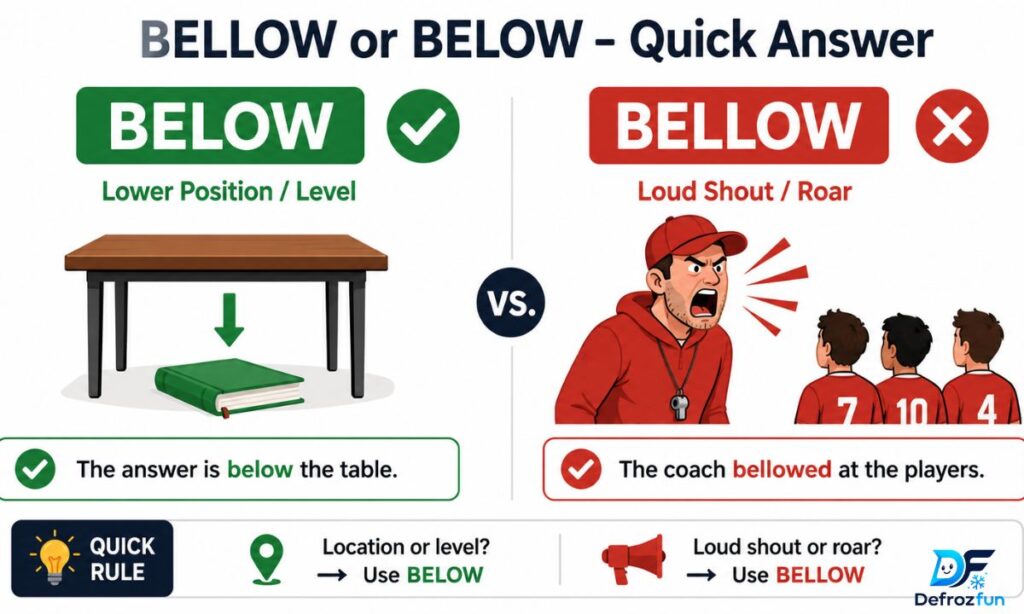
Both words are correct — but they are NOT interchangeable.
- Below = at a lower position, level, or amount (preposition/adverb)
- Bellow = to shout loudly in a deep voice (verb/noun)
Quick rule:
- Talking about location or level? → Use below
- Talking about a loud shout or roar? → Use bellow
✅ “The answer is below the table.” ✅ “The coach bellowed at the players.”
The Origin of Bellow and Below
Understanding where these words come from helps you remember the difference for good.
Origin of Bellow
The word bellow traces back to Old English bylgian, meaning “to roar.” It is linked to the Proto-Indo-European root *bʰel-, which means “to sound or roar.” Originally, it described the deep cry of animals — particularly bulls and cows. It wasn’t until around 1600 that it began being used to describe human shouting. The connection to bell is no accident: both words share that same ancient root of loud, resonating sound.
Origin of Below
Below comes from Middle English belo, meaning “lower down.” It evolved as a positional word to describe anything placed at a lower level, rank, or amount. Over time, it became one of the most common prepositions in the English language, used in everyday speech, formal writing, and academic contexts alike.
Although both words evolved from early English, they traveled completely separate paths — one describing sound, the other describing space.
British English vs American English Spelling
One of the most common questions people ask is whether there’s a spelling difference between British and American English for these words.
There is none.
| Feature | British English | American English |
| Spelling of below | below | below |
| Spelling of bellow | bellow | bellow |
| Pronunciation of below | /bɪˈləʊ/ | /bɪˈloʊ/ |
| Pronunciation of bellow | /ˈbɛl.əʊ/ | /ˈbɛl.oʊ/ |
| Usage rules | Same | Same |
Unlike words such as colour/color or centre/center, bellow and below are spelled identically in both dialects. If you’re confused between these two words, the issue is meaning — not regional spelling variation.
Which Spelling Should You Use?
The answer depends entirely on what you want to say. Here’s a simple breakdown:
Use below when you mean:
- A lower physical position (the text below)
- A smaller number or amount (below average)
- A lower rank or level (below the manager)
- Further down in a document (see the table below)
Use bellow when you mean:
- To shout loudly and deeply (he bellowed across the hall)
- A loud, deep roar (the bellow of the crowd)
- A tool used to blow air into a fire (a pair of bellows)
The Fastest Memory Trick
- BELLOW starts with BELL → bells make a loud noise → bellow is loud
- BELOW ends with LOW → something low is below something else
Once you learn those two anchors, you’ll never mix them up again.
Common Mistakes with Bellow or Below
These are the most frequent errors writers make — and how to fix them.
| ❌ Incorrect | ✅ Correct | Why |
| The results are bellow expectations. | The results are below expectations. | Talking about level/standard |
| The teacher belowed at the class. | The teacher bellowed at the class. | Talking about shouting (bellowed is the past tense) |
| The price is bellow $50. | The price is below $50. | Talking about amount |
| Please find the details bellow. | Please find the details below. | Referring to position in a document |
| He let out a loud below. | He let out a loud bellow. | Referring to a shout/roar |
Important note: Spell-check tools will NOT catch these errors because both words are valid English words. You must know the meaning to use the right one.
Bellow or Below in Everyday Examples
Seeing these words in real sentences is the fastest way to internalize the difference.
Below in Sentences
- The temperature dropped below freezing overnight.
- His performance score was below the national average.
- Please review the summary below before the meeting.
- She lives in the apartment below mine.
- Children below the age of 12 get free entry.
Bellow in Sentences
- The sergeant bellowed orders across the training ground.
- We heard a deep bellow coming from the forest.
- He bellowed into the phone, demanding an explanation.
- The crowd bellowed when the winning goal was scored.
- The old blacksmith used a pair of bellows to stoke the forge.
Bellow as a Noun vs Verb
| Part of Speech | Example |
| Verb | She bellowed for help. |
| Noun (shout) | His bellow shook the room. |
| Noun (tool) | He used bellows to fan the flames. |
Bellow or Below – Google Trends & Usage Data

Looking at how often each word is searched gives us useful insight into real-world confusion.
- “Below” is one of the most frequently used English prepositions, appearing in millions of documents, emails, and websites daily.
- “Bellow” is far less common in everyday writing and is mostly used in creative, literary, or expressive contexts.
- Searches for “bellow or below which is correct” peak in English-learning communities and among non-native speakers, particularly those writing professional emails.
The word below dominates written English by a wide margin. The word bellow is more specialized — you’ll mostly see it in storytelling, journalism, and sports commentary.
Keyword Comparison Table
| Feature | Below | Bellow |
| Part of Speech | Preposition / Adverb / Adjective / Noun | Verb / Noun |
| Core Meaning | At a lower level or position | To shout loudly; a loud roar |
| Used in formal writing? | Yes, very commonly | Rarely (more literary) |
| Pronunciation | bee-LOW | BELL-oh |
| Common phrase | “below average,” “see below” | “bellowed out,” “a bellow of rage” |
| Spelling rule | One “l” | |
| Same in UK/US? | Yes | Yes |
| Caught by spell-check? | No (both are valid words) | No |
Frequently Asked Questions
Q: Is “bellow” ever used as a preposition like “below”?
No. Bellow is a verb or noun only — it cannot replace below in positional sentences.
Q: What is the past tense of “bellow”?
The past tense is bellowed — for example, “He bellowed at the crowd.”
Q: Can “below” describe sound?
No. Below describes position or level, not sound. Use bellow for anything related to loud noise.
Q: Is “bellowed” a real word?
Yes. Bellowed is the simple past and past participle of bellow — “She bellowed his name across the room.”
Q: Are bellow and below homophones?
No. They are pronounced differently: below = bee-LOW; bellow = BELL-oh.
Q: What does “bellows” mean as a noun?
Bellows refers to a device used to blow air into a fire — it’s always plural and unrelated to the verb bellow in everyday usage.
Q: Which word is more common in professional writing?
Below is far more common in professional and academic writing. Bellow is mostly found in creative or journalistic writing.
Q: Why does autocorrect not fix these mistakes?
Because both words are spelled correctly — autocorrect only flags misspellings, not wrong word choices.
Conclusion
Below and bellow are two words that look almost the same but serve completely different purposes. Below tells you where something is — lower in position, rank, or amount. Bellow tells you what someone is doing — shouting loudly or making a deep, powerful sound.
The one-letter difference between them is easy to overlook, but the meaning gap is enormous. A simple way to remember: if you’re pointing somewhere down, use below. If someone is making a loud noise, use bellow.
When in doubt, use this test: Can you replace the word with “underneath” or “lower than”? If yes, it’s below. Can you replace it with “shouted” or “roared”? If yes, it’s bellow.
Bookmark this page the next time you’re unsure — and write with confidence.

Daniel Brooks is a passionate writer and digital content creator dedicated to sharing insightful, engaging, and informative articles across multiple niches. With a strong interest in technology, lifestyle, trending topics, and online media, Daniel Brooks focuses on delivering well-researched and reader-friendly content that inspires and informs audiences worldwide.