

If you’ve ever paused while writing and wondered whether to type halves or halfs, you’re not alone. It’s one of those small spelling questions that trips up native speakers and English learners alike. The good news? There’s a clear, definitive answer — and once you understand the rule behind it, you’ll never second-guess yourself again.
Halves or Halfs – Quick Answer
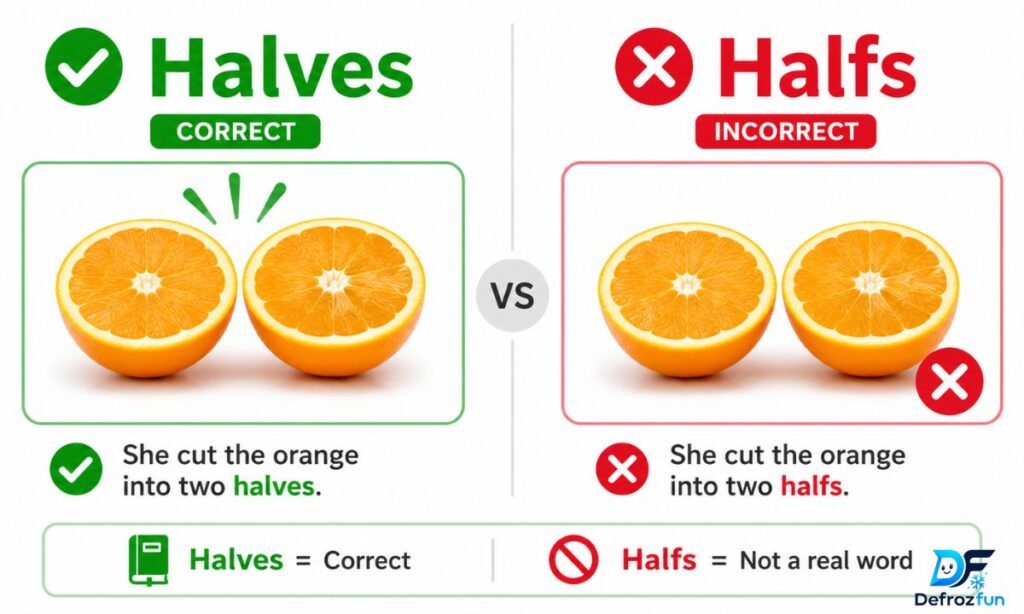
Halves is correct. Halfs is not a real word in the English language.
“Halves” is the proper plural form of the noun “half.” If you write “halfs,” grammar tools like Grammarly and Microsoft Word will flag it as an error — and for good reason. No major English dictionary (Cambridge, Oxford, Merriam-Webster) recognizes “halfs” as a valid spelling.
✅ Correct: She cut the orange into two halves. ❌ Incorrect: She cut the orange into two halfs.
The Origin of Halves / Halfs
The word half has ancient Germanic roots. It traces back to the Old English word healf, meaning “side” or “part” — not necessarily an equal division. From there, it shares lineage with Old High German halp, Dutch half, and Gothic halbs, all stemming from Proto-Germanic halbaz, meaning “something divided.”
The plural form halves didn’t arise by accident. During the Middle English period (roughly 1100–1500 CE), a natural phonological shift occurred: the voiceless /f/ sound at the end of certain nouns became the voiced /v/ sound when vowels surrounded it in the plural form. This is why half becomes halves — the spelling caught up to how people were actually pronouncing the word.
This same sound shift produced the pattern you see in many other English words today.
British English vs. American English Spelling
One common assumption is that British and American English might differ on this point — similar to how “colour” and “color” split the two dialects. But with halves, both agree completely.
| Variety of English | Correct Plural | Accepted? |
| British English | halves | ✅ Yes |
| American English | halves | ✅ Yes |
| Both | halfs | ❌ No |
There is no regional variation here. Whether you’re writing for a UK audience or a US one, halves is always the right choice.
Which Spelling Should You Use?
Always use halves when:
- You’re referring to two equal parts of something (“cut into two halves”)
- You’re talking about the two periods of a sports match (“the second half ended 1–0; both halves were exciting”)
- You’re discussing fractions in a general sense (“one and a half” is singular; “two and a half” uses the singular half, but “the two halves” is plural)
- You’re writing formally — academic papers, business reports, or published content
Use half (singular) when referring to just one portion:
I ate half of the sandwich. The first half of the movie was slow.
The noun half stays as half in singular. The only time the spelling changes to halves is in the plural noun form.
Halves Pronunciation
This is where some confusion creeps in. The spelling change from half to halves is also reflected in pronunciation:
| Word | Pronunciation (IPA) | Sounds Like |
| half | /hɑːf/ | “haf” |
| halves | /hɑːvz/ | “havz” |
Notice how the /f/ sound in “half” becomes a /v/ sound in “halves.” This is the spoken version of the same f-to-v shift that appears in the spelling. If you’re ever unsure which form to write, say the word aloud — if it sounds like “havz,” write halves.
Common Mistakes with Halves / Halfs
Here are the most frequent errors people make with this word:
1. Writing “halfs” as the plural This is the most common mistake. Adding a simple “-s” feels natural, but half is an irregular noun.
❌ I ate two halfs of the apple. ✅ I ate two halves of the apple.
2. Confusing “halves” (noun) with “halves” (verb) Halves is both the plural of the noun half AND the third-person present tense of the verb halve (to divide into two equal parts). The spelling is identical — context tells you which it is.
She halves the recipe every time. (verb) The two halves are equal. (noun)
3. Misspelling the verb as “halfes” or “halfs” All verb forms of halve use a “v”: halve, halves, halved, halving. None are spelled with an “f.”
4. Incorrect subject-verb agreement When half precedes a plural noun, the verb should be plural too:
✅ Half of the students are absent. ❌ Half of the students is absent.
Halves in Everyday Examples
Here’s how halves appears naturally across different contexts:
Cooking & Food
- Cut the avocado into two halves and remove the pit.
- The recipe calls for the two halves of the lemon.
Sports
- The team dominated both halves of the match.
- They scored three goals in the second half; the halves were very different in intensity.
Mathematics & Education
- Students learn to identify equal halves in early fraction lessons.
- The two halves of the number line represent positive and negative values.
Business & Finance
- Revenue in both halves of the fiscal year exceeded projections.
- The company split its operations into two halves.
Everyday Life
- I’ll take the bigger of the two halves.
- The two halves of the story finally came together.
Halves – Google Trends & Usage Data
Search data and corpus analysis consistently confirm that halves dominates written English by an enormous margin, while halfs is virtually absent from published text.
| Term | Usage in Published Writing | Google Trends Interest | Dictionary Status |
| halves | Extremely common | High | ✅ Recognized |
| halfs | Rare (error) | Very low | ❌ Not recognized |
Tools like the Google Ngram Viewer show halves appearing consistently throughout written English over hundreds of years, while halfs barely registers as a blip. This confirms that halves is not just technically correct — it’s what fluent English speakers and writers actually use.
Keyword Comparison Table
| Feature | halves | halfs |
| Correct spelling | ✅ Yes | ❌ No |
| Recognized by dictionaries | ✅ Yes | ❌ No |
| Used in formal writing | ✅ Yes | ❌ No |
| Flagged by grammar tools | ❌ No | ✅ Yes |
| Part of speech | Noun (plural) / Verb | — |
| Pronunciation | /hɑːvz/ | N/A |
| Follows f-to-ves rule | ✅ Yes | ❌ No |
FAQs – Halves or Halfs
Q: Is “halfs” ever correct in any context?
No. “Halfs” is not recognized in any major English dictionary or style guide — it’s always an error.
Q: What is the plural of half?
The plural of “half” is “halves” — formed by changing the “f” to “v” and adding “-es.”
Q: Why does “half” become “halves” and not “halfs”?
Because “half” follows the irregular f-to-ves pluralization rule, similar to “leaf → leaves” and “knife → knives.”
Q: Does British English spell it differently from American English?
No. Both British and American English use “halves” as the correct plural form.
Q: What other words follow the same f-to-ves rule?
Common examples include: leaf → leaves, knife → knives, wolf → wolves, calf → calves, and shelf → shelves.
Q: Can “halves” be used as a verb?
Yes — “halves” is the third-person singular present tense of the verb “halve,” meaning to divide something into two equal parts (e.g., “She halves the dough”).
Q: Is “half” a noun, adjective, or adverb?
“Half” can function as all three: a noun (“I want the bigger half”), an adjective (“a half hour”), or an adverb (“he was half asleep”).
Q: Will spell-checkers catch “halfs” as an error?
Yes — tools like Grammarly and Microsoft Word will flag “halfs” as a misspelling and suggest “halves.”
Conclusion
The answer is simple: halves is correct, halfs is not a word. This isn’t a regional preference or a style choice — it’s a firm grammatical rule rooted in how the English language evolved from Old English through the Middle English period.
The key takeaway is the f-to-ves rule: nouns like half, leaf, knife, wolf, and shelf all change their ending from “-f” to “-ves” in the plural. Half follows this exact pattern and becomes halves.
So the next time you’re writing a recipe, a sports recap, or a financial report, you can type halves with complete confidence — and move on.

Daniel Brooks is a passionate writer and digital content creator dedicated to sharing insightful, engaging, and informative articles across multiple niches. With a strong interest in technology, lifestyle, trending topics, and online media, Daniel Brooks focuses on delivering well-researched and reader-friendly content that inspires and informs audiences worldwide.