

If you have ever typed this word and paused to wonder whether you wrote it correctly, you are not alone. “Receive” is one of the most commonly misspelled words in the English language. Students, professionals, and even native speakers get it wrong every single day. This article clears up the confusion once and for all, explains the rule behind the correct spelling, and shows you how to use the word confidently in your writing.
Receive / Recieve – Quick Answer
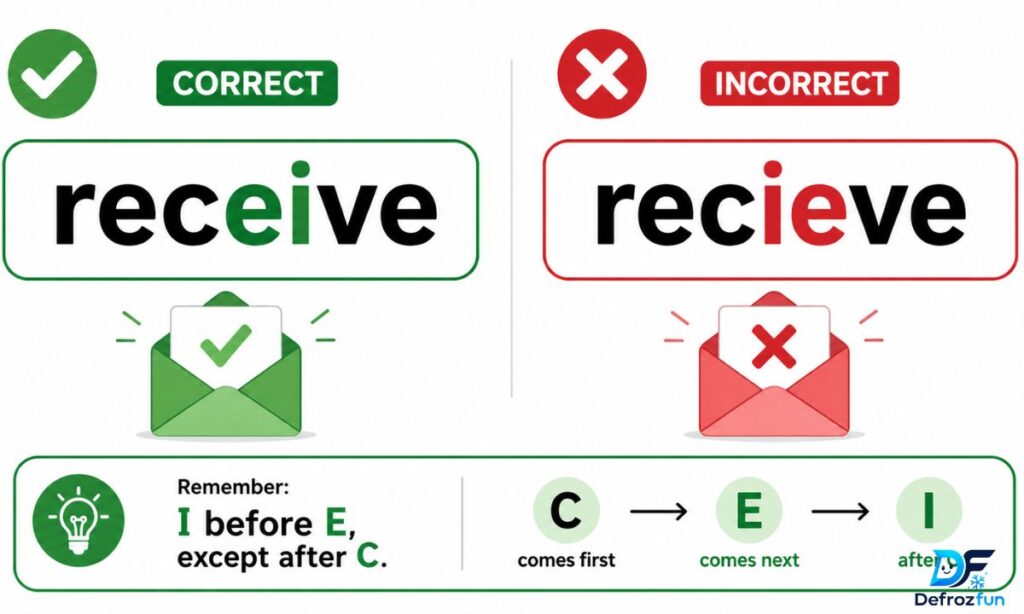
The correct spelling is receive. “Recieve” is always wrong and is simply a misspelling. There is no context, no dialect, and no style guide in which “recieve” is acceptable.
To remember it, use the classic rule: “I before E, except after C.” Since the letter C appears just before the vowels in this word, the correct order is E-I, not I-E. So it is always r-e-c-e-i-v-e.
The Origin of Receive
Understanding where a word comes from often makes it easier to remember how to spell it. The word “receive” has a rich history that traces back through several languages.
Around 1300, the word entered English as “receiven,” meaning “take into one’s possession or accept possession of.” It came from Old North French “receivre,” which meant to seize, take hold of, pick up, or welcome. That French word itself came from Latin “recipere,” meaning to regain, take back, recover, or admit. The Latin root is built from “re-” (back) and “-cipere,” a form of “capere,” meaning to take.
So the word has been with us for over 700 years, traveling from Latin to Old French to Middle English and finally to the modern English we use today. The spelling has stayed stable across that journey, which is why “recieve” has never been correct at any stage.
British English vs American English Spelling
One very common question people ask is whether “recieve” might be the British English version while “receive” is the American version, or vice versa. The answer is no. Both British English and American English use exactly the same spelling: receive.
Unlike words such as “colour/color” or “organise/organize,” there is no regional split with this word. Whether you are writing in the UK, the US, Canada, Australia, or anywhere else, you must always write receive. “Recieve” is wrong in every variety of English, full stop.
Which Spelling Should You Use?
Always use receive. There is no debate here, no gray area, and no exception. If you write “recieve” in an email, an essay, a job application, or a text message, it is a spelling error. Spell checkers will flag it, grammar tools will catch it, and careful readers will notice it.
The only time you will ever see “recieve” in print is in examples of what not to do, exactly like this article is doing right now.
Receive or Recieve – Meaning
Receive is a verb. It typically means “get,” “be given,” or “be the recipient of” something. In more formal or ceremonial contexts, it can also mean “give a formal welcome,” as in a host receiving guests at an event.
Here are some of the main ways the word is used:
To get something sent or delivered: She received a package in the mail. To accept something offered: He received the award with gratitude. To be given information or news: We received a message from the team. To experience something: The film received excellent reviews. To formally welcome someone: The ambassador received the foreign delegates.
The word also appears in several related forms: receives, received, receiving, receiver, and reception. All of these follow the same -ei- spelling pattern after the C.
Common Mistakes with Receive
The confusion around this word is understandable. Here is why so many people get it wrong, and how to fix it.
The main reason people write “recieve” is the influence of other common English words. Words like “believe,” “achieve,” “relieve,” and “grieve” all follow an I-before-E pattern and make the same long “ee” sound. Your brain naturally applies that same pattern to receive, but the C before the vowels changes the rule.
The “-ie-” spelling appears in many common English words with the “ee” sound, which is exactly why people instinctively apply it to “receive” as well. But “recieve” is always an error.
A few other common errors connected to this word include “recieved” instead of “received,” “recieving” instead of “receiving,” and “reciever” instead of “receiver.” The rule applies to all of them: after C, use EI.
A simple memory trick that works: break the word into two parts in your mind. Think of it as “re-ceive.” The C sits right in the middle, and it reminds you that what comes after must follow the “except after C” part of the rule.
Receive in Everyday Examples

Seeing a word used in real sentences is one of the best ways to lock in the correct spelling. Here are ten natural examples:
- I did not receive your email until this morning.
- She will receive her results next week.
- The charity received thousands of donations.
- Did you receive the invitation I sent?
- He was happy to receive such positive feedback.
- The package should arrive once you receive the confirmation.
- We received a warm welcome at the hotel.
- Please confirm that you receive this message.
- The team received instructions before the match.
- I hope you receive everything you need for the project.
In every one of these sentences, “receive” could not be replaced by “recieve.” That word simply does not exist in English.
Receive – Google Trends and Usage Data
Search data tells an interesting story about this word. Thousands of people search for “receive or recieve” and “received vs recieved” every single month, which shows just how widespread this confusion is. The searches spike around exam seasons, academic submission deadlines, and the start of the school year, suggesting that students are particularly affected.
For anyone writing content online, using the correct spelling also has practical SEO benefits. Search engines associate accurate spelling with quality content, and correct use of the word “receive” across your writing signals reliability and professionalism.
Comparison Table
| Form | Correct? | Example |
| Receive | Yes | I will receive the parcel today. |
| Recieve | No | Never use this spelling. |
| Received | Yes | She received the award yesterday. |
| Recieved | No | This is always a misspelling. |
| Receiving | Yes | We are receiving great feedback. |
| Recieving | No | Incorrect in all contexts. |
| Receiver | Yes | The receiver was left off the hook. |
| Reciever | No | Not a valid English word. |
Frequently Asked Questions
Is “recieve” ever correct?
No, “recieve” is always wrong. It is a misspelling of “receive” in every dialect and context.
What is the correct spelling, receive or recieve?
The correct spelling is “receive” — E before I, because it comes after C.
Do British and American English spell this word differently?
No, both use “receive.” There is no regional difference for this word.
What does receive mean?
It means to get, accept, or be given something. It can also mean to formally welcome someone.
Q: Why do people confuse receive and recieve? Because words like “believe” and “achieve” use I-before-E for the same sound, making people apply the same pattern incorrectly to “receive.”
How can I remember the correct spelling?
Use the rule “I before E, except after C.” Since receive has a C before the vowels, it must be E-I, not I-E.
What are some related words that follow the same rule?
Receipt, receiver, receiving, reception — all follow the same -ei- after C pattern.
Is “recieve” a word in any language?
No, it is not a word in any language. It is simply an English spelling error.
Conclusion
The answer is clear and simple: receive is correct, recieve is not. This is one of those spelling questions where there is no ambiguity, no exception, and no debate. The rule “I before E, except after C” handles this word perfectly, and once you internalize it, you will never second-guess yourself again.
Getting small details like spelling right matters more than people realize. In professional emails, academic writing, job applications, and everyday communication, correct spelling builds trust and shows attention to detail. So the next time you reach for this word, remember: it is always receive, never recieve.

Daniel Brooks is a passionate writer and digital content creator dedicated to sharing insightful, engaging, and informative articles across multiple niches. With a strong interest in technology, lifestyle, trending topics, and online media, Daniel Brooks focuses on delivering well-researched and reader-friendly content that inspires and informs audiences worldwide.