

If you’ve ever typed “Salvadoran” and second-guessed yourself, you’re not alone. This is one of the most commonly Googled spelling questions about Central American nationalities — and the answer is simpler than you think.
Quick answer: Salvadoran is the correct, standard spelling used in journalism, academic writing, dictionaries, and official documents. Salvadorian is an informal variant that appears online but is not recognized as the standard form by major style guides or dictionaries.
Salvadoran or Salvadorian – Quick Answer
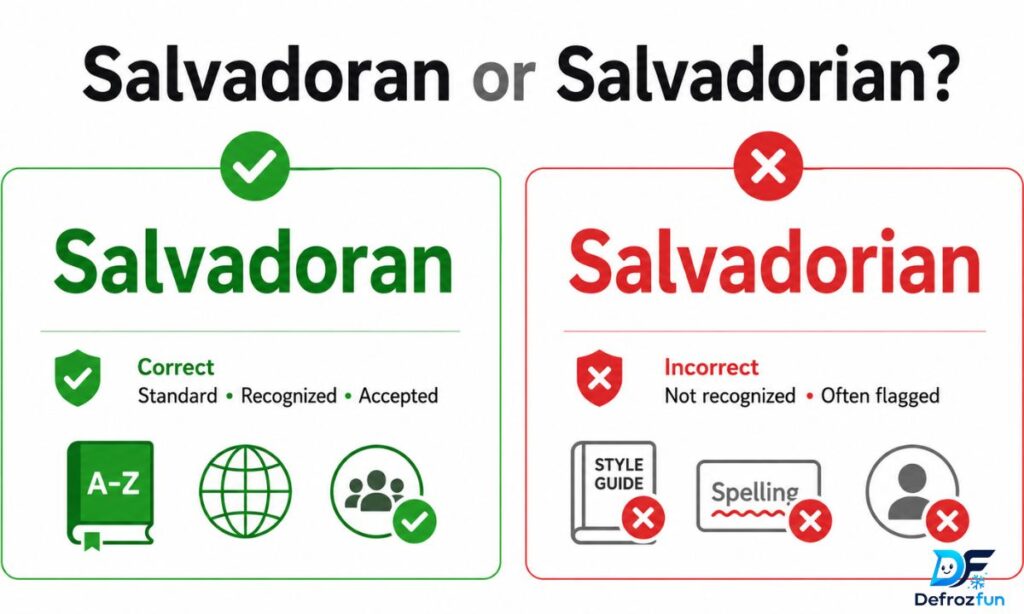
Salvadoran is correct. Use it in every context — formal or informal.
- ✅ Salvadoran — standard, dictionary-recognized, universally accepted
- ❌ Salvadorian — informal, not recognized in major style guides, often flagged by spell-checkers
That’s the short version. Keep reading if you want to understand why one is preferred, where each form comes from, and how to use the correct spelling confidently.
The Origin of Salvadoran or Salvadorian
To understand this spelling debate, it helps to look at where the word comes from.
El Salvador is a country in Central America. The name comes from Spanish and means “The Savior.” When English speakers form a demonym (a word for people from a particular place), they typically drop the article “El” and add a suffix to Salvador.
How “Salvadoran” Was Formed
The suffix -an is one of the most common English demonym endings:
- Mexico → Mexican
- America → American
- El Salvador → Salvadoran
This follows a clean, well-established rule. The word has appeared in newspapers, government reports, and textbooks for decades, making it the dominant standard form in written English.
How “Salvadorian” Came About
The suffix -ian is also a legitimate English pattern — think Victorian, Floridian, or Californian. It’s likely that some writers applied this pattern to “Salvador” and produced Salvadorian.
The problem? This form was never officially adopted. It doesn’t appear as the primary entry in Merriam-Webster, Cambridge Dictionary, or the Associated Press Stylebook. It exists as a secondary variant at best — and a common error at worst.
Bottom line: Salvadoran follows the standard demonym formation rule. Salvadorian is a logical but non-standard creation.
British English vs American English Spelling
One common source of spelling confusion is British vs American English differences. However, in this case, there is no regional split.
Both British English and American English use Salvadoran as the standard spelling. This is confirmed by major dictionaries used in each region:
| Dictionary | Preferred Spelling | Notes |
| Merriam-Webster (US) | Salvadoran | Lists Salvadorian as a variant only |
| Cambridge Dictionary (UK) | Salvadorean | Also accepts Salvadoran |
| Oxford English Dictionary (UK) | Salvadoran | Standard entry |
| AP Stylebook (US journalism) | Salvadoran | Follows Merriam-Webster |
Note: Cambridge lists Salvadorean (with an “e”) as its primary British variant. However, even in British English, Salvadoran is widely accepted and increasingly preferred.
Salvadorian is not the preferred spelling in either variety of English. It’s an informal, internet-influenced form that has spread through social media and casual writing.
Which Spelling Should You Use?
The answer depends on your context — but in most cases, Salvadoran is always the safe choice.
Use “Salvadoran” when:
- Writing for a newspaper, magazine, or news website
- Submitting academic papers or research
- Creating official documents, reports, or legal materials
- Writing blog posts, travel guides, or educational content
- Using any professional spell-checker or grammar tool
When does “Salvadorian” appear?
- Casual social media posts
- Informal conversation or text messages
- Some user-generated content online
- Older articles before standardization became widespread
Even in casual writing, using Salvadoran is never wrong. It’s the spelling that makes your writing look sharp, credible, and professional.
Common Mistakes with Salvadoran or Salvadorian
Spelling errors in demonyms are surprisingly common. Here are the most frequent mistakes people make with this word:
1. Using “Salvadorian” in formal writing
This is the biggest mistake. Writers often pull the spelling from social media or casual sources without checking a dictionary. Always verify with Merriam-Webster or your preferred style guide.
2. Writing “El Salvadoran” or “El Salvadorian”
You don’t need El in the demonym. Just as people from The Gambia are called Gambians (not “The Gambians”), people from El Salvador are Salvadorans — not “El Salvadorans.”
3. Spelling it “Salvadorean” without context
Salvadorean (with an “e”) is a legitimate British variant, but it’s less common in modern usage. If you’re writing for a global audience, stick with Salvadoran.
4. Treating all three forms as equal
They’re not. Salvadoran is the primary standard form. Salvadorean is a valid British variant. Salvadorian is informal and non-standard.
Salvadoran or Salvadorian in Everyday Examples
Seeing the correct form in real sentences makes it easier to remember. Here are practical examples across different contexts:
News and Journalism
- ✅ The Salvadoran government announced new economic reforms.
- ❌ The Salvadorian government announced new economic reforms.
Travel and Culture
- ✅ Salvadoran pupusas are among the most beloved dishes in Central America.
- ❌ Salvadorian pupusas are among the most beloved dishes in Central America.
Academic Writing
- ✅ The study focused on Salvadoran immigration patterns in the United States.
- ❌ The study focused on Salvadorian immigration patterns in the United States.
Everyday Conversation (Written)
- ✅ My Salvadoran coworker makes incredible tamales.
- ✅ She is proud of her Salvadoran heritage.
As a Noun (Referring to People)
- ✅ Thousands of Salvadorans live in the Washington D.C. metro area.
- ✅ She is a Salvadoran who moved to the U.S. in 2005.
Salvadoran or Salvadorian – Google Trends & Usage Data
Search data and corpus analysis confirm that Salvadoran dominates in real-world usage.
What the Data Shows:
- Google Trends consistently shows Salvadoran as the higher-volume search term
- Salvadorian searches are mostly people asking which spelling is correct — not actively using the word
- In news databases and academic journals, Salvadoran appears far more frequently than Salvadorian
- Most modern spell-checkers (including Microsoft Word, Google Docs, and Grammarly) flag Salvadorian as a potential error
This pattern mirrors what linguists call frequency-driven standardization — the more one form is used by authoritative sources (news, government, academia), the more it becomes the standard.
Comparison Table: Salvadoran vs Salvadorian
| Feature | Salvadoran | Salvadorian |
| Correct spelling? | ✅ Yes | ❌ Not standard |
| Dictionary recognized? | ✅ Merriam-Webster, Oxford | ⚠️ Variant only |
| AP Style / journalism? | ✅ Yes | ❌ No |
| Used in academic writing? | ✅ Yes | ❌ Avoid |
| Spell-checker approved? | ✅ Yes | ❌ Often flagged |
| British English variant? | Salvadoran / Salvadorean | Salvadorian |
| Appropriate for formal use? | ✅ Always | ❌ No |
| Seen in casual/social media? | ✅ Yes | ✅ Yes |
| Recommended form? | ✅ Yes | ❌ No |
Frequently Asked Questions
Is Salvadorian a real word? .
It appears in some dictionaries as a secondary variant, but it is not the standard or preferred spelling in formal English.
What do Salvadorans call themselves?
In Spanish, they call themselves Salvadoreños. In English, the correct term is Salvadorans.
Is it “El Salvadoran” or just “Salvadoran”?
Just Salvadoran. The article “El” is part of the country name but is not carried into the English demonym.
Does the AP Stylebook say “Salvadoran”?
Yes. The AP follows Merriam-Webster, which lists Salvadoran as the primary spelling.
Can I use “Salvadorean”? Yes, particularly in British English. It is a recognized variant, though Salvadoran is more globally standard.
Will spell-check catch “Salvadorian”?
Most modern spell-checkers will flag it or suggest Salvadoran as the correction.
Is there a difference in meaning between Salvadoran and Salvadorian?
No — they refer to the same thing. The difference is purely one of standardization, not meaning.
Which spelling does Wikipedia use?
Wikipedia primarily uses Salvadorans as the standard form in its articles about the people of El Salvador.
Conclusion
The answer to Salvadoran or Salvadorian is clear: use Salvadoran.
It’s the spelling that dictionaries prefer, newsrooms use, academics write, and spell-checkers accept. Salvadorian isn’t completely unheard of, but it’s informal and non-standard — not something you want appearing in a professional article, academic paper, or formal document.
The rule is easy to remember: El Salvador → Salvadoran (drop “El,” add “-an”). That’s it.
Whether you’re writing about Salvadoran culture, cuisine, politics, or people, Salvadoran is the word that communicates clearly, correctly, and professionally every single time.

Daniel Brooks is a passionate writer and digital content creator dedicated to sharing insightful, engaging, and informative articles across multiple niches. With a strong interest in technology, lifestyle, trending topics, and online media, Daniel Brooks focuses on delivering well-researched and reader-friendly content that inspires and informs audiences worldwide.