

If you have ever typed “fiend” and wondered if “feen” is also acceptable, you are not alone. Millions of people search this exact question every year. They see “feen” in rap lyrics, social media captions, and text messages — then second-guess themselves. This guide gives you a clear, fast answer and explains everything you need to know about both spellings, their origins, and when (if ever) each one applies.
Fiend or Feen – Quick Answer
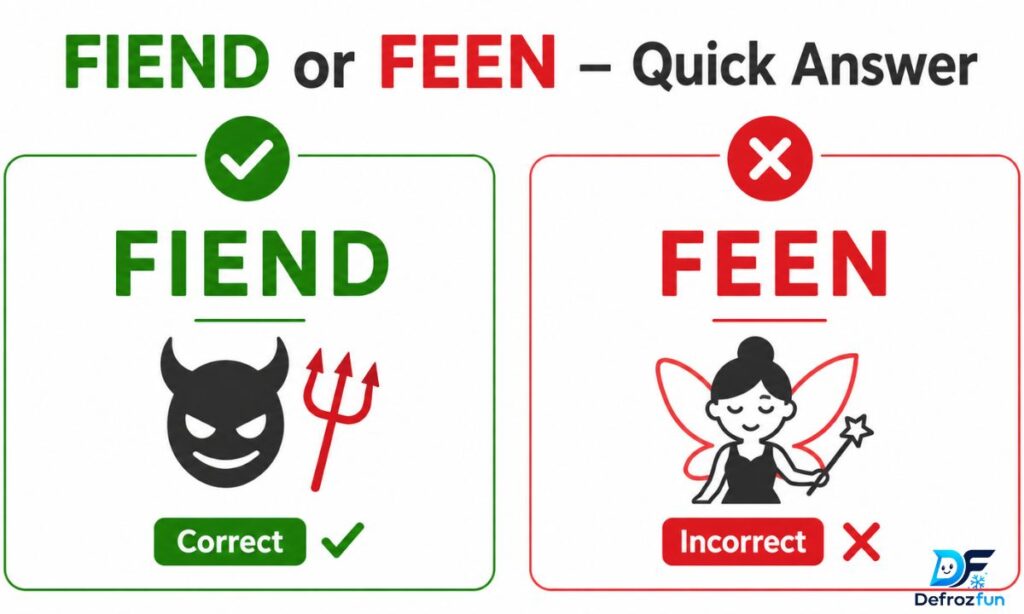
Fiend is the correct spelling in standard English. It is recognized by every major dictionary — Merriam-Webster, Oxford, Cambridge — and is used in both formal and informal writing.
Feen is not a standard English word. It is a slang or phonetic spelling that appears mostly in casual conversation, song lyrics, and social media. It is widely understood in those contexts but is never correct in formal writing.
✅ Use “fiend” — always safe, always correct.
❌ Avoid “feen” — informal slang only, not accepted in standard English.
The Origin of Fiend or Feen
Where Did “Fiend” Come From?
The word fiend has deep roots in Old English. It comes from the Old English word fēond, meaning “enemy” or “one who hates.” It is closely related to the German word Feind (enemy) and the Gothic fijands. In Middle English, it evolved into feend, and eventually settled into the modern spelling “fiend.”
For centuries, the word was used to describe the devil, evil spirits, or dangerously wicked people. Over time, its meaning softened and expanded. By the modern era, calling someone a “coffee fiend” or a “puzzle fiend” simply means they are obsessively passionate about something — no evil required.
Where Did “Feen” Come From?
“Feen” is a much more recent creation. It emerged from African American Vernacular English (AAVE) and hip-hop culture in the late 20th century. As people heard “fiend” spoken aloud — particularly in phrases like “dope fiend” or “I’m fiending for that” — the pronunciation naturally became “feen-ing.” When those speakers wrote the word down phonetically, “feen” was born.
The R&B group Jodeci helped push this spelling into mainstream awareness with their 1990s hit Feenin’. Decades later, Travis Scott’s 2023 track FE!N (featuring Playboi Carti) brought the slang back into viral territory, cementing “feen” and “fein” as widely recognized — though still informal — spellings.
British English vs American English Spelling
One of the most common questions people ask is whether British and American English handle this word differently. The short answer: no, they do not.
Unlike words such as colour/color or centre/center, there is no transatlantic split with “fiend.” Both British English and American English use the same spelling: fiend.
| Variety of English | Correct Spelling | Is “Feen” Accepted? |
| British English | fiend | No |
| American English | fiend | No (informal slang only) |
| Australian English | fiend | No |
| Canadian English | fiend | No |
The confusion around “feen” is not regional — it is cultural. It stems from music, social media, and spoken slang, not from any dialect difference between countries.
The “I Before E” Spelling Rule
One reason people misspell “fiend” is the classic i before e except after c rule. Interestingly, “fiend” is one of the words that follows a common exception: the sound is /ee/ (as in “field”), and it is spelled ie, not ei. Common misspellings like feind or fein occur when people misremember this rule. The correct order is always F-I-E-N-D.
Which Spelling Should You Use?
The right choice depends entirely on your context and audience.
Always use “fiend” when:
- Writing academic papers, essays, or reports
- Drafting professional emails or business content
- Publishing blog posts or SEO content
- Describing someone obsessively passionate about something (noun)
- Writing fiction, journalism, or any formal creative work
“Feen” may appear in:
- Casual texts and direct messages
- Social media captions aimed at younger audiences
- Song lyrics, especially in hip-hop or R&B
- Dialogue written to reflect street vernacular or AAVE authentically
The safest rule: When in doubt, always write fiend. It works in every context. “Feen” only works in very specific informal settings and can make your writing look careless in professional spaces.
Common Mistakes with Fiend or Feen
These are the errors writers make most often — and how to correct them:
Mistake 1: Using “feen” as a noun
- ❌ He is a total coffee feen.
- ✅ He is a total coffee fiend.
Mistake 2: Misspelling “fiend” as “feind”
- ❌ The villain was a heartless feind.
- ✅ The villain was a heartless fiend.
Mistake 3: Assuming “feen” is an American spelling
- ❌ Americans write it as “feen.”
- ✅ Americans also write it as “fiend.” There is no regional difference.
Mistake 4: Thinking “feen” and “fiend” are interchangeable everywhere
- ❌ She is a detail-oriented feen at work. (Professional context — wrong)
- ✅ She is a detail-oriented fiend at work.
Mistake 5: Writing “fiend” as a verb in formal writing
- ❌ She fiends for chocolate every afternoon. (Informal)
- ✅ She craves chocolate every afternoon. (Formal alternative)
Also Read This: Analysing or Analyzing: Which Spelling Is Correct? (2026)
Fiend or Feen in Everyday Examples

Here is how “fiend” looks in natural, correct usage across different contexts:
Describing obsession (positive):
- She is an absolute fitness fiend — hits the gym every single morning.
- My dad is a classic car fiend; he has six in the garage.
- I’m a Netflix fiend lately; I can’t stop watching documentaries.
Describing a villain or evil person:
- The novel portrays the antagonist as a cold, calculating fiend.
- Witnesses described the attacker as a dangerous fiend.
Using “fiending” informally (verb form, understood in casual speech):
- I’m fiending for pizza right now.
- He’s been fiending for that new game since it was announced.
“Feen” in casual/slang context (acceptable only informally):
- I feen for that new album drop. (Social media caption — informal only)
- Feening for the weekend to start. (Text message — informal only)
Fiend or Feen – Google Trends & Usage Data
Search data consistently shows that users look up “feen or fiend” to verify correct spelling — not to find an alternative. This confirms that most people already sense “fiend” is correct and are simply checking.
Key patterns from search trend analysis:
- Most searches for “feen or fiend” come from the United States, United Kingdom, Canada, and Australia.
- “Fiend” dominates all formal writing contexts across search results.
- “Feen” appears primarily in lyrics databases, slang dictionaries, and social media posts.
- The search intent is almost always spelling verification — users want to confirm the standard form.
- Searches spike around new music releases (e.g., after Travis Scott’s FE!N in 2023) showing how pop culture drives spelling confusion.
Bottom line from trends: Fiend dominates correct, trusted usage. Feen stays confined to slang and informal culture.
Comparison Table: Fiend vs Feen
| Feature | Fiend | Feen |
| Standard English? | ✅ Yes | ❌ No |
| In major dictionaries? | ✅ Yes | ❌ No |
| Part of speech | Noun (sometimes informal verb) | Informal verb / slang noun |
| Origin | Old English (fēond) | AAVE / hip-hop slang |
| First recorded use | Before 900 AD | Late 20th century |
| Formal writing | ✅ Always correct | ❌ Never appropriate |
| Social media / texts | ✅ Correct | ⚠️ Understood, but informal |
| British English | ✅ fiend | ❌ Not accepted |
| American English | ✅ fiend | ❌ Not accepted (informal only) |
| Example (noun) | “He is a coffee fiend.” | ❌ “He is a coffee feen.” |
| Example (verb, informal) | “She’s fiending for tacos.” | “She’s feening for tacos.” |
Conclusion
The answer to “fiend or feen” is simple and clear: fiend is correct, feen is not standard English.
“Fiend” has been part of the English language for over a thousand years, rooted in Old English and recognized by every major dictionary. “Feen” is a phonetic slang spelling that emerged from hip-hop and AAVE culture in the late 20th century. While it is widely understood in casual digital spaces, it has no place in formal, professional, or academic writing.
The rule is easy to remember: if you want your writing to look polished, credible, and correct — in an email, an essay, a blog post, or even a social media caption — always choose fiend. Save “feen” for text messages and song lyrics, if you use it at all.
Know your audience. Match your spelling to your setting. And when in doubt, one word is always the right answer: fiend.

Daniel Brooks is a passionate writer and digital content creator dedicated to sharing insightful, engaging, and informative articles across multiple niches. With a strong interest in technology, lifestyle, trending topics, and online media, Daniel Brooks focuses on delivering well-researched and reader-friendly content that inspires and informs audiences worldwide.