

If you’ve ever typed the word and second-guessed yourself — you’re not alone. “Monkeys or monkies?” is one of those small spelling questions that trips up even confident writers. The answer is simple, but understanding why helps you never make this mistake again.
Monkeys or Monkies – Quick Answer
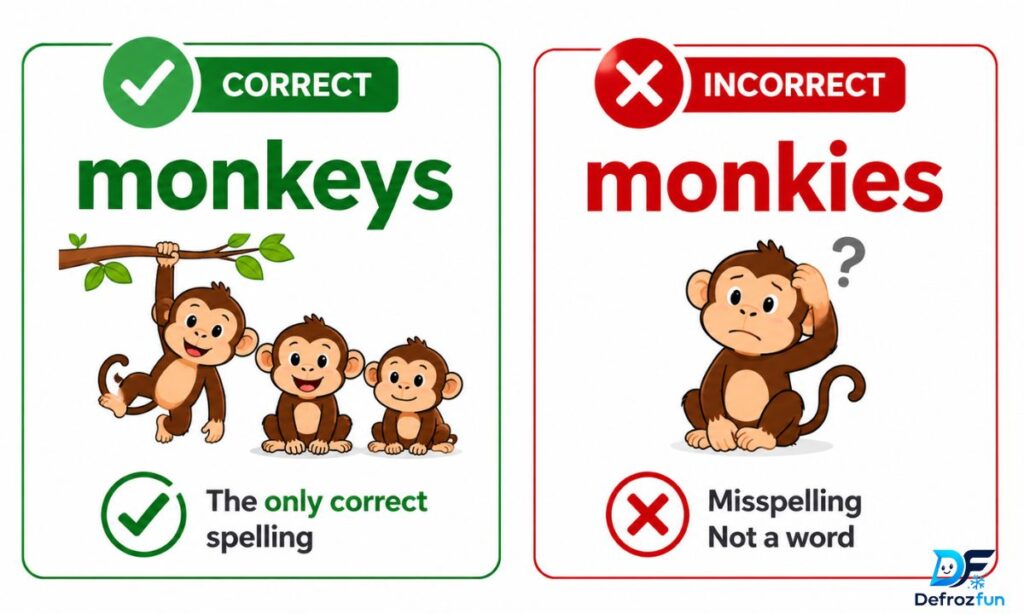
“Monkeys” is the only correct spelling. “Monkies” is a misspelling and does not exist as a valid word in standard English. Every major dictionary — Merriam-Webster, Oxford, Cambridge — lists “monkeys” as the accepted plural form of “monkey.” No debate, no regional variation. Just one right answer.
✅ Correct: monkeys ❌ Incorrect: monkies
The Origin of “Monkeys” or “Monkies”
The word “monkey” has an interesting backstory. It originated in a German version of the Reynard the Fox legend, published around 1580, where “Moneke” was the name of an offspring of Martin the Ape.
As the word entered English, it kept its original spelling structure. The original English spelling of “monkeys” was preserved despite it being a tricky word to spell.
Interestingly, in Shakespeare’s Merchant of Venice, the word appears as “monkies” in the 1623 Folio edition — but that spelling carries no authority in modern English, just as “wildernesse” does not. Old spellings were inconsistent, and modern grammar has since standardized the word as “monkeys.”
British English vs American English Spelling
One common assumption is that “monkies” might be a British variant, the way “colour” differs from “color.” That’s not the case here.
“Monkeys” is the correct plural form in all contexts — whether you are writing an academic paper, a blog post, or a casual message. There is no British/American divide on this word. Both dialects use “monkeys,” full stop.
This makes it easier to remember: no matter where you are writing or who your audience is, stick with monkeys.
Which Spelling Should You Use?
Always use monkeys. There is no situation — formal or informal, British or American, academic or creative — where “monkies” is acceptable.
Here’s a quick guide:
| Situation | Correct Spelling |
| Academic writing | monkeys |
| Casual conversation | monkeys |
| Blog posts & articles | monkeys |
| Children’s books | monkeys |
| Scientific papers | monkeys |
The rule is consistent across the board. When in doubt, consult a reliable dictionary — the answer will always be “monkeys.”
Monkeys or Monkies Plural — Understanding the Grammar Rule
This is where most of the confusion comes from. English has a well-known rule:
If a word ends in a consonant + y → change the “y” to “ies”
Examples:
- baby → babies
- city → cities
- fly → flies
- hobby → hobbies
So why doesn’t “monkey” follow the same pattern?
When a noun ends in a vowel followed by “y,” like “monkey” (where “e” is a vowel), you simply add an “s.”
The rule is:
- Consonant + y → -ies (baby → babies)
- Vowel + y → -s (monkey → monkeys)
In “monkey,” the letter before “y” is “e” — a vowel. So you just add “s.”
More examples that follow the same vowel + y rule:
| Singular | Plural |
| monkey | monkeys |
| key | keys |
| donkey | donkeys |
| trolley | trolleys |
| journey | journeys |
| chimney | chimneys |
| turkey | turkeys |
| toy | toys |
| day | days |
The most confusing aspect of pluralizing words that end in “-ey” is that the very last letter is still “y,” which invites confusion about whether to use “-ies.” Once you learn the vowel rule, the confusion disappears.
Common Mistakes with Monkeys or Monkies
Here are the most frequent errors writers make — and how to avoid them:
Mistake 1: Applying the wrong rule Writers familiar with “babies” and “cities” try to apply the same “-ies” pattern to “monkey.” Remember: that rule only applies when a consonant comes before the “y.”
Mistake 2: Trusting pronunciation over spelling The word “monkey” sounds like it ends in “ee,” which some people associate with a “y” that needs the -ies treatment. Phonetics can be tricky — the rule is about spelling structure, not how the word sounds.
Mistake 3: Thinking it’s a style choice Some writers assume both forms are acceptable variants. “Monkies” is incorrect and not recognized in standard English — this isn’t a matter of preference or style, it’s a straightforward grammar rule.
Quick trick to remember:
Look at the letter before the “y.” Is it a vowel? → Add “s.” Is it a consonant? → Change to “ies.”
Monkeys or Monkies Meaning
The word “monkey” refers to a primate — typically a medium-sized mammal belonging to the order Primates, excluding apes and humans. Monkeys are intelligent primates found in a variety of habitats around the globe. They communicate using vocalizations as well as body language and facial expressions.
“Monkies” has no meaning because it is not a word. It is simply a misspelling of “monkeys.”
In informal English, “monkey” is also used figuratively — for example, “stop monkeying around” or “there’s a monkey on my back.” In all such uses, the plural remains “monkeys.”
Monkeys or Monkies in Everyday Examples
Seeing the correct spelling in real sentences helps it stick. Here are practical examples:
Correct usage (monkeys ✅):
- “The zoo has five different species of monkeys on display.”
- “We observed several monkeys swinging through the canopy.”
- “Researchers have studied monkeys to better understand social behavior.”
- “The children laughed at the monkeys making faces through the glass.”
- “Spider monkeys are known for their incredibly long limbs.”
Incorrect usage (monkies ❌):
- “The monkies were playing near the river.”
- “We saw three monkies at the wildlife sanctuary.”
The incorrect versions look wrong because they are wrong — and once you understand why, you’ll never write them again.
Monkeys or Monkies – Google Trends & Usage Data
Search data confirms what grammar rules already tell us: “monkeys” dominates all written usage while “monkies” appears almost exclusively as a search query from people checking the spelling.
In the Google Ngram Viewer (which tracks word usage in published books), “monkeys” shows consistent, widespread usage across centuries. “Monkies” appears only as a rare archaic variant from older texts — similar to Shakespeare’s era — and has essentially zero modern usage in published material.
Search engines themselves recognize “monkies” as a likely misspelling and often auto-correct to “monkeys” in results.
Comparison Table – Keyword Variations
| Variation | Correct? | Notes |
| monkeys | ✅ Yes | Standard plural form |
| monkies | ❌ No | Misspelling, not valid |
| monkey’s | ✅ Yes | Possessive singular (the monkey’s tail) |
| monkeys’ | ✅ Yes | Possessive plural (the monkeys’ habitat) |
| monkeyz | ❌ No | Slang/informal, not standard |
| monkey | ✅ Yes | Singular form |
Frequently Asked Questions
Is “monkies” ever correct?
No. “Monkies” is always incorrect in standard English — there is no context where it is acceptable.
Why do people write “monkies” instead of “monkeys”?
They mistakenly apply the consonant + y rule (baby → babies) to “monkey,” ignoring that “e” before the “y” is a vowel.
Does “monkies” appear in any dictionary?
No. Neither Merriam-Webster, Oxford, nor Cambridge list “monkies” as a valid word.
Is the plural of monkey the same in British and American English?
Yes — both use “monkeys.” There is no regional difference.
What is the possessive form of monkeys?
For plural possessive, use “monkeys'” (e.g., the monkeys’ enclosure). For singular possessive, use “monkey’s” (e.g., the monkey’s tail).
How do you remember the correct plural of monkey?
Check the letter before “y” — since it’s “e” (a vowel), just add “s” to get “monkeys.”
Is “monkies” used in older English texts?
Rarely, and only in archaic texts like the 1623 Shakespeare Folio. It holds no authority in modern English.
Conclusion
The answer to “monkeys or monkies” is clear: always use monkeys. The word follows a consistent English grammar rule — when a word ends in a vowel + y, you simply add “s.” Since “monkey” ends in “-ey,” the plural is “monkeys,” not “monkies.”
This small spelling detail matters more than it seems. Correct spelling builds trust in your writing, whether it’s an email, a school essay, or a published article. Now that you know the rule, you’ll get it right every time — and you’ll likely start noticing the same pattern in words like “donkeys,” “turkeys,” and “journeys” too.
The bottom line: Monkeys ✅ — Monkies ❌ — and that’s all there is to it.

Daniel Brooks is a passionate writer and digital content creator dedicated to sharing insightful, engaging, and informative articles across multiple niches. With a strong interest in technology, lifestyle, trending topics, and online media, Daniel Brooks focuses on delivering well-researched and reader-friendly content that inspires and informs audiences worldwide.