

If you’ve ever typed this word and paused mid-sentence — you’re not alone. Millions of people search “lieing or lying” every year, and it’s one of the most common spelling questions in English. The confusion is understandable, but the answer is crystal clear.
This guide covers everything: the correct spelling, the grammar rule behind it, British vs. American usage, real-life examples, and a quick comparison table. By the end, you’ll never second-guess this word again.
Lieing or Lying – Quick Answer
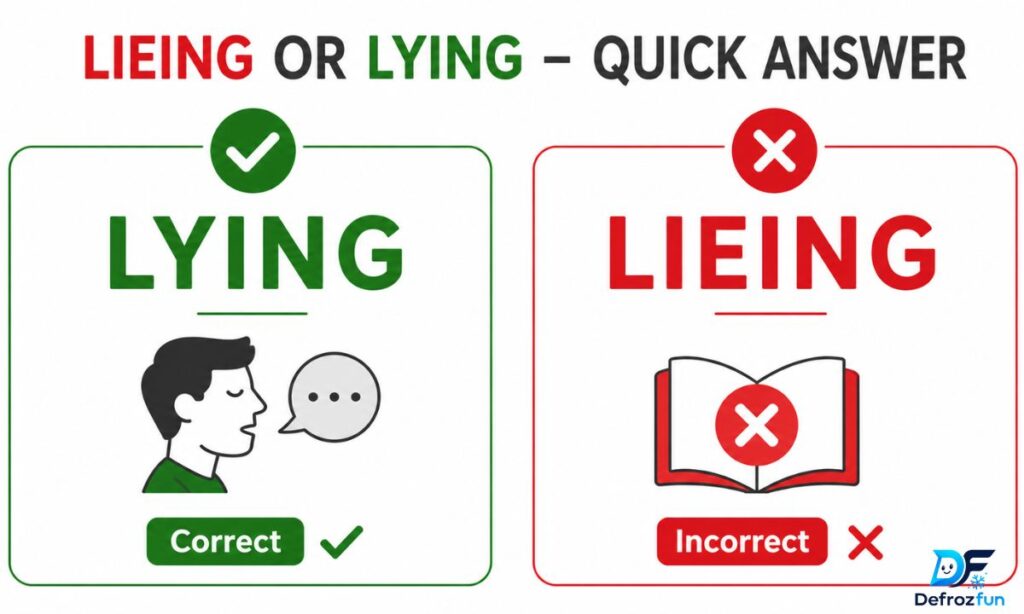
The correct spelling is lying. “Lieing” is always wrong — it does not exist as a valid word in any standard English dictionary, grammar guide, or style manual.
✅ Correct: She is lying on the couch. ❌ Incorrect: She is lieing on the couch.
Both meanings of the verb lie — to recline and to tell an untruth — use the same present participle: lying.
The Origin of Lieing or Lying
To understand why “lying” is correct, it helps to look at where the word comes from.
The verb lie (to rest or recline) traces back to Old English licgan, which meant to rest in a flat position. The verb lie (to tell an untruth) comes from Old English lēogan, a word of Proto-Germanic origin related to the German lügen and Dutch liegen.
Although both verbs developed from different roots, they eventually converged into the same spelling in Modern English — and both follow the same present participle rule.
Over centuries, English developed spelling conventions to make pronunciation smoother. The result: verbs ending in -ie began following a specific transformation rule when -ing was added. That rule is the reason “lieing” never became the standard form — because it was always harder to say and looked awkward on the page.
The Grammar Rule Behind the Spelling
This is the key to understanding everything:
When a verb ends in -ie, change -ie to -y before adding -ing.
Here’s how it works across similar verbs:
| Base Verb | Present Participle |
| lie | lying |
| die | dying |
| tie | tying |
| vie | vying |
Notice the pattern? Every -ie verb follows the same rule. “Lieing,” “dieing,” and “tieing” are all incorrect for the same reason.
This rule exists because back-to-back vowels like ie + ing create an awkward vowel cluster that’s difficult to read and pronounce. Changing ie to y before adding -ing keeps the word smooth and readable.
British English vs American English Spelling
One of the most common assumptions people make is that “lieing” might be the British spelling — or vice versa. This is not true.
Both British English and American English use lying. There is no regional variation for this word. Unlike colour/color or travelling/traveling, the spelling of lying never changes based on geography.
| Feature | British English | American English |
| Correct spelling | lying | lying |
| Incorrect spelling | lieing | lieing |
| Regional difference? | No | No |
No matter where your audience is — the UK, the US, Australia, or Canada — lying is always the right choice.
Which Spelling Should You Use?
Simple: always use lying.
There is no formal vs. informal exception. There is no creative writing exception. There is no context — not an email, essay, social media post, academic paper, or text message — where “lieing” is acceptable.
Use lying when:
- Describing someone in a resting or horizontal position
- Referring to someone being dishonest or untruthful
- Using it as a noun (gerund) or adjective
Every time, the answer is the same: lying.
Also Read This: Loses or Losses – Which One Is Correct? (2026 Guide)
Common Mistakes with Lieing or Lying
Here are the most frequent errors writers make — and how to fix them:
Mistake 1: Adding -ing Directly to “Lie”
Many people treat lie like a regular verb and simply attach -ing:
❌ He is lieing about where he went. ✅ He is lying about where he went.
Mistake 2: Confusing “Lying” with “Laying”
This is arguably the bigger mistake. Lying and laying come from two different verbs:
- Lying = present participle of lie (no object needed)
- Laying = present participle of lay (always needs a direct object)
| Sentence | Correct? | Why |
| She is lying on the bed. | ✅ Yes | No object — use lying |
| He is laying the tiles. | ✅ Yes | Has object (tiles) — use laying |
| The dog is laying on the floor. | ❌ No | No object — should be lying |
Mistake 3: Assuming “Lieing” Is a UK/Informal Variant
It isn’t. Spell-check tools in Microsoft Word, Google Docs, and Grammarly all flag “lieing” as an error — because it simply doesn’t exist in the language.
Lieing or Lying in Everyday Examples
Here are real-life sentences showing lying used correctly in both of its meanings:
Meaning 1: To Be in a Resting Position
- The keys are lying on the kitchen counter.
- He spent the afternoon lying on the sofa.
- The cat was lying in a patch of sunlight.
- She found her jacket lying on the floor.
Meaning 2: To Tell an Untruth
- The witness was accused of lying under oath.
- Stop lying — I already know what happened.
- She kept lying to avoid getting in trouble.
- The data showed the company had been lying in its reports.
Context is what separates the two meanings — the spelling never changes.
Lieing or Lying – Google Trends & Usage Data
Search data and language corpora both confirm lying is the dominant, accepted form:
- Google Trends shows that “lieing” appears almost entirely as a search query — meaning people are looking up whether it’s correct, not using it confidently in writing.
- Google Ngram Viewer shows that lying has been the consistent standard for centuries, while “lieing” has no meaningful presence in published literature.
- Most searches for “lieing or lying” come from students, ESL learners, and exam preparation users — pointing to this being a learning gap, not a genuine spelling debate.
- Spell-check tools across all major platforms (Google Docs, Word, Grammarly) automatically flag “lieing” as a typo.
The data is unanimous: lying is used universally in professional, academic, and casual writing.
Comparison Table: Lieing vs Lying
| Feature | Lieing | Lying |
| Is it correct? | ❌ No | ✅ Yes |
| In dictionaries? | ❌ No | ✅ Yes |
| Spell-check result | Flagged as error | Accepted |
| British English | ❌ Incorrect | ✅ Correct |
| American English | ❌ Incorrect | ✅ Correct |
| Formal writing | Never use | Always use |
| Grammar rule applies | Breaks the rule | Follows the -ie → y rule |
| Usage in literature | Not found | Universal |
Conclusion
The debate between “lieing or lying” is really no debate at all. Lying is the only correct spelling — always, in every context, for every audience, in both British and American English.
The reason comes down to a simple grammar rule: when a verb ends in -ie, you change -ie to -y before adding -ing. That’s why lie becomes lying, just as die becomes dying and tie becomes tying.
Keep this trick in your back pocket: if you can remember die → dying, you’ll never write “lieing” again.
Whether you’re writing a casual text, a professional report, or an academic essay — use lying every time. Clear spelling builds credibility, and getting this small detail right makes your writing look polished and professional.

Daniel Brooks is a passionate writer and digital content creator dedicated to sharing insightful, engaging, and informative articles across multiple niches. With a strong interest in technology, lifestyle, trending topics, and online media, Daniel Brooks focuses on delivering well-researched and reader-friendly content that inspires and informs audiences worldwide.