

If you’ve ever typed this word and paused — wondering whether it needs one “r” or two — you’re not alone. This is one of the most common spelling mix-ups in the English language, and the answer is simpler than you think. Let’s settle it once and for all.
Forest or Forrest – Quick Answer
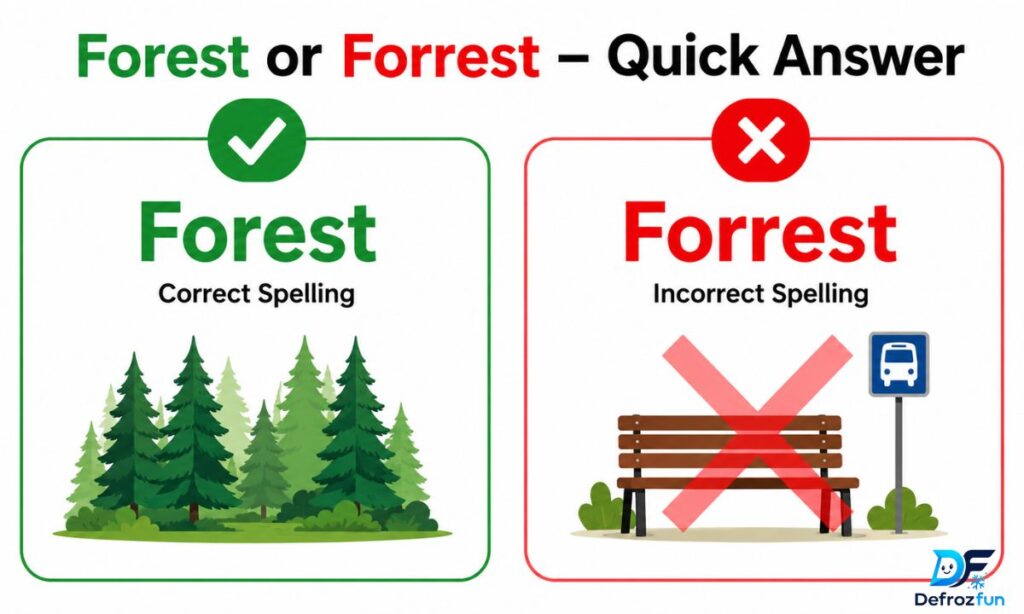
Forest (one “r”) is always the correct spelling when referring to a large area covered with trees and undergrowth. Forrest (two “r”s) is only correct as a personal name or surname — such as Forrest Gump or actor Forest Whitaker (who actually spells his name with one “r”).
| Word | Correct Use | Example |
| Forest | Common noun — area of trees | “We hiked through the forest.” |
| Forrest | Proper noun — a person’s name | “My friend’s name is Forrest.” |
Using “forrest” to describe trees or nature is always a spelling error.
The Origin of Forest or Forrest
Understanding where these words come from makes the distinction easy to remember.
The word forest entered English around the 13th century, borrowed from Old French forest, which itself came from the Medieval Latin phrase forestem silvam — meaning “the outside wood.” The Latin root foris means “outside,” referring to land that lay beyond the central fenced woodlands, typically reserved for royal hunting grounds.
The Norman rulers of England introduced “forest” as a legal term. In those days, a “forest” didn’t necessarily mean a place full of trees — it referred to land placed off limits by royal decree, protected for the king’s hunt. Over centuries, the meaning shifted to what we know today: a large, tree-covered area of land.
Forrest, on the other hand, developed as a topographical surname given to people who lived or worked near woodland areas. It’s derived from “forest” but adopted a different spelling over time, functioning exclusively as a proper noun (a personal name).
British English vs American English Spelling
One common question is whether “forrest” might be accepted in British English while “forest” is the American form — or vice versa. The answer is no.
| Variety | Correct Spelling |
| British English | forest |
| American English | forest |
| Australian English | forest |
| Canadian English | forest |
| All other varieties | forest |
Both British and American English — along with every other variety of the language — use forest with a single “r.” There is no regional variation that accepts “forrest” as a valid spelling for the noun meaning a wooded area. This is one of those rare cases where spelling is completely consistent across dialects.
Which Spelling Should You Use?
The rule is straightforward:
- Writing about trees, nature, woodlands, or ecosystems? → Use forest (one “r”)
- Writing a person’s name or surname? → Use Forrest (two “r”s)
Ask yourself one simple question before you write: Am I talking about trees, or a person?
That’s your answer. Nature gets one “r.” Names can have two.
Quick Memory Trick
“There’s only one road (R) through the forest.” “Forrest has two legs — just like his name has two R’s.”
These mnemonics make it almost impossible to forget the difference.
Also Read This: Kindergarten or Kindergarden: Everything You Need to Know (2026)
Common Mistakes with Forest or Forrest
Here are the most frequent errors writers make with these two words:
Mistake 1 — Using “forrest” for a natural area:
- ❌ Wrong: “We camped in the forrest overnight.”
- ✅ Right: “We camped in the forest overnight.”
Mistake 2 — Writing “Forest Gump” instead of “Forrest Gump”:
- ❌ Wrong: “My favorite movie is Forest Gump.”
- ✅ Right: “My favorite movie is Forrest Gump.”
Mistake 3 — Assuming British English uses a different spelling:
- ❌ Wrong: “The forrest near London is beautiful.” (in any dialect)
- ✅ Right: “The forest near London is beautiful.”
Mistake 4 — Confusing names with the common noun:
- ❌ Wrong: “Forrest Whitaker filmed scenes in a beautiful Forest.”
- ✅ Right: “Forest Whitaker filmed scenes in a beautiful forest.” (Note: His name is actually spelled “Forest” with one “r”)
Why Do People Get This Wrong?
There are a few reasons this confusion is so common:
- They sound identical — “forest” and “forrest” are homophones in speech, so there’s no audio cue to guide spelling.
- Pop culture influence — The film Forrest Gump (1994) made the double-“r” spelling extremely familiar to millions of people worldwide.
- Double letters feel natural — English has many words with double consonants (glitter, flutter, pattern), so adding an extra “r” feels instinctive.
- Fast typing errors — When typing quickly, an extra “r” slips in easily.
Forest or Forrest in Everyday Examples
Here are correct and incorrect uses across different writing contexts:
Correct Usage of “Forest” (one “r”)
- “The Amazon rainforest covers billions of acres.”
- “We spotted deer tracks on the forest floor.”
- “Deforestation is one of the biggest environmental concerns of our time.”
- “The Black Forest in Germany is famous for its dense woodlands.”
- “She loved the smell of pine in the forest.”
Correct Usage of “Forrest” (two “r”s)
- “Forrest Gump is one of the most iconic film characters of all time.”
- “My uncle’s name is Forrest, and he’s an avid hiker.”
- “Dr. Forrest is the leading researcher on climate policy.”
- “The Forrest family moved to a cabin near the woods.”
Side-by-Side Comparison
| Sentence | Correct? |
| “The forest was dark and misty at dawn.” | ✅ Yes |
| “The forrest was dark and misty at dawn.” | ❌ No |
| “Forrest ran through the woods as a child.” | ✅ Yes (name) |
| “Forest ran through the woods as a child.” | ✅ Yes (name — alternate spelling of the proper name) |
| “We need to protect the world’s forrests.” | ❌ No |
| “We need to protect the world’s forests.” | ✅ Yes |
Forest or Forrest – Google Trends & Usage Data
When you compare “forest” and “forrest” on Google Ngram Viewer — which tracks word frequency in books over centuries — forest appears overwhelmingly more often than forrest across all time periods.
This is expected for two reasons:
- “forest” is a common everyday noun used in science, literature, journalism, and conversation.
- “forrest” only appears as a proper name, which naturally shows up far less frequently in printed text.
Search data consistently shows that most people searching for “forrest or forest” are looking to confirm which spelling is correct — suggesting widespread awareness that a mistake is easy to make, but a willingness to get it right.
Real-World Frequency Highlights
- Major dictionaries (Merriam-Webster, Oxford, Cambridge) all list forest as the standard spelling for the noun.
- “Forrest” does not appear in any major dictionary as a common noun — only as a proper name.
- Google corrects “forrest” to “forest” automatically in many search contexts, indicating it’s recognized as a common misspelling.
Conclusion
The difference between forest and forrest comes down to one simple rule: one “r” for trees, two “r”s for names.
“Forest” is the universally accepted spelling for any wooded area, in every English-speaking country, across all dictionaries and style guides. “Forrest” belongs exclusively to proper nouns — names and surnames.
The next time you’re writing about nature, ecology, woodland trails, or rainforests, you can be confident: it’s always forest with a single “r.” And if you’re writing about a person named Forrest — go ahead and give that name its second “r.”

Daniel Brooks is a passionate writer and digital content creator dedicated to sharing insightful, engaging, and informative articles across multiple niches. With a strong interest in technology, lifestyle, trending topics, and online media, Daniel Brooks focuses on delivering well-researched and reader-friendly content that inspires and informs audiences worldwide.