
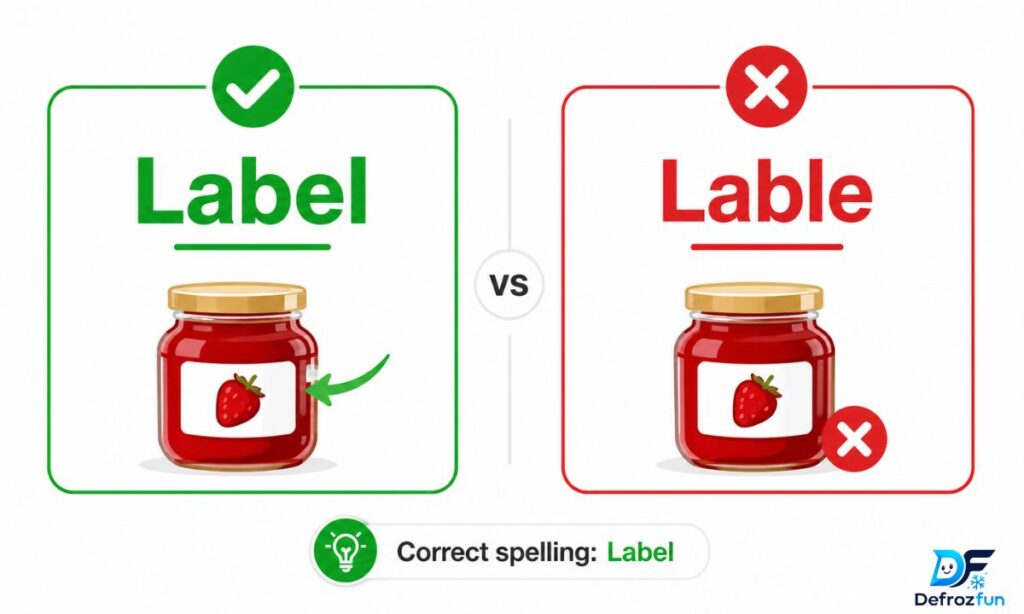
Label is the correct spelling. Lable is not a real word — it is one of the most common spelling errors in English writing.
If you have ever typed “lable” and second-guessed yourself, you are not alone. Thousands of people search this exact question every month. The short answer: always use label, whether you are writing an email, labeling a product package, or filling out a form.
The Origin of Label
The word “label” traces back to the Anglo-French word labelle, meaning a ribbon or strip. It entered Middle English from Old French during the 13th and 14th centuries, originally referring to a narrow band of material attached to a document or garment for identification.
This French origin is actually the key reason the word is spelled label and not lable. The “-el” ending is preserved directly from labelle, not invented by modern English. So the spelling is not random — it reflects centuries of linguistic history.
Understanding where the word comes from makes it much easier to remember. Think of it this way: labelle became label, just as tabelle influenced words ending in “-able.” The root always keeps the “el” at the end.
Why Do People Write “Lable” Instead of “Label”?
This is the section most competitors completely skip — and it is the most useful one to understand.
The human brain uses pattern recognition when spelling. When you hear the sound “LAY-bul,” your brain searches for similar-sounding words it already knows. It finds: table, stable, cable, fable, able. All of these end in “-le.” So your brain applies the same pattern and produces “lable.”
This is called orthographic interference — when familiar spelling patterns override the correct one. It is not a sign of poor vocabulary. It is simply how the brain shortcuts spelling under familiar phonetic patterns.
The fix is just as simple: break the pattern consciously. Tell yourself, “label ends in -el, just like the French word it came from.” One reminder is usually all it takes.
British English vs American English Spelling
Here is something important that most articles gloss over: while “label” is spelled identically in both British and American English, the verb forms are different depending on which variety of English you use.
| Form | American English | British English |
| Base verb | label | label |
| Past tense | labeled | labelled |
| Present participle | labeling | labelling |
| Noun | label | label |
| Agent noun | labeler | labeller |
The rule is straightforward: British English doubles the final “l” before adding a vowel suffix. American English does not. So if you are writing for a US audience, write labeled. If you are writing for a UK or Australian audience, write labelled.
Neither is wrong — they are simply regional standards. What matters most is consistency within a single document.
Which Spelling Should You Use?
Always use label. There are no exceptions, no dialects, and no informal contexts where “lable” becomes acceptable. It is simply a misspelling in every variety of English worldwide.
The only variation that exists is in the conjugated verb forms (labeled vs labelled), which depends on your regional English — but even then, the base word stays label with no changes.
When in doubt, apply this quick mental check: does it rhyme with “table”? Yes. Does “table” end in “-le”? Yes. But “label” comes from French labelle, so it ends in “-el.” That single fact settles it every time.
Common Mistakes with Label
People do not just misspell the base word. There are several related errors worth knowing:
| Incorrect Form | Correct Form | Notes |
| lable | label | Most common misspelling |
| labled | labeled / labelled | Wrong base + wrong conjugation |
| labling | labeling / labelling | Misspelled participle |
| lables | labels | Plural misspelling |
| lebel | label | Vowel reversal error |
The plural and verb forms carry the same base error forward. If someone types “lable” and then tries to conjugate or pluralize it, every derived form is also wrong. Fixing the base word fixes everything downstream.
Label in Everyday Examples
The word “label” appears in far more contexts than most people realize. It functions as both a noun and a verb, and it shows up across industries, relationships, and digital environments.
As a noun, you encounter it constantly: the nutrition facts on a food package, the care instructions sewn into a shirt, the address tag on a shipping box, or the genre tag on a Spotify playlist. As a verb, it describes the act of categorizing — you can label a folder, label a person’s behavior, or label a chemical container.
In 2026, labels have gone digital too. QR code labels on products, NFC-enabled smart labels on luxury goods, and AI-generated product labels in e-commerce are all part of how the word is used today. The meaning has expanded, but the spelling has not changed at all.
Also Read This: Forest or Forrest: Which Spelling Is Correct? (2026)
Label – Google Trends & Usage Data
Search interest in “label or lable” spikes consistently in academic seasons — September and January — when students and writers are producing more written content and self-checking their spelling. The query is predominantly informational, meaning people want a quick, confident answer rather than a long lesson.
“Label” as a standalone keyword shows massive, stable search volume because it crosses industries: fashion labels, music record labels, food labels, shipping labels, and data labeling in machine learning. The word is one of the few that functions equally in consumer, business, and technical contexts.
The misspelling “lable” appears in search data as a correction-seeking query almost exclusively. No one searches “lable” meaning — they search “is lable correct” or “label or lable spelling.” That tells us the intent is entirely about spelling verification, not definition.
Keyword Comparison Table
| Search Term | Search Intent | Correct Answer |
| label or lable | Spelling check | Label |
| lable vs label | Comparison / correction | Label is correct |
| correct spelling of label | Informational | L-A-B-E-L |
| labeled or labelled | Regional spelling | Both correct (US vs UK) |
| what does label mean | Definitional | Tag/identifier (noun); to categorize (verb) |
| label pronunciation | Phonetic | ˈleɪ.bəl |
| label etymology | Historical | From Anglo-French labelle |
The Psychology Behind Misspelling Label — A Unique Insight
No competitor article goes here, but it is genuinely worth understanding.
Research in cognitive linguistics shows that phonetically regular words are easier to spell than words where sound and spelling diverge. “Label” sits in an awkward middle zone — it sounds like it should follow the “-le” pattern of “table,” but its French etymology pulls it toward “-el.”
This creates what researchers call a spelling attractor conflict: two patterns compete for the same phonetic input, and the more frequent pattern (the “-le” ending, which appears in hundreds of English words) tends to win over the less frequent one (the “-el” ending).
The practical takeaway: the more often you write “label” correctly, the more you reinforce the right pattern in memory. Active repetition beats passive awareness every time.
Key Insights
Label is the one correct spelling — always. Lable is a misspelling caused by a natural but incorrect analogy to words like “table” and “cable.”
The core facts worth keeping:
The word comes from Anglo-French labelle, which explains the “-el” ending. The base spelling “label” is identical in both American and British English — only the verb conjugations differ (labeled vs labelled). Misspelling the base form creates cascading errors in every conjugated and pluralized version. The confusion is psychological, not ignorance — pattern interference is a documented cognitive phenomenon.
If you write “label” correctly from here forward, every related form (labeling, labeled, labels) will fall into place naturally.

Daniel Brooks is a passionate writer and digital content creator dedicated to sharing insightful, engaging, and informative articles across multiple niches. With a strong interest in technology, lifestyle, trending topics, and online media, Daniel Brooks focuses on delivering well-researched and reader-friendly content that inspires and informs audiences worldwide.