

If you have ever typed this word and paused to wonder, “Wait, is it fulfilment or fulfillment?” you are not alone. Both spellings appear everywhere online, in books, in business emails, and on official websites. This guide clears up the confusion once and for all, explains which version to use, and shows you real examples so you can write with confidence.
Fulfilment or Fulfillment – Quick Answer
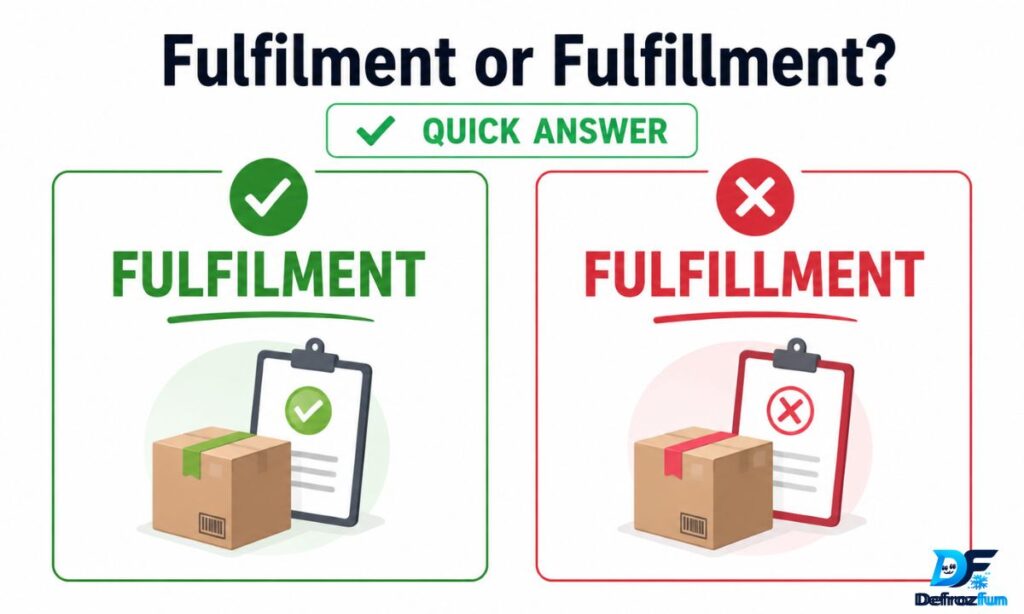
Both spellings are correct. The difference is not about meaning; it is about geography.
| Spelling | Region | Example |
| Fulfillment | American English (US) | “Order fulfillment takes 2–5 days.” |
| Fulfilment | British English (UK, AU, NZ, CA) | “The fulfilment of her dream took years.” |
Same word. Same meaning. Different audiences.
The Origin of Fulfilment/Fulfillment
The word traces back to Old English “fullfyllan,” a combination of full (meaning complete) and fyllan (meaning to fill). The base verb meant to carry out, complete, or bring something to its full conclusion.
Over centuries, as English spread to different parts of the world, spelling conventions diverged. American English, influenced by 18th-century spelling reformers like Noah Webster, leaned toward simplified spellings. British English preserved older conventions. This same split gave us color vs colour, organize vs organise, and of course, fulfillment vs fulfilment.
The noun form, whether you spell it with two Ls or three, entered common use to describe the act of completing something promised or the feeling of satisfaction that comes from doing so.
British English vs American English Spelling
This is the core of the fulfilment vs fulfillment debate. Here is how the two spelling systems handle this word:
American English:
- Verb: fulfill
- Noun: fulfillment
- Adjective: fulfilling
British English:
- Verb: fulfil
- Noun: fulfilment
- Adjective: fulfilling
Notice that the adjective form fulfilling stays the same in both dialects. The split only appears in the verb and noun forms.
| Word Form | American English | British English |
| Verb | fulfill | fulfil |
| Noun | fulfillment | fulfilment |
| Past tense | fulfilled | fulfilled |
| Adjective | fulfilling | fulfilling |
| Related noun | fulfillment center | fulfilment centre |
Also Read This: Blankie or Blanky: What’s The Difference (2026)
Fulfilment or Fulfillment Synonym
Both words share the same synonyms because they carry identical meaning:
- Satisfaction – the most common substitute in emotional contexts
- Achievement – used when describing reaching a goal
- Completion – emphasizes the finishing of a task or promise
- Realization – used when a dream or potential comes true
- Accomplishment – highlights personal success
- Gratification – carries a sense of reward or pleasure
- Attainment – formal synonym often used in academic writing
- Fruition – suggests something reaching its full result
- Consummation – formal, often used in legal or literary contexts
Which Spelling Should You Use?
The answer depends entirely on your audience, not on grammar rules.
Use “fulfillment” if you are writing for:
- US-based readers
- American publications, websites, or businesses
- Content targeting North American search traffic
Use “fulfilment” if you are writing for:
- UK, Australian, New Zealand, or Canadian audiences
- British publications or Commonwealth markets
- International SEO targeting those regions
The golden rule is consistency. Pick one spelling and stick to it throughout your piece. Mixing both in the same document is the only actual mistake you can make here.
For global content, fulfillment (American spelling) tends to have a wider search volume internationally, especially given the dominance of US-based platforms like Amazon, Google, and major eCommerce tools.
Fulfilment or Fulfillment Synonym in Writing
When you want to avoid repeating either word, rotate between these alternatives based on context:
- Emotional context: satisfaction, contentment, joy, peace of mind
- Professional context: achievement, accomplishment, execution, realization
- Business/logistics context: completion, delivery, dispatch, order processing
Common Mistakes with Fulfilment/Fulfillment
Even experienced writers trip up here. Watch out for these errors:
1. Mixing spellings in one document Using fulfillment in the headline and fulfilment in the body text looks careless and confuses readers. Set your spell-checker to the correct regional dialect before you start.
2. Assuming one is wrong Some writers assume the spelling they learned is the only correct one and mark the other as a typo. Both are grammatically valid.
3. Confusing the verb and noun forms The verb is fulfill (US) or fulfil (UK). The noun is fulfillment or fulfilment. Using “fulfillment” as a verb is incorrect in either dialect.
4. Using “fullfilment” or “fullfillment” These are actual misspellings. Neither form exists in standard dictionaries. Double-check that you are not doubling the full prefix.
5. Applying American spelling to a British audience (or vice versa) This is especially important in business and eCommerce. If your UK logistics partners use fulfilment centre and your website says fulfillment center, it creates an inconsistency that can appear unprofessional.
Fulfilment/Fulfillment in Everyday Examples
Seeing these words in context makes it far easier to remember how they work.
In personal and emotional contexts:
- “Volunteering gave her a deep sense of fulfillment.”
- “The fulfilment he found in teaching was unlike anything else.”
- “A fulfilling career is worth more than a high salary.”
In business and logistics:
- “The company expanded its fulfillment network across five states.”
- “Third-party fulfilment services are popular in the UK eCommerce market.”
- “Fast order fulfillment is a key driver of customer loyalty.”
In formal and legal writing:
- “The fulfillment of the contract terms is expected by Q3.”
- “Both parties agreed to the fulfilment of all obligations within 30 days.”
In academic and literary writing:
- “The novel explores the fulfilment of human potential.”
- “Maslow placed self-fulfillment at the top of his hierarchy of needs.”
Fulfilment or Fulfillment – Google Trends & Usage Data
Search data consistently shows a clear regional divide:
- “Fulfillment” dominates in the United States, Canada (partially), and globally due to US platform influence.
- “Fulfilment” leads in the United Kingdom, Australia, New Zealand, and parts of South Asia.
- On a global scale, fulfillment has a higher overall search volume, largely driven by US eCommerce searches around Amazon fulfillment, 3PL fulfillment services, and order fulfillment processes.
For SEO purposes, if you are targeting a mixed international audience, you may consider including both spellings naturally in your content, as search engines recognize them as regional variants of the same term. However, never force both spellings awkwardly; let them appear where they fit naturally.
Conclusion
The fulfilment vs fulfillment debate has a simple answer: both are correct, and neither is better than the other. The only thing that determines which one you should use is your audience.
Write for Americans? Use fulfillment. Write for British or Commonwealth readers? Use fulfilment. Write for both? Pick one and stay consistent, or consult your platform’s regional SEO strategy.
Whatever you choose, avoid the real mistakes: mixing spellings in one piece, using the made-up forms like fullfillment, or treating the other dialect’s spelling as an error. English belongs to many regions, and this word is a perfect example of how the same language can express the same idea in more than one way.

Daniel Brooks is a passionate writer and digital content creator dedicated to sharing insightful, engaging, and informative articles across multiple niches. With a strong interest in technology, lifestyle, trending topics, and online media, Daniel Brooks focuses on delivering well-researched and reader-friendly content that inspires and informs audiences worldwide.