

If you have ever paused mid-sentence wondering whether to write organised or organized, you are not alone. This is one of the most searched spelling questions in English, and the answer is simpler than you think. Both spellings are correct — the difference comes down to where you are writing and who your audience is. This guide breaks down everything you need to know, with clear examples, common mistakes to avoid, and a quick-reference comparison table.
Organised or Organized – Quick Answer
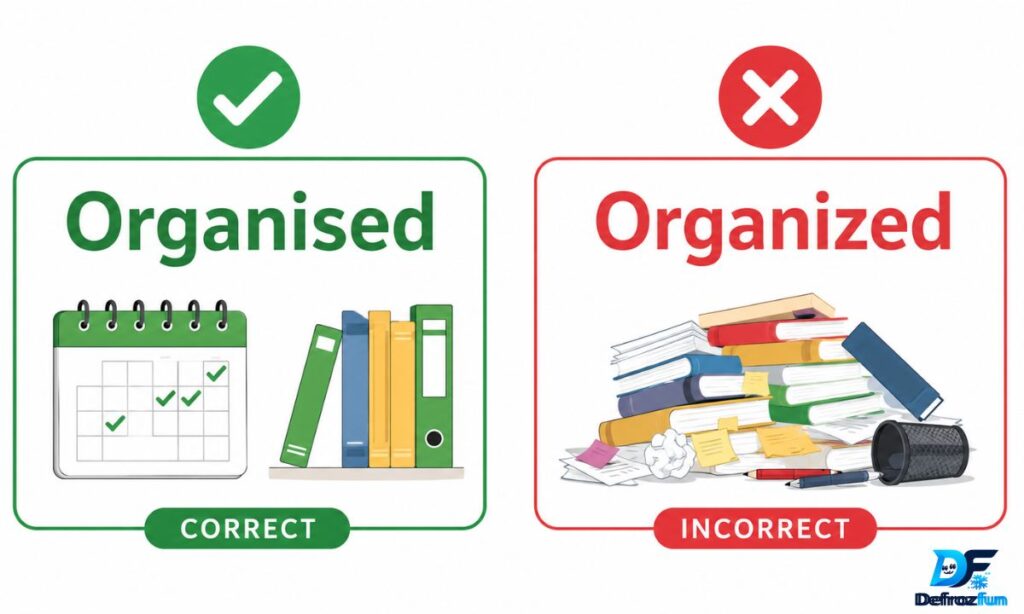
Both organised and organized are correct spellings of the same word. Organised is the standard British English spelling, used across the UK, Australia, New Zealand, and most Commonwealth countries. Organized is the American English spelling, standard in the United States and Canada.
| Feature | Organised | Organized |
| Spelling variant | British English | American English |
| Countries used | UK, AU, NZ, India | USA, Canada |
| Meaning | Arranged/structured | Arranged/structured |
| Verb root | Organise | Organize |
| Both correct? | Yes | Yes |
The Origin of Organised / Organized
The word traces back to the Greek organon, meaning “tool” or “instrument,” and the Latin organizare, meaning “to form into a system.” When the word entered English in the 15th century through French influence, the primary spellings were organize and organyse.
The -ise variant appeared a century or two later and became common in British writing. In the 19th century, the American lexicographer Noah Webster standardized -ize endings in American English as part of his effort to simplify and Americanize the language. This is why you see the pattern repeated across dozens of word pairs: recognise/recognize, realise/realize, and so on.
British English vs American English Spelling
The organised/organized split follows one of the most consistent spelling patterns in the English language. British English favors -ise endings, while American English uses -ize. Understanding this rule helps you predict the correct spelling for many similar words.
British English (-ise / -ised)
- Used in the UK, Australia, New Zealand, South Africa, and India
- Organised, organising, organisation
- Preferred in academic writing, formal UK publications, and Commonwealth media
- Note: Oxford University Press sometimes accepts -ize spellings (Oxford spelling), but -ise remains the everyday British standard
American English (-ize / -ized)
- Used in the United States and Canada
- Organized, organizing, organization
- Standard in US academic institutions, American media, and global tech companies
- Generally more common in global digital content due to American tech dominance
The Same Rule Applies to Related Words
| Base Form | British English | American English |
| Organise/Organize | Organise | Organize |
| Past tense | Organised | Organized |
| Present participle | Organising | Organizing |
| Noun | Organisation | Organization |
| Realise/Realize | Realise | Realize |
| Recognise/Recognize | Recognise | Recognize |
Which Spelling Should You Use?
The right choice depends on three things: your audience, your platform, and your style guide.
- Writing for a UK, Australian, or Commonwealth audience? Use organised.
- Writing for a US or Canadian audience? Use organized.
- Writing for a global digital audience with no specific region? Organized is the safer default, as it is more widely recognized internationally.
- Following a specific style guide (AP, Chicago, Oxford)? Check their regional preference and stick to it.
- Most important rule: pick one spelling and stay consistent throughout your entire document.
Organised or Organized in a Sentence
Here are clear examples of both spellings used correctly in context:
| British English (Organised) | American English (Organized) |
| She organised the conference last week. | She organized the conference last week. |
| The files were neatly organised by date. | The files were neatly organized by date. |
| He is very well organised at work. | He is very well organized at work. |
| The event was poorly organised. | The event was poorly organized. |
| They organised a fundraiser for charity. | They organized a fundraiser for charity. |
Common Mistakes with Organised / Organized
Even experienced writers make these errors. Here are the most common pitfalls and how to avoid them:
1. Mixing Spellings in the Same Document
This is the most frequent mistake. Writers switch between organised and organized in the same article or report, which looks inconsistent and unprofessional. Choose one and use it throughout.
2. Assuming One Spelling Is Wrong
Many writers mark the British spelling organised as incorrect when writing in American English, or vice versa. Both are correct — the context decides which is appropriate.
3. Misspelling the Word Entirely
Common misspellings to watch out for:
- organsied (letters transposed)
- organissed (double s)
- orgainzed (misplaced vowel)
- organisied (extra i)
4. Using American Spelling in British Academic Writing
Many UK universities and publications require British spelling. Submitting a paper with organized instead of organised can be flagged for inconsistency or incorrect spelling in those contexts.
Organised or Organized Synonym
If you want to avoid the spelling debate altogether, or simply vary your language, here are strong synonyms that work in any dialect of English:
| Synonym | Meaning | Register |
| Arranged | Put in order | Neutral |
| Structured | Given a clear form | Formal |
| Coordinated | Parts working together | Formal |
| Planned | Prepared in advance | Neutral |
| Systematised | Put into a system | Formal |
| Ordered | Placed in sequence | Neutral |
| Methodical | Following a method | Formal |
Organised or Organized in Everyday Examples
Seeing both spellings in real-world contexts makes the distinction much easier to remember.
In the Workplace
- UK: The HR team organised the induction schedule for new staff.
- US: The HR team organized the onboarding schedule for new employees.
In Academic Writing
- British: The research was well organised into clearly defined sections.
- American: The research was well organized into clearly defined sections.
In Everyday Speech
- British: I need to get organised before the holidays.
- American: I need to get organized before the holidays.
In News and Media
- The Guardian (UK): The protest was organised by a coalition of local groups.
- The New York Times (US): The protest was organized by a coalition of local groups.
Organised or Organized – Google Trends & Usage Data
Search volume and usage data confirm the regional split clearly and consistently:
| Metric | Organised | Organized |
| Global search volume | Lower | Higher |
| Dominant regions | UK, AU, NZ, IN | US, CA |
| Google Trends dominance | British English regions | American English regions |
| Academic corpus usage | More in British journals | More in US journals |
| Digital content (global) | Less common | More common |
Organized consistently outperforms organised in global search volume, largely because the internet is dominated by American English content. However, organised holds its ground firmly in UK, Australian, and South Asian English searches.
Comparison Table – Keyword Variations
Here is a complete reference for the organised/organized word family and related spelling pairs:
| Word Form | British English | American English |
| Verb (base) | Organise | Organize |
| Past tense | Organised | Organized |
| Present participle | Organising | Organizing |
| Noun | Organisation | Organization |
| Adjective | Well-organised | Well-organized |
| Agent noun | Organiser | Organizer |
| Related: realise/realize | Realised | Realized |
| Related: recognise/recognize | Recognised | Recognized |
| Related: analyse/analyze | Analysed | Analyzed |
Conclusion
The organised vs organized question has a straightforward answer: both are correct. The spelling you use depends entirely on your audience and the English dialect you are writing in. Use organised for British, Australian, and Commonwealth English. Use organized for American and Canadian English.
The most important takeaway is consistency. Whether you choose organised or organized, stick with one spelling throughout your document. Mixing them signals carelessness, not creativity. If you are writing for a global audience without a clear regional focus, organized is the more widely recognized default.
Bookmark this guide as a quick reference, and the next time the question comes up, you will know exactly which spelling to reach for.
Frequently Asked Questions
Is organised or organized correct?
Both are correct. Organised is British English; organized is American English.
Which spelling should I use for formal writing?
Use the spelling that matches your audience’s dialect — organised for UK/Commonwealth, organized for US/Canada.
Is organized more common than organised globally?
Yes. Organized has higher global search volume due to the dominance of American English online.
Does organised mean the same thing as organized?
Yes, they are identical in meaning — only the spelling differs based on regional English conventions.
Can I use organized in British English?
It is technically understood, but using organised is strongly preferred in British academic and professional writing.
What is the noun form of organised/organized?
Organisation (British English) or organization (American English).

Daniel Brooks is a passionate writer and digital content creator dedicated to sharing insightful, engaging, and informative articles across multiple niches. With a strong interest in technology, lifestyle, trending topics, and online media, Daniel Brooks focuses on delivering well-researched and reader-friendly content that inspires and informs audiences worldwide.