

If you have ever stopped mid-sentence wondering whether to write “afterward” or “afterwards,” you are not alone. This is one of the most common spelling questions in English. The good news? Both are correct. The difference comes down to where you are writing and who your audience is.
Quick Answer
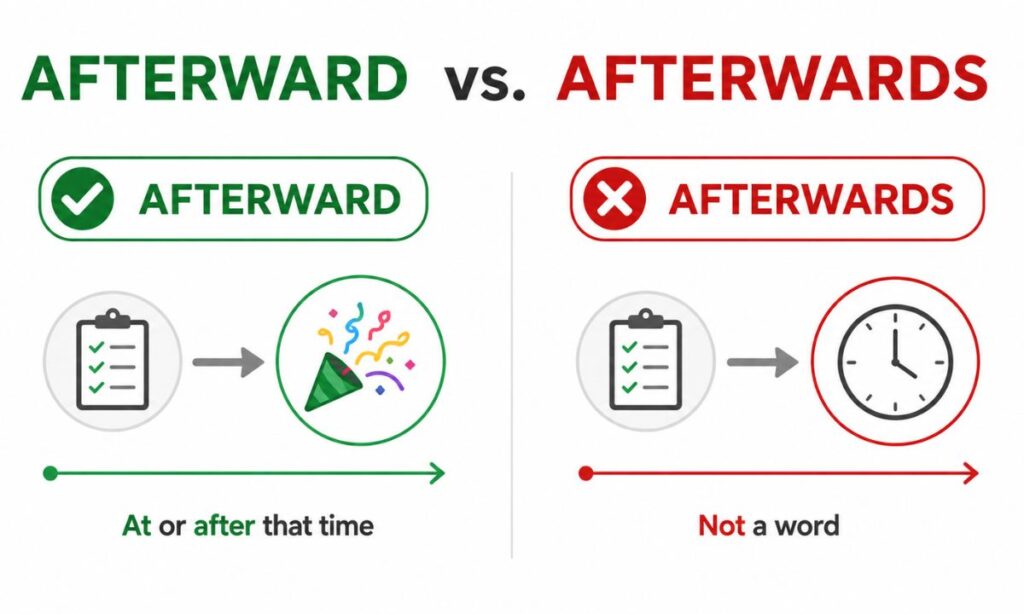
Afterward and afterwards mean exactly the same thing. Both are adverbs that describe something happening at a later time. The only real difference is regional:
- Afterward → preferred in American English (US and Canada)
- Afterwards → preferred in British, Australian, and Commonwealth English
Afterward vs. Afterwards Meaning
Both words are adverbs. They describe an event that happens after something else has already taken place.
Core meaning: at a later time; subsequently; following a previous event
| Word | Part of Speech | Meaning |
| Afterward | Adverb | At a later time; subsequently |
| Afterwards | Adverb | At a later time; subsequently |
Neither word can be used as a noun or adjective. They only function as adverbs in a sentence.
Note: Do not confuse these with afterword (noun) — the concluding section written at the end of a book. That is a completely different word.
Afterward vs. Afterwards Difference
The difference between these two words is not about meaning — it is purely about regional spelling preference.
| Feature | Afterward | Afterwards |
| Meaning | Same | Same |
| Part of speech | Adverb | Adverb |
| Regional use | American English | British / Commonwealth English |
| Formality | Slightly more concise | Common in literature and formal British writing |
| Interchangeable? | Yes | Yes |
Both spellings appear in respected dictionaries, including Merriam-Webster and Oxford.
Grammar Rule Depth
Both words follow the same grammatical rules:
- They modify verbs, adjectives, or other adverbs
- They are placed either at the beginning or end of a clause
- They cannot stand alone as a subject or object
- They are not comparative or superlative (no “more afterward” or “most afterwards”)
Examples showing placement:
- Afterward, she felt much better. (beginning of clause)
- She felt much better afterward. (end of clause)
- Afterwards, they decided to leave. (beginning of clause)
- They decided to leave afterwards. (end of clause)
Both placements are grammatically correct.
The Origin of Afterward and Afterwards
The history of these two words explains why both exist today.
Afterward traces back to Old English “æfterwearde”, combining:
- æft — meaning “after”
- -weard — a directional suffix meaning “toward” or “in the direction of”
Originally, it meant “behind” or “in the rear.” Over time, it shifted to mean “at a later time.”
Afterwards appeared around the early 1300s, formed by adding the adverbial genitive suffix “-s” to “afterward.” This extra “-s” was a standard way in Middle English to build adverbs from existing words.
Both forms lived side by side in the language for centuries. American English gradually dropped the “-s” in most directional adverbs, while British English held onto it.
Why Two Spellings Exist
English has many -ward / -wards word pairs. This is not unique to “afterward.” The same pattern shows up across the language:
| -ward form | -wards form |
| toward | towards |
| forward | forwards |
| backward | backwards |
| afterward | afterwards |
| inward | inwards |
| outward | outwards |
In all these pairs, American English tends to drop the “-s” while British English keeps it. The meanings stay the same across both forms.
Which Spelling Should You Use?
The right choice depends on your audience and style guide:
- Writing for American readers? Use afterward
- Writing for British, Australian, or international audiences? Use afterwards
- No specific audience? Pick one and stay consistent throughout your piece
- Following a style guide? AP Stylebook and most American guides prefer afterward
The most important rule is consistency. Do not switch between the two forms in the same document.
Afterward vs. Afterwards Exercises
Test your understanding with these practice sets.
Exercise 1: Choose the Correct Word
Choose the best word based on context clues in each sentence.
- The meeting ran long, but ________, everyone went for coffee. (American English context)
- She apologized, and ________ they became close friends. (British English context)
- He finished the report and ________ went home. (neutral context)
- ________, the team celebrated their win. (formal American writing)
- They argued for an hour; ________, they shook hands. (British newspaper style)
Answer Key:
- afterward
- afterwards
- afterward / afterwards (both correct)
- Afterward
- Afterwards
Exercise 2: Correct the Sentence
Identify whether each sentence contains an error and correct it where needed.
- The afterword, she realized her mistake. ❌ → The afterward, she realized her mistake. ❌ → Afterward, she realized her mistake. ✅
- He ate dinner and went for a walk afterward. ✅ (No error)
- She wrote an afterwards to the novel. ❌ → She wrote an afterword to the novel. ✅
- Afterwards, the children played in the yard. ✅ (No error — British/Commonwealth English)
- They spoke to the press afterward’s. ❌ → They spoke to the press afterward. ✅
Also Read This: Piece vs. Peice: Which Spelling Is Correct? Meaning, Examples & Common Mistakes (2026)
Real-World Usage of Afterward and Afterwards
Here is how these words appear across different types of published writing:
American news (afterward preferred):
The president signed the bill and spoke to reporters afterward.
British press (afterwards preferred):
The Prime Minister met with advisors and issued a statement afterwards.
Australian writing (afterwards preferred):
The match ended in a draw, and afterwards both teams met for a press conference.
Academic writing (both acceptable):
Participants completed the survey and were debriefed afterward(s).
Afterward vs. Afterwards Quiz
Quick Quiz — True or False:
- “Afterward” and “afterwards” have different meanings. → False
- “Afterward” is more common in American English. → True
- “Afterwards” can be used as a noun. → False
- Both spellings are correct English. → True
- “Afterword” is the same as “afterward.” → False
Afterward vs. Afterwards in Everyday Examples
| Sentence with Afterward | Sentence with Afterwards |
| We had lunch and went shopping afterward. | We had lunch and went shopping afterwards. |
| Afterward, he apologized. | Afterwards, he apologized. |
| She cried but felt better afterward. | She cried but felt better afterwards. |
| The surgery went well; afterward, he rested. | The surgery went well; afterwards, he rested. |
| Afterward, the team reviewed their strategy. | Afterwards, the team reviewed their strategy. |
Every pair above carries the exact same meaning. Only the spelling changes.
Common Mistakes with Afterward vs. Afterwards
Mistake 1: Using “afterword” instead of “afterward/afterwards”
- ❌ Afterword the game, we celebrated.
- ✅ Afterward the game, we celebrated.
Mistake 2: Adding an apostrophe
- ❌ She felt relieved afterward’s.
- ✅ She felt relieved afterward.
Mistake 3: Switching between spellings in the same document
- ❌ He arrived afterward. She came afterwards.
- ✅ He arrived afterward. She came afterward. (consistent)
Mistake 4: Using “afterward” as a noun
- ❌ The afterward of the story was sad.
- ✅ The story ended on a sad note.
Afterward vs. Afterwards in Different Contexts
Academic Writing
Most American academic journals follow APA or Chicago style, both of which accept “afterward.” British academic writing commonly uses “afterwards.”
Fiction Writing
Both spellings appear in fiction. The choice usually mirrors the author’s nationality or the publisher’s house style.
Business Writing
American business documents, press releases, and reports tend to use “afterward.” British corporate writing uses “afterwards.”
Everyday Conversation
In speech, most people say the same word regardless of the spelling. The difference is primarily a written distinction.
Related Words and Similar Patterns
Understanding the -ward/-wards pattern helps you handle similar word pairs with confidence:
| Word Pair | American Preference | British Preference |
| toward / towards | toward | towards |
| forward / forwards | forward | forwards |
| backward / backwards | backward | backwards |
| upward / upwards | upward | upwards |
| downward / downwards | downward | downwards |
| afterward / afterwards | afterward | afterwards |
The rule is consistent: American English drops the “-s,” British English keeps it.
Usage Trends and Language Patterns
Corpus data from large databases of published English text shows:
- In American English books and newspapers, “afterward” appears far more often than “afterwards”
- In British English publications, “afterwards” is the dominant form
- In Australian and Canadian English, “afterwards” is slightly preferred but “afterward” is also used
- Both forms have remained stable in usage over the last century with no sign that one is replacing the other
Neither spelling is becoming outdated. Both will continue to coexist in standard English.
Conclusion
The debate between afterward and afterwards has a simple answer: both are right. The only meaningful difference is geography. American writers use “afterward”; British, Australian, and Commonwealth writers use “afterwards.” Neither form is wrong, and both carry the exact same meaning.
When in doubt, pick the form that matches your audience and stick with it throughout your writing. The key is consistency, not which spelling you choose.
And whatever you do — do not mix them up with afterword, the book section. That is a completely different word.

Daniel Brooks is a passionate writer and digital content creator dedicated to sharing insightful, engaging, and informative articles across multiple niches. With a strong interest in technology, lifestyle, trending topics, and online media, Daniel Brooks focuses on delivering well-researched and reader-friendly content that inspires and informs audiences worldwide.