

If you’ve ever typed this word and paused — “wait, is it cosy or cozy?” — you’re not alone. It’s one of the most commonly searched spelling questions in English. The good news? You’re not making a mistake either way. Both spellings are correct. The one you use simply depends on where you are, and who you’re writing for.
Cosy or Cozy – Quick Answer
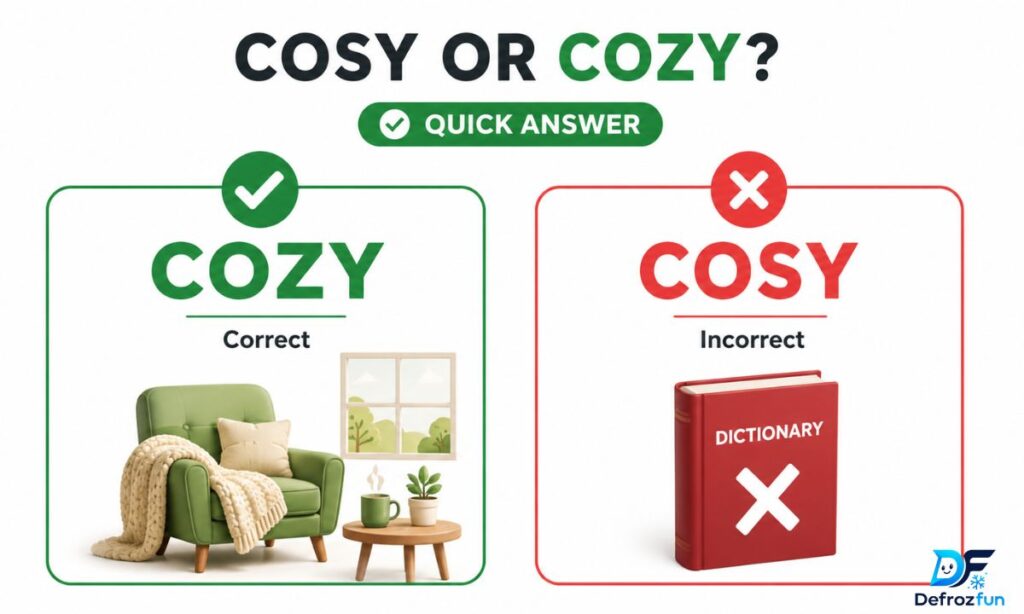
Both spellings are correct. “Cozy” is standard American English. “Cosy” is standard British English. The meaning is identical — warm, comfortable, snug, and inviting. There is no grammar difference, no formality difference, and no hidden rule. It’s purely a regional spelling variation.
In a sentence:
- The cabin felt cozy on a cold winter night. ✅ (American English)
- The cabin felt cosy on a cold winter night. ✅ (British English)
The Origin of Cosy / Cozy
The word traces back to 18th-century Scotland. It comes from the Scottish dialect word “cosie” (sometimes spelled colsie), meaning warm and snug. It also shares roots with the Norwegian word “kos” — a concept tied to comfort, warmth, and simple pleasures, similar to the Danish idea of hygge.
From Scotland, the word spread into mainstream English writing. At that point, both the “s” and “z” versions existed side by side. The split into two distinct regional spellings happened in the 19th century — and one man played a major role in that divide.
British English vs American English Spelling
How Noah Webster Changed Everything
In 1828, American lexicographer Noah Webster published his American Dictionary of the English Language. His goal was straightforward: make American English distinct from British English and simplify spelling to match how words actually sound.
Webster pushed for phonetic accuracy. He believed the letter “z” better captured the buzzing sound in words like cozy, realize, and organize. As a result, many British spellings with “s” shifted to “z” in American usage — and cosy became cozy.
Meanwhile, the British held onto their traditional “s” spelling. The Oxford English Dictionary kept cosy as the primary British entry, while Merriam-Webster listed cozy as standard American English.
Which Countries Use Which Spelling?
| Spelling | Regions That Use It |
| Cozy | United States, Canada (increasingly), Philippines, most Caribbean varieties |
| Cosy | United Kingdom, Australia, New Zealand, Ireland, India, South Africa |
Key pattern: Countries with historical ties to British English use cosy. American English and regions heavily influenced by US media tend to use cozy.
Which Spelling Should You Use?
The rule is simple: match your audience.
- Writing for a US audience? Use cozy. It’s the expected form in American academic, professional, and casual writing.
- Writing for a UK, Australian, or Commonwealth audience? Use cosy. It’s what readers there expect and recognize.
- Writing for a global or international audience? Either works, but cozy is currently more widely recognized due to the heavy global reach of American media, social platforms, and publishing.
The Most Important Rule: Be Consistent
Whichever spelling you choose, stick to it throughout your entire piece. Mixing cosy and cozy in the same article, email, or post looks careless and unprofessional — even though both are technically correct.
✅ The room was cozy, and the blankets were cozier than I expected. ❌ The room was cosy, and the blankets were cozier than I expected.
Common Mistakes with Cosy / Cozy
Even experienced writers make small errors with this word. Here are the most frequent ones to avoid:
1. Mixing both spellings in the same piece
- ❌ A cozy living room with cosy lighting
- ✅ Pick one and stay consistent
2. Using wrong comparative and superlative forms
- ❌ More cozy / most cozy (technically allowed, but less natural)
- ✅ Cozier / coziest (American) or cosier / cosiest (British)
3. Misspelling variants Common wrong spellings include: cosey, cosie, cozie, cozey None of these are accepted in any standard English dialect.
4. Ignoring your audience If you’re writing a lifestyle blog for UK readers and use cozy throughout, it can subtly feel out of place. It won’t confuse anyone, but it may reduce your credibility with local readers.
5. Applying the wrong derived forms
| Base Word | American English | British English |
| Adjective | cozy | cosy |
| Comparative | cozier | cosier |
| Superlative | coziest | cosiest |
| Noun (tea cover) | cozy / cozies | cosy / cosies |
| Noun (abstract) | coziness | cosiness |
Also Read This: Label or Lable – Correct Spelling and Meaning for 2026
Cosy / Cozy in Everyday Examples

Here’s how the word appears naturally across different writing contexts:
Home & Lifestyle:
- She decorated the bedroom to feel warm and cozy during winter.
- A cosy fireplace is the heart of any British home.
Food & Drink:
- Use a tea cosy to keep your pot hot while you brew.
- The coffee shop had a cozy corner with soft lighting.
Travel & Description:
- We found a cosy little inn just outside Edinburgh.
- The ski lodge was perfectly cozy after a long day on the slopes.
Social Media / Casual Use:
- Nothing better than a cosy night in with a good book. (UK)
- Feeling cozy vibes this weekend 🍂 (US)
As a noun (tea/egg cover):
- Pop the tea cosy over the pot to keep it warm. (British English)
- She knitted an egg cozy for each cup. (American English)
Cosy or Cozy – Google Trends & Usage Data
Search data and book analysis both tell a clear story about global usage patterns.
What Google Trends Shows
- “Cozy” consistently outperforms “cosy” in global search volume, largely due to American internet dominance.
- Both terms spike in autumn and winter months, tied to seasonal content around home decor, lifestyle, and comfort.
- In the UK and Australia, “cosy” maintains strong regional search preference.
- On social media platforms like Instagram and TikTok, “cozy” appears more frequently — particularly in lifestyle, home decor, and “cozy season” content.
What Google Ngram Shows
Google’s Ngram Viewer — which tracks word frequency across millions of books — shows that:
- “Cozy” appears far more frequently in American English publications.
- “Cosy” remains dominant in British English texts.
- The gap between the two has widened over recent decades as American content reaches global audiences online.
Keyword Comparison Table
| Feature | Cozy (American English) | Cosy (British English) |
| Spelling | C-O-Z-Y | C-O-S-Y |
| Primary regions | USA, Philippines, Caribbean | UK, Australia, New Zealand, Ireland |
| Dictionary source | Merriam-Webster | Oxford English Dictionary |
| Comparative form | Cozier | Cosier |
| Superlative form | Coziest | Cosiest |
| Noun form | Coziness | Cosiness |
| Tea cover noun | Cozy | Cosy |
| Global search volume | Higher (US media influence) | Lower but regionally strong |
| Introduced/standardized | 19th century (Noah Webster) | 18th century (retained from Scottish) |
| Style guide preference | AP Style, Chicago Manual | Oxford Style Guide |
Conclusion
The cosy vs cozy debate has a simple answer: both are correct, and neither is better. Cozy is the American English spelling. Cosy is the British English spelling. Same word, same meaning, same warm and comfortable feeling — just different traditions on either side of the Atlantic.
The spelling you choose should be guided by your audience, not personal preference. Write for US readers? Use cozy. Write for UK or Commonwealth readers? Use cosy. Writing for the world? Either works — just be consistent.
The one mistake to avoid is mixing both spellings in the same piece. That’s the only error here. Choose your spelling, commit to it, and your writing will look polished and professional, wherever your readers are.

Daniel Brooks is a passionate writer and digital content creator dedicated to sharing insightful, engaging, and informative articles across multiple niches. With a strong interest in technology, lifestyle, trending topics, and online media, Daniel Brooks focuses on delivering well-researched and reader-friendly content that inspires and informs audiences worldwide.