

You’re writing a restaurant review, interior design brief, or a travel blog — and you pause. Is it ambience or ambiance? Both look right. Both feel right. So which one actually is right?
The short answer: both are correct. But there’s more to the story — and knowing the difference will make you a sharper, more confident writer.
Ambience or Ambiance – Quick Answer
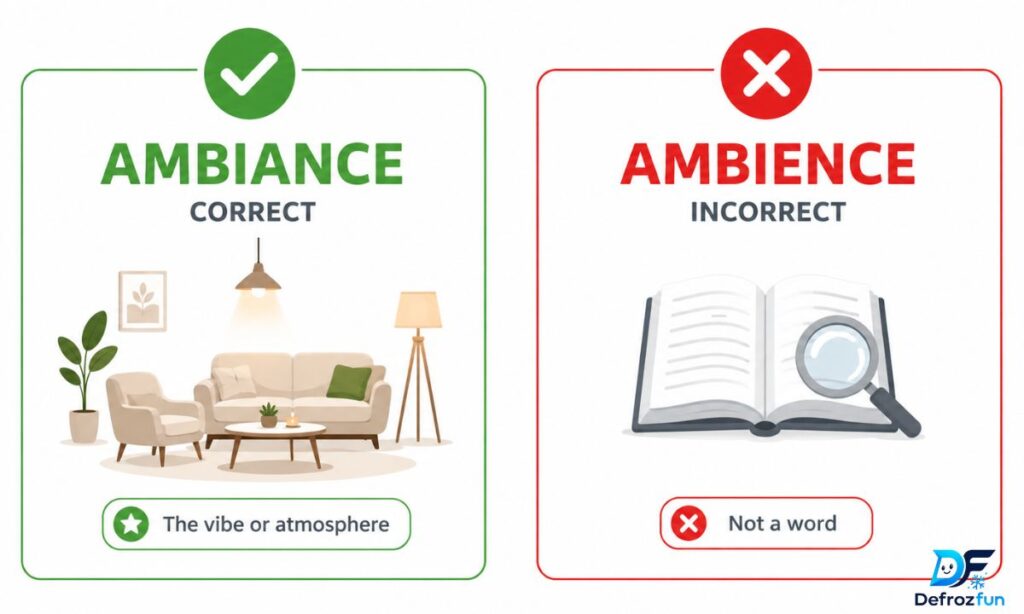
Both “ambience” and “ambiance” are correct spellings of the same word. They share the same meaning, the same pronunciation options, and are accepted by every major English dictionary including Merriam-Webster, Oxford, and Cambridge.
That said, ambience is more commonly used in everyday English — both in British and American writing. Ambiance leans closer to the original French spelling and tends to appear in contexts involving art, design, dining, or luxury.
Quick Rule: Use ambience for general writing. Use ambiance when a French-influenced or design-focused tone fits better.
The Origin of Ambience or Ambiance
Both words trace back to the Latin word ambiens, meaning “going around” or “surrounding.” The Latin root also gave us the familiar adjective ambient, as in ambient light or ambient sound.
Here’s how the word evolved:
- Latin: ambiens → “surrounding, going around”
- French: ambiance → “environment, atmosphere”
- English (18th century): ambience → Anglicized form entered English first
- English (20th century): ambiance → French spelling re-entered English as a stylish, vogue word
This timeline explains something important: ambience is actually the older English word. Ambiance came later, borrowed directly from French in the 1900s — often used to add a certain sophisticated flair. Because ambience was established in English first, it naturally became the dominant spelling.
British English vs. American English Spelling
You might assume British English prefers the French spelling (ambiance) and American English prefers the anglicized one (ambience). In fact, it’s the opposite.
| Variety of English | Preferred Spelling |
| British English | Ambience |
| American English | Ambience (slightly more flexible) |
| Australian English | Ambience |
| Canadian English | Ambience |
| French origin | Ambiance |
Most British publications — The Guardian, The Times, BBC — consistently use ambience. American publications use both, but ambience still dominates. The French spelling ambiance is used across all varieties when the writer wants to evoke elegance, French culture, or a design-forward tone.
One firm exception: When used in a technical context — such as audio recording, filmmaking, or lighting — the spelling is almost always ambience (e.g., ambient sound, ambience track).
Which Spelling Should You Use?
Here’s a practical guide based on context:
Use Ambience when:
- Writing in a neutral, modern English tone
- Covering technical topics (sound design, lighting, film production)
- Publishing for a general audience (blogs, news articles, academic work)
- You want to play it safe with editors and spell-checkers
Use Ambiance when:
- Writing about restaurants, interior design, hospitality, or luxury brands
- You want to convey sophistication or a French-influenced aesthetic
- The context is creative writing where the French flair fits the mood
Both choices are grammatically correct. The difference is stylistic, not grammatical.
Common Mistakes with Ambience or Ambiance
Even experienced writers slip up with this word. Here are the most common errors to avoid:
- ❌ “Ambients” — Not a valid plural. The word is already a noun; its plural form is rare and unusual in standard usage.
- ❌ Mixing spellings — Pick one spelling and stick with it throughout a piece of writing. Switching between the two in the same document looks inconsistent.
- ❌ Confusing with “ambient” — Ambient is the adjective form (ambient lighting, ambient music). It is never spelled ambience when used as an adjective.
- ❌ Over-French pronunciation — Pronouncing ambiance as “ahm-bee-AHNTS” to sound sophisticated can come across as affected in casual English conversation.
Also Read This: Labelling or Labeling – Which Spelling Is Correct?
Ambience or Ambiance in Everyday Examples
Seeing both words in real sentences makes the choice much clearer.
Using ambience:
- “The soft lighting and live jazz gave the restaurant a warm, welcoming ambience.”
- “Interior designers carefully consider the ambience of each room before choosing a color palette.”
- “The ambience of the old library — with its creaking floors and smell of aged paper — was irreplaceable.”
Using ambiance:
- “The French bistro had an authentic ambiance that transported you straight to Paris.”
- “The designer aimed for a minimalist ambiance in the hotel lobby.”
- “Candles and fresh flowers added to the romantic ambiance of the evening.”
Notice how ambiance appears more naturally in contexts tied to fine dining, design, and romance — while ambience fits broader, more neutral descriptions. Both are perfectly readable in either context.
Ambience or Ambiance – Google Trends & Usage Data
Real-world data backs up what grammar guides say:
- According to Google Ngram Viewer (which tracks word frequency across millions of books), ambience appears more than twice as often as ambiance in published English texts.
- In corpus linguistics data, ambience consistently outperforms ambiance in British, American, and Australian English corpora.
- On Google Search, “ambience” receives significantly more search queries globally than “ambiance,” suggesting it’s the spelling most people default to.
- Merriam-Webster lists ambience as the primary entry, with ambiance as an accepted variant.
- Oxford English Dictionary does the same — ambience first, ambiance as an alternative.
The data is clear: if you’re unsure which to use, ambience is the statistically safer choice.
Comparison Table: Ambience vs. Ambiance
| Feature | Ambience | Ambiance |
| Spelling | -ence ending | -ance ending |
| Origin | Anglicized Latin/French | Direct French borrowing |
| First used in English | 18th century | 20th century |
| More common spelling? | ✅ Yes | No |
| British English preference | ✅ Yes | Less common |
| American English | ✅ Preferred | Accepted |
| Used in technical contexts | ✅ Always | Rarely |
| Used in design/luxury contexts | Yes | ✅ More common |
| Dictionary primary entry | ✅ Yes (most dictionaries) | Secondary/variant |
| Both grammatically correct? | ✅ Yes | ✅ Yes |
Conclusion
The debate between ambience and ambiance comes down to style, not correctness — both are fully accepted in modern English. However, the practical takeaway is simple:
- Default to ambience for most writing — it’s more common, more neutral, and preferred in both British and American English.
- Choose ambiance when the French influence adds something to your tone — in restaurant reviews, design writing, or luxury branding.
Whatever spelling you pick, use it consistently. The real mistake isn’t choosing one over the other — it’s switching between them in the same piece of writing.
Now that you know the full story behind these two spellings, you can write with confidence. The ambience of your writing just got a little better.

Daniel Brooks is a passionate writer and digital content creator dedicated to sharing insightful, engaging, and informative articles across multiple niches. With a strong interest in technology, lifestyle, trending topics, and online media, Daniel Brooks focuses on delivering well-researched and reader-friendly content that inspires and informs audiences worldwide.