

If you have ever typed rosey and then second-guessed yourself, you are not alone. Many people wonder whether the correct spelling is rosy or rosey when describing pink cheeks, an optimistic mood, or a bright future. Because both versions look similar and sound identical when spoken, the confusion is completely understandable.
This guide gives you a clear, direct answer. You will learn the correct spelling, understand why the other version exists, and see practical examples so you never mix them up again.
Rosy or Rosey – Quick Answer
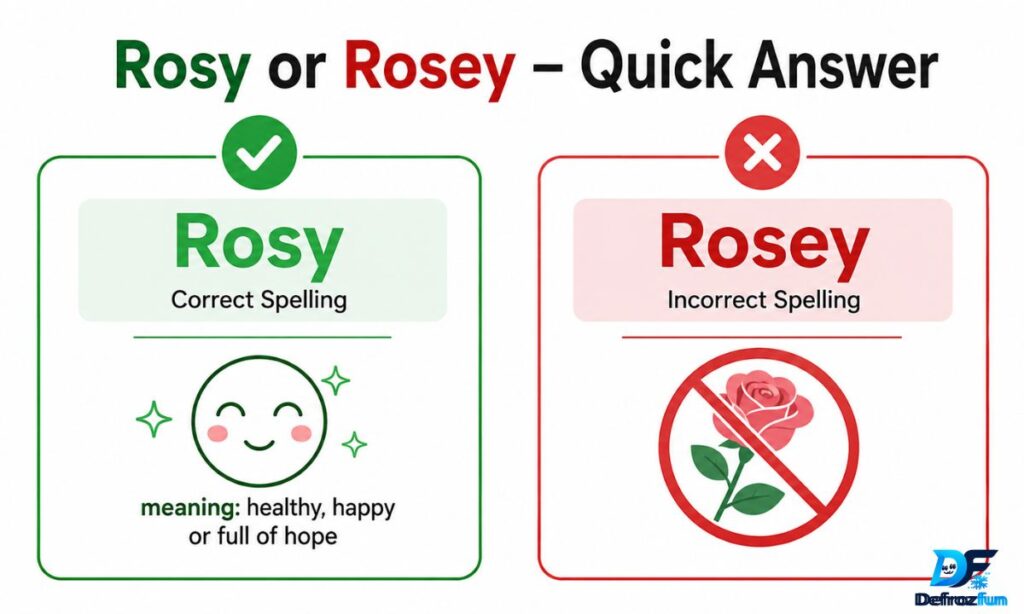
The correct spelling is rosy. It is the standard adjective in both American and British English used to describe something pink-colored, cheerful, or optimistic. Rosey is not a recognized word in standard dictionaries and is generally considered a misspelling — unless it appears as a proper name or nickname.
| Term | Correct? | When to Use |
| Rosy | Yes | Adjective — describing color, mood, or outlook |
| Rosey | No (as adjective) | Only acceptable as a personal name or nickname |
| Rosie | Yes (as a name) | Common girl’s name or informal nickname |
Rosey vs Rosy: Which Spelling Is Correct?
When used as an adjective, rosy is the only correct spelling. Major dictionaries including Merriam-Webster, Oxford, and Cambridge all list rosy — and none of them include rosey as a valid entry.
What Does Rosy Mean?
Rosy is an adjective with two main meanings:
- Pink or reddish in color, typically used to describe skin, cheeks, or a sky at sunrise
- Optimistic, hopeful, or promising — as in a rosy outlook or rosy future
Examples of correct usage:
- Her cheeks were rosy from the cold winter air.
- The company painted a rosy picture of its financial health.
- The sunset cast a rosy glow across the horizon.
The Origin of Rosey or Rosy
The word rosy traces its roots to Old French rosé and Latin roseus, both meaning resembling or colored like a rose. It entered Middle English in the 14th century and has been the standard adjective form ever since. By 1775, rosy had also taken on its figurative meaning of cheerful or optimistic.
The rose itself — from Latin rosa and Ancient Greek rhodon — has always carried associations with beauty, health, and positive emotion. The adjective rosy naturally inherited those connotations.
Rosey, on the other hand, has no independent historical basis. It appears to be a modern variant that arose because the base word rose already ends in an e, leading some writers to incorrectly carry that e into the adjective form.
British English vs American English Spelling
One common source of spelling confusion in English is regional variation. However, rosy vs rosey is not one of those cases. Both American English and British English use rosy as the standard spelling. There is no regional split here.
| Region | Correct Spelling | Notes |
| American English | Rosy | Standard adjective form |
| British English | Rosy | Standard adjective form |
| Australian English | Rosy | Standard adjective form |
| All informal writing | Rosy | Rosey = non-standard variant |
This consistency makes it easy: no matter where you are writing, rosy is always the right choice for the adjective.
Which Spelling Should You Use?
Always use rosy when you mean the adjective. Use rosey only when referring to a person’s name or nickname, such as Rosey Brown or Rosey the character. Here is a simple rule to remember:
- Use rosy for describing color, mood, or outlook.
- Use Rosey only as a proper noun (a personal name).
- If you are writing professionally, academically, or for a blog, always choose rosy.
Also Read This: Proove or Prove: What Is the Correct Spelling?
Rosey vs Rosie: What’s the Difference?
People also confuse rosey with rosie, so it is worth clarifying both at once.
| Word | Type | Meaning / Use |
| Rosy | Adjective | Pink, hopeful, or cheerful in appearance or outlook |
| Rosey | Non-standard / Name | Misspelling of rosy OR an informal proper name |
| Rosie | Proper name | A common girl’s first name (e.g., Rosie O’Donnell) |
Rosie is a well-established given name with its own spelling history. It is not the same word as rosy. If you are writing about the adjective, use rosy. If you are writing about a person named Rosie, use that specific spelling.
Common Mistakes with Rosey or Rosy
Here are the most common errors writers make and how to fix them:
Mistake 1: Writing Rosey as an Adjective
Wrong: The sky had a rosey glow at dawn.
Right: The sky had a rosy glow at dawn.
Mistake 2: Confusing the Name Rosie with the Adjective
Wrong: Her face looked rosie after the run.
Right: Her face looked rosy after the run.
Mistake 3: Thinking British English Uses Rosey
This is a myth. Both British and American English use rosy. There is no regional exception.
Rosey or Rosy Cheeks: Which One Is Correct?
This is one of the most searched phrases around this topic, and the answer is simple: rosy cheeks is correct. Rosey cheeks is a misspelling.
Rosy cheeks describes a pinkish, healthy flush on a person’s face, often from cold weather, exercise, or good health. It is a well-established phrase in English writing and literature.
- Correct: The baby had rosy cheeks and bright eyes.
- Correct: Her rosy cheeks glowed in the cold morning air.
- Incorrect: His rosey cheeks turned even redder with embarrassment.
Rosey or Rosy in Everyday Examples

Seeing the word used correctly in context is one of the best ways to lock in the right spelling. Here are natural, everyday examples:
Describing Appearance
- She came in from the snow with rosy cheeks and cold fingers.
- The newborn had a rosy complexion that made everyone smile.
Describing Outlook or Mood
- The investor painted a rosy picture of the startup’s future.
- Despite the setbacks, she remained rosy about the team’s chances.
- Things are looking rosy for the economy this quarter.
Describing Color or Light
- A rosy tint spread across the evening sky.
- The room was filled with a soft, rosy glow from the lamp.
Rosey or Rosy – Google Trends & Usage Data
When you look at search and usage data, rosy dominates overwhelmingly as the standard form. Google Trends consistently shows rosy cheeks, rosy outlook, and rosy future as high-volume search terms. The phrase rosey cheeks does appear in searches, but primarily from people looking to confirm which spelling is correct — which tells you something about why it circulates.
In published books, academic texts, and news media, rosy is used almost exclusively. Rosey appears rarely and almost always in the context of a proper name.
| Phrase | Standard Usage | Search Intent |
| Rosy cheeks | Very High | Descriptive phrase, widely used |
| Rosy outlook | High | Business, news, commentary |
| Rosey cheeks | Low | Mostly spelling-check queries |
| Is rosey a word? | Moderate | Grammar / spelling verification |
Is Rosey a Word?
Technically, rosey does not appear in any major English dictionary as a standard adjective. Merriam-Webster, Oxford, and Cambridge all list rosy — not rosey. So in formal writing, the answer is no: rosey is not a word.
However, rosey does exist in limited contexts:
- As a nickname for people named Rose, Rosa, or Rosemary
- As an informal personal name (e.g., Rosey Grier, former NFL player)
- In very casual or creative writing where non-standard spellings are intentional
Outside of these specific uses, rosey is simply a spelling error.
Conclusion
The answer to rosy or rosey is clear: rosy is the correct spelling every time you use it as an adjective. Whether you are describing a person’s complexion, an optimistic forecast, or a colorful sky, rosy is the word you want.
Rosey is not a standard English word. It only belongs in writing as a proper name or nickname. Keeping this distinction in mind will make your writing cleaner, more professional, and more credible.
The next time you reach for this word, remember: if it describes color, mood, or outlook — it’s rosy. No e.
Frequently Asked Questions
Is it rosy or rosey?
Rosy is correct. Rosey is a misspelling when used as an adjective and is only acceptable as a personal name.
What does rosy mean?
Rosy means pinkish in color or optimistic and hopeful in tone. Example: a rosy complexion or a rosy future.
Is rosey a real word?
No. Rosey does not appear in standard dictionaries as an adjective. It exists only as a proper name or informal nickname.
Rosy cheeks or rosey cheeks — which is right?
Rosy cheeks is correct. Rosey cheeks is a common misspelling.
Do British English and American English spell it differently?
No. Both use rosy. There is no regional variation for this word.
What is the difference between Rosie and rosy?
Rosie is a proper name (a person’s name). Rosy is an adjective describing color or optimism. They are completely different words.

Daniel Brooks is a passionate writer and digital content creator dedicated to sharing insightful, engaging, and informative articles across multiple niches. With a strong interest in technology, lifestyle, trending topics, and online media, Daniel Brooks focuses on delivering well-researched and reader-friendly content that inspires and informs audiences worldwide.