

Have you ever paused mid-sentence, unsure whether to write feet or foot? You’re not alone. This is one of the most common grammar confusions in the English language — and it trips up native speakers just as often as learners. Whether you’re writing a school assignment, a work email, or a social media post, using the wrong form can make your writing look careless.
The good news? The rule is actually quite simple once you understand it. This guide breaks down everything you need to know about feet vs. foot — from grammar rules and real-world examples to common mistakes, British vs. American usage, and much more.
Feet or Foot – Quick Answer
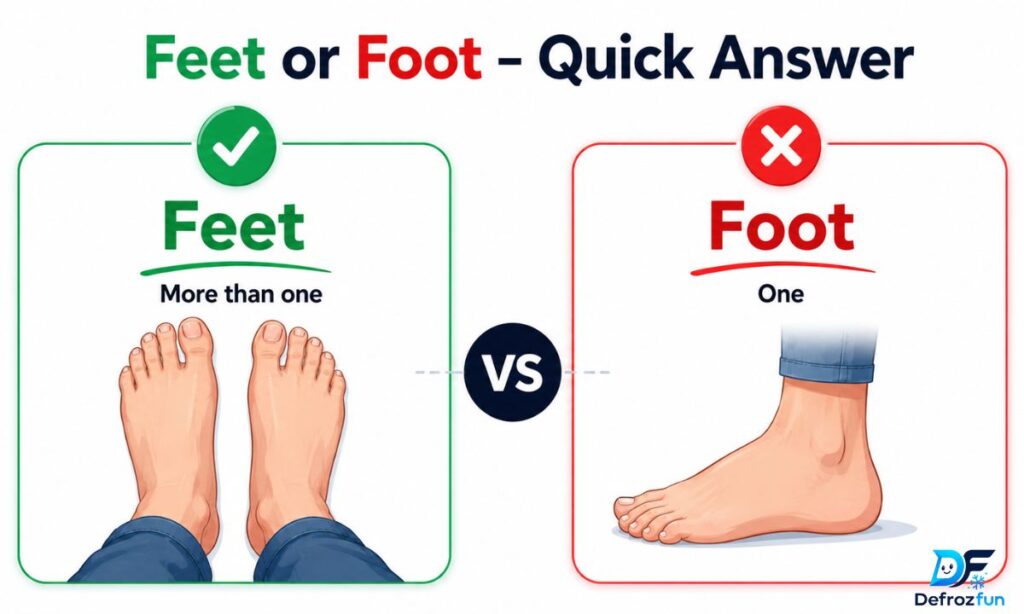
Here’s the short version:
- Foot = singular (one unit, one body part)
- Feet = plural (two or more units or body parts)
“I hurt my foot.” ✅ “My feet are sore after the hike.” ✅
But there’s a twist. When foot is used as a modifier before a noun, the singular form is used — even if the number is greater than one. For example: a ten-foot ladder, not a ten-feet ladder.
That one exception causes most of the confusion. Let’s dig deeper.
The Origin of Feet or Foot
The word foot has ancient roots. It comes from Old English fōt, which traces back to the Proto-Germanic fōts and even further to the Proto-Indo-European root ped-, meaning “foot.” Related words appear in Latin (pes), Greek (pous), and Sanskrit (pad).
So why is the plural feet instead of foots? The answer lies in a linguistic process called i-mutation (also called umlaut). In early Germanic languages, the plural of fōt was fōtiz. Over centuries, the vowel in the suffix changed the root vowel — ō gradually shifted toward ē — and the suffix itself eventually disappeared. What remained was fēt, which evolved into modern English feet.
This same vowel-shifting process explains other irregular plurals like:
- goose → geese
- tooth → teeth
- man → men
- mouse → mice
These are called irregular plurals — they don’t follow the standard add an -s rule that governs most English nouns. Feet is simply one of the most widely used examples.
British English vs. American English Spelling
Both British and American English use foot and feet the same way grammatically. There is no spelling difference between the two. However, there is a subtle usage difference that’s worth knowing.
In American English
Americans are fairly strict about the plural rule. If a measurement follows a noun or stands alone, they use feet:
- The ceiling is nine feet high.
- She ran six feet before stopping.
In British English
British speakers tend to be more flexible. In casual conversation, foot is often used as a plural for measurements — even where American English would require feet:
- “He’s about six foot tall.” (common in the UK)
- “The table is four foot wide.” (informal British usage)
This colloquial British practice reflects an older grammatical pattern — specifically, the Old English genitive plural, where foot was used after a numeral. This usage is still considered informal in most style guides, but it is widely accepted in British speech.
Which Spelling Should You Use?
Follow these three clear rules:
Rule 1: Use “foot” for singular
When referring to exactly one unit or one body part, always use foot.
- She stepped on a nail with her left foot.
- The shelf is one foot wide.
Rule 2: Use “feet” for plural
When referring to two or more units or body parts, use feet.
- The pool is twelve feet deep.
- Both his feet were cold.
Rule 3: Use “foot” as a modifier (compound adjective)
When the measurement comes before a noun and functions as an adjective, always use the singular foot — and add a hyphen.
- a six-foot fence ✅ (not six-feet fence)
- a ten-foot pole ✅ (not ten-feet pole)
- a twenty-foot crocodile ✅
Think of it like other compound adjectives: a four-door car, a two-hour movie. The unit stays singular when it modifies a noun.
Also Read This: Cosy or Cozy – Which Spelling Is Correct?
Common Mistakes with Feet or Foot
Even experienced writers make these errors. Here are the most frequent ones to watch out for:
❌ Using “feets” — Never correct
Feets is not a real word in standard English. The plural of foot is always feet, never feets.
- ❌ My feets are tired.
- ✅ My feet are tired.
❌ Using “feet” before a noun
- ❌ We need a ten-feet ladder.
- ✅ We need a ten-foot ladder.
❌ Using “foot” after a noun (standalone measurement)
- ❌ The room is fifteen foot long.
- ✅ The room is fifteen feet long. (formal written English)
- ✓ The room is fifteen foot long. (acceptable informally in British English)
❌ Confusing height expressions
When describing a person’s height informally with feet and inches, foot is commonly used:
- She is five foot two. ✅ (informal, very common)
- She is five feet two inches tall. ✅ (formal)
Both are acceptable depending on context.
Feet or Foot in Everyday Examples
Seeing these words in context makes the rules much easier to remember. Here are natural examples across different situations:
Body part usage:
- The doctor examined his injured foot.
- Her feet ached after standing all day.
Measurement — standalone:
- The table is four feet long.
- They dug a hole six feet deep.
Measurement — as a modifier:
- He jumped over a five-foot wall.
- They built a twelve-foot fence around the yard.
Describing height:
- He is six feet tall. (formal)
- She’s about five foot four. (informal, everyday speech)
Figurative or idiomatic use:
- We’ll cross that bridge when we come to it — on foot.
- The terms were set on an equal footing. (note: footing, not feeting)
- She put her best foot forward.
Notice how idioms almost always use foot — because idioms are fixed expressions that don’t change with grammar rules.
Feet or Foot – Google Trends & Usage Data
Search data consistently shows that people search for “feet” more often than “foot” in contexts related to measurement and body parts, simply because most real-world scenarios involve more than one. Here are some interesting patterns:
- Searches for “how many feet in a mile” and “square feet” dominate real estate and conversion queries.
- Searches for “six foot two” and “five foot ten” reflect how common the informal singular form is in everyday height descriptions.
- Searches for “foot pain” outperform “feet pain” — correctly so, since most people describe pain in one specific foot at a time.
These patterns confirm that both forms are in active, frequent use — and that context determines which one is correct.
Comparison Table: Feet vs. Foot
| Scenario | Correct Form | Example |
| One body part | foot | She hurt her left foot. |
| Two body parts | feet | My feet are cold. |
| One unit of measurement | foot | The shelf is one foot wide. |
| Two or more units (standalone) | feet | The fence is six feet high. |
| Measurement before a noun | foot (with hyphen) | a ten-foot pole |
| Informal height description | foot or feet | He’s six foot / six feet tall. |
| Never use | feets | ❌ My feets hurt. |
Conclusion
The difference between feet and foot comes down to one simple idea: singular vs. plural — with one important exception for compound adjectives. Use foot when you’re talking about one, use feet when you’re talking about more than one, and always use foot when the measurement comes before a noun (like a six-foot fence).
The word feets should never appear in your writing — it’s nonstandard in every variety of English. And while British English does allow foot as an informal plural in speech, formal writing in both British and American English follows the same standard rules.
Now that you have the full picture, you can write with confidence. Whether you’re drafting a real estate listing, describing someone’s height, or simply talking about sore feet after a long day, you’ll know exactly which word to reach for.

Daniel Brooks is a passionate writer and digital content creator dedicated to sharing insightful, engaging, and informative articles across multiple niches. With a strong interest in technology, lifestyle, trending topics, and online media, Daniel Brooks focuses on delivering well-researched and reader-friendly content that inspires and informs audiences worldwide.