

If you’ve ever typed this word and second-guessed yourself, you’re not alone. Writers, students, marketers, and content creators search this question every day. The short answer: both spellings are correct. The one you should use depends entirely on your audience and which variety of English you’re writing in.
This guide breaks it all down clearly — no fluff, just the facts you need.
Labelling or Labeling – Quick Answer
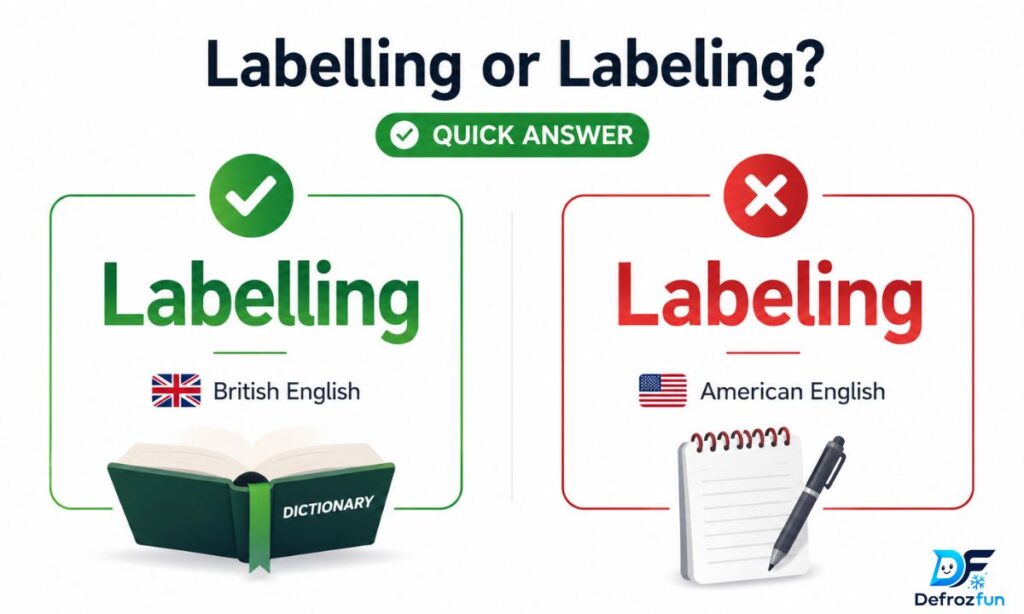
| Spelling | Correct In |
| Labeling (one L) | American English (US) |
| Labelling (double L) | British English (UK, Canada, Australia) |
Both words mean exactly the same thing: the act of attaching or applying a label to something. The only difference is spelling — and that difference comes down to regional rules.
Quick Rule: If you write “color,” “organize,” and “traveling” — use labeling. If you write “colour,” “organise,” and “travelling” — use labelling.
The Origin of Labelling / Labeling
The word traces back to the Old French word label or lambel, meaning a ribbon, strip, or tag. It entered Middle English in the medieval period and eventually became both a noun (a label on a bottle) and a verb (to label something).
When writers began adding the suffix -ing to form the present participle, two regional conventions diverged — and that is where “labelling” and “labeling” were born. Both forms evolved naturally within their respective dialects and are equally correct today.
British English vs American English Spelling
The spelling difference isn’t random — it follows a clear grammatical rule applied differently on each side of the Atlantic.
The British English Rule (Double L)
In British English, when a verb ends in a single vowel + consonant “L”, you double the final L before adding a vowel suffix like -ing or -ed, regardless of where the stress falls in the word.
- travel → travelling
- cancel → cancelled
- model → modelling
- label → labelling ✓
The American English Rule (Single L)
In American English, you only double the final consonant when the last syllable is stressed. Since “LA-bel” has its stress on the first syllable, the L is not doubled.
- travel → traveling
- cancel → canceled
- model → modeling
- label → labeling ✓
Who Follows Which Rule?
| Region | Preferred Spelling |
| United States | Labeling |
| United Kingdom | Labelling |
| Canada | Labelling |
| Australia | Labelling |
| New Zealand | Labelling |
| India | Labelling |
| Global / Mixed Audience | Pick one, stay consistent |
This pattern was largely shaped in the early 19th century by American lexicographer Noah Webster, who deliberately simplified many English spellings to make them shorter and more phonetic. His 1828 dictionary standardized forms like “labeling,” “traveling,” and “canceled” for American readers.
Which Spelling Should You Use?
The answer depends on three things: your audience, your platform, and your consistency.
Use “labeling” (one L) if you are:
- Writing for a US audience
- Publishing on American websites or publications
- Following AP Style or Chicago Manual of Style (US editions)
- Working in fields like FDA food labeling compliance or US product standards
Use “labelling” (double L) if you are:
- Writing for a UK, Canadian, Australian, or Commonwealth audience
- Following Oxford Style or UK academic standards
- Working with EU product labelling regulations
- Writing for British English-based exams (IELTS, Cambridge, etc.)
For global content: Choose one spelling and use it consistently throughout the entire document. Mixing both in the same piece looks careless and unprofessional.
Common Mistakes with Labelling / Labeling
Even experienced writers slip up here. Watch out for these errors:
- Mixing both spellings in the same document
- ❌ She is labeling the folders, and the labelling is complete.
- ✅ She is labeling the folders, and the labeling is complete. (American)
- ✅ She is labelling the folders, and the labelling is complete. (British)
- Dropping both L’s entirely
- ❌ labling — This is never correct in any dialect.
- Using British spelling in American-style content
- ❌ The FDA requires labelling on all food products. (US context)
- ✅ The FDA requires labeling on all food products.
- Using American spelling in British-style content
- ❌ The UK government updated its product labeling guidelines. (UK context)
- ✅ The UK government updated its product labelling guidelines.
- Overthinking it — Both are real words. Neither is wrong on its own. Just match your style to your audience.
Labelling / Labeling in Everyday Examples
Here are real-world sentence examples showing both spellings in context:
American English (Labeling):
- Food labeling regulations require manufacturers to list all allergens.
- The teacher spent the afternoon labeling folders for each student.
- Proper data labeling is essential for training accurate AI models.
- He is labeling boxes before the warehouse shipment.
British English (Labelling):
- The EU introduced new product labelling standards this year.
- She was labelling parcels when the courier arrived.
- Nutritional labelling on food packaging helps consumers make better choices.
- The librarian finished labelling the new arrivals.
Both sets of sentences are grammatically correct. The action described is identical — only the regional spelling differs.
Labelling or Labeling – Google Trends & Usage Data
Google Trends data consistently reflects the regional split between both spellings:
- “Labeling” dominates search volume in the United States, Canada (partially), and global English tech content.
- “Labelling” is more commonly searched in the United Kingdom, Australia, and other Commonwealth nations.
In terms of overall global internet traffic, “labeling” (American spelling) tends to appear more frequently because the US has a large share of English-language web content. However, this does not make it more “correct” — it simply reflects internet usage patterns.
Google understands both spellings and will rank pages for both variants, especially when the content is relevant and high-quality. For SEO, it’s generally best to match the spelling your primary target audience uses when searching.
Keyword Comparison Table
| Feature | Labeling | Labelling |
| Spelling | Single L | Double L |
| English Variant | American English | British English |
| Regions | USA | UK, Canada, Australia, NZ, India |
| Pronunciation | LAY-buh-ling | LAY-buh-ling |
| Meaning | Identical | Identical |
| Part of Speech | Verb / Gerund | Verb / Gerund |
| Related Words | labeled, labels | labelled, labels |
| Style Guides | AP Style, Chicago (US) | Oxford, Cambridge |
| Common Context | FDA regulations, US product standards | EU regulations, UK compliance |
Conclusion
The answer to “labelling or labeling” is simple: both are correct, and neither is a mistake. The choice comes down to your audience.
- Writing for readers in the US? Use labeling.
- Writing for readers in the UK, Canada, Australia, or other Commonwealth countries? Use labelling.
- Writing for a global mixed audience? Pick one spelling and stay consistent throughout.
The most important takeaway is consistency. Mixing both spellings in the same piece of writing looks unprofessional, regardless of how good your content is. Once you know your audience, the right spelling is obvious — and you’ll never second-guess this word again.

Daniel Brooks is a passionate writer and digital content creator dedicated to sharing insightful, engaging, and informative articles across multiple niches. With a strong interest in technology, lifestyle, trending topics, and online media, Daniel Brooks focuses on delivering well-researched and reader-friendly content that inspires and informs audiences worldwide.