

If you’ve ever stopped mid-sentence wondering whether to write proove or prove, you’re not alone. It’s one of the most searched spelling questions in the English language — and the answer is simpler than you think. This guide gives you everything you need: the correct spelling, the reason people get confused, the word’s history, and how to use it properly in everyday writing.
Proove or Prove – Quick Answer
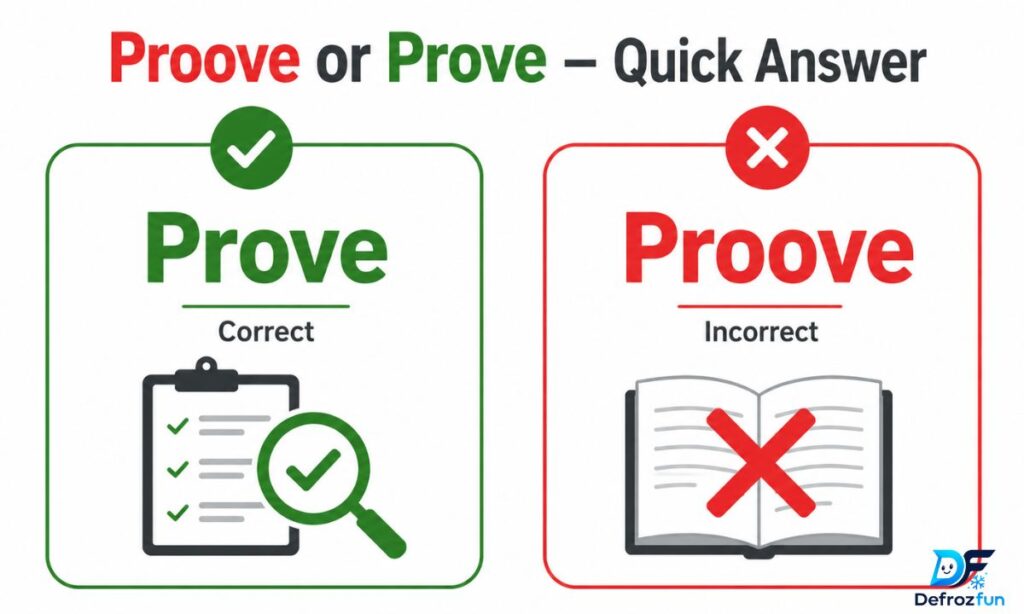
The correct spelling is prove. “Proove” is not a real word in modern English. It does not appear in any major dictionary — not Merriam-Webster, not Oxford, not Cambridge. No matter the context, the audience, or the style of writing, prove is always the right choice.
Quick rule: If you’re tempted to write “proove,” think of the word love. You wouldn’t write loove, right? The same logic applies here.
The Origin of Prove
Understanding where a word comes from often helps you remember how to spell it.
The word prove has a rich linguistic history that stretches back over 800 years:
- Latin root: The word originates from the Latin probāre, meaning “to test, examine, or show something is good.” This is also the root of related English words like probe, probation, and probity.
- Old French: Latin probāre evolved into Old French prover (also spelled pruver), meaning “to show” or “to put to the test.”
- Middle English: Around the 13th century, Middle English adopted the word as proven or pruven, which eventually settled into the modern form prove.
Notice that at no point in its history did the word take on a double “o.” The spelling proove simply never existed in the word’s standard evolution.
Both prove and proof share the same Latin root word — probare — which was later adapted into Old French as preove. In Old English, proof as a noun was used more commonly, which is why it was adapted more fully into English spelling, while prove stayed closer to its French predecessor.
In fact, proove is an obsolete spelling of prove, dated back to the 16th–18th century. Today, it is considered a common misspelling.
Why Do People Write “Proove”?
This is a fair question. English pronunciation doesn’t always match spelling, and that’s where the confusion starts.
When you say prove out loud, it sounds like it has a long “oo” vowel — the same sound you hear in food, groove, smooth, and choose. Many of those words use a double “o” to represent that sound, so the brain naturally assumes prove should too.
Here are the main reasons people misspell it:
- Sound-to-spelling confusion: The word sounds like it ends in “oove,” similar to groove or move.
- Influence of the noun proof: Writers see proof with its long vowel and assume prove must follow a similar pattern.
- Muscle memory and autocorrect: Some users have typed it wrong so many times that it feels natural.
- Non-native speaker reasoning: Learners who use spelling analogies may default to the double “o” pattern.
The good news? Once you know the rule, you won’t forget it.
British English vs. American English Spelling
Some spelling differences — like colour vs. color or analyse vs. analyze — vary between British and American English. Prove is not one of them.
There is no difference between British and American English for this word. You should always use prove, no matter your audience.
Both style guides and dictionaries on both sides of the Atlantic agree: prove is the only correct spelling. This makes it one of the easier spelling rules to follow — no regional exceptions to memorize.
Which Spelling Should You Use?
Always use prove. Here’s a simple breakdown:
| Situation | Correct Spelling |
| Academic writing | prove |
| Legal documents | prove |
| Everyday conversation | prove |
| British English | prove |
| American English | prove |
| Formal business writing | prove |
| Social media / casual writing | prove |
There is no situation where proove is appropriate. It will be flagged as a spelling error by every major word processor, style checker, and grammar tool.
Common Mistakes with Prove
Even experienced writers sometimes trip up with prove and its related forms. Here are the most common errors to avoid:
1. Confusing prove (verb) with proof (noun)
These two words are related but they function differently in a sentence.
- Prove is a verb — it describes an action.
- Proof is a noun (or adjective in compound words) — it refers to the evidence itself.
Incorrect: “I need to proof my theory.” Correct: “I need to prove my theory.” / “I need proof for my theory.”
2. Using the wrong past tense
The past tense of prove can be either proved or proven, and both are accepted — but they’re used slightly differently.
- Proved is more common in British English as the simple past tense: “She proved her point.”
- Proven is typically used as an adjective or in American English: “a proven method” / “He has proven himself reliable.”
The verb prove has forms: prove → proving → proved/proven. Proof is a noun (or adjective in compounds), not a verb form of prove.
3. Writing “proove” by habit
If you’ve been writing proove for years, make a conscious effort to correct it. A simple trick: when in doubt, say the word love in your head. Love → prove. One “o,” never two.
Also Read This: Vulkan or DX12 – Which Is Better? (2026)
Prove in Everyday Examples

Seeing a word used in real sentences is one of the best ways to lock in the correct spelling and meaning. Here’s how prove appears across different contexts:
In academic writing:
- “The researcher designed the experiment to prove the hypothesis.”
- “Students must prove their arguments with credible evidence.”
In legal contexts:
- “The prosecution must prove guilt beyond a reasonable doubt.”
- “He hired a lawyer to prove his innocence in court.”
In everyday speech:
- “She wanted to prove she could handle the job on her own.”
- “He worked hard to prove his critics wrong.”
In science:
- “Centuries of observation helped prove that the Earth orbits the Sun.”
- “No study has yet proven that link conclusively.”
With the adjective form:
- “This is a proven technique for managing stress.”
- “The team relied on proven methods to get the project done.”
Prove – Google Trends & Usage Data
Search data and language corpus research consistently show that prove dominates in everyday English usage, while proove only appears as a misspelling in search queries — meaning people are searching to find out if it’s correct (it isn’t).
Key usage facts:
- Prove appears in Merriam-Webster’s most-used verbs list.
- Google’s English corpus data shows proove has near-zero usage in published text.
- Proove appears almost exclusively in online comments, informal messages, and search queries — never in edited, published writing.
- Grammar-checking tools (Grammarly, Microsoft Editor, Hemingway) universally flag proove as incorrect.
This confirms what the dictionaries say: proove is a spelling error, not a regional or informal variant.
Comparison Table: Prove vs. Proove
| Feature | Prove | Proove |
| Correct spelling | ✅ Yes | ❌ No |
| Found in dictionaries | ✅ Yes | ❌ No |
| Accepted in formal writing | ✅ Yes | ❌ No |
| Accepted in British English | ✅ Yes | ❌ No |
| Accepted in American English | ✅ Yes | ❌ No |
| Historical use | Used since 13th century | Obsolete (16th–18th century) |
| Grammar tool result | Passes | Flagged as error |
| Part of speech | Verb | N/A (misspelling) |
| Related noun form | Proof | N/A |
Conclusion
The answer is clear: prove is always correct, and proove is always wrong. There are no exceptions, no regional differences, and no informal contexts where the double “o” version becomes acceptable.
The confusion makes sense — the word sounds like it could have two o’s, and words like groove and smooth reinforce that instinct. But English spelling doesn’t always follow sound patterns, and prove is a perfect example of that.
A quick memory trick to take with you: prove rhymes with love, and neither one doubles the vowel. One “o” is all you need to make your point — and to prove it.

Daniel Brooks is a passionate writer and digital content creator dedicated to sharing insightful, engaging, and informative articles across multiple niches. With a strong interest in technology, lifestyle, trending topics, and online media, Daniel Brooks focuses on delivering well-researched and reader-friendly content that inspires and informs audiences worldwide.