

If you have ever stopped mid-sentence wondering whether to write organised or organized, you are not alone. This is one of the most searched spelling questions in the English language — and the answer is simpler than most people think. Both spellings are correct. The one you use depends entirely on which variety of English you are writing in.
This guide breaks down the difference, the history behind it, and the most common mistakes writers make — so you never second-guess yourself again.
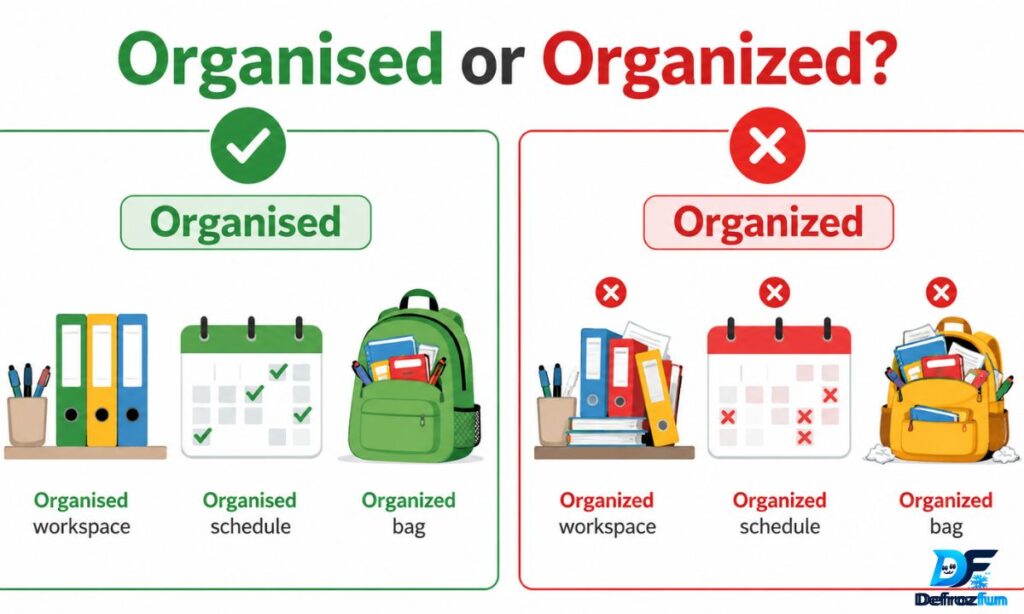
Organised or Organized – Quick Answer
| Spelling | Variant | Used In |
| Organized | American English | USA, Canada |
| Organised | British English | UK, Australia, New Zealand, India |
In one line: Organized = American English. Organised = British English. Same meaning, different spelling based on region.
The Origin of Organised / Organized
The word traces back to the Greek word organon, meaning “tool” or “instrument,” and the Latin organizare, meaning “to form into a system.” It entered English through French influence in the 15th and 16th centuries.
At that point, both organize and organise existed side by side.
The split between the two spellings happened largely because of Noah Webster, the American lexicographer behind the first major American dictionary (1828). Webster intentionally standardized American English spellings to distinguish them from British ones — changing colour to color, centre to center, and pushing -ise endings toward -ize.
His reforms stuck in the US and Canada. The rest of the English-speaking world largely kept the older -ise spelling — though even today, Oxford style guides often accept -ize endings in British English as well.
British English vs American English Spelling
The organised / organized split is part of a much broader pattern. British English tends to use -ise, while American English standardized -ize across hundreds of words.
| Word (American) | Word (British) |
| Organized | Organised |
| Recognize | Recognise |
| Customize | Customise |
| Realize | Realise |
| Prioritize | Prioritise |
| Summarize | Summarise |
This pattern applies across all forms of the verb:
- American: organize / organizing / organized / organization
- British: organise / organising / organised / organisation
The meaning never changes — only the spelling.
Oxford Exception: The Oxford English Dictionary and many academic UK publishers actually accept -ize spellings. So organized is not “wrong” in the UK — it just is not the most common choice in everyday British writing.
Which Spelling Should You Use?
The answer depends on your audience and context, not personal preference.
Use organized if you are:
- Writing for a US or Canadian audience
- Publishing on American platforms or media
- Following APA or Chicago style (both use American English)
Use organised if you are:
- Writing for a UK, Australian, or Commonwealth audience
- Taking UK exams (IELTS, GCSE, A-Level)
- Working for a British company or publication
The golden rule: pick one and be consistent. Mixing organised in one paragraph and organized in the next looks careless and undermines your credibility — especially in professional or academic writing.
Common Mistakes with Organised / Organized
Here are the errors writers make most often with this word:
- Mixing spellings in the same document — the most common mistake. If you start with organized, use it throughout.
- Assuming one is “wrong” — both are correct. Neither spelling is a typo or an error.
- Applying the wrong variant to the wrong audience — submitting a UK school essay using organized (American spelling) can affect your marks.
- Forgetting the spelling rule extends to all forms — if you use organised, also write organising, organisation, and organiser. Do not mix forms.
- Relying on spellcheck without checking regional settings — Microsoft Word and Google Docs use your document’s language settings. If your document is set to English (US), it will flag organised as an error — even though it is correct in British English.
Organised or Organized in Everyday Examples
Seeing both spellings in real sentences makes the difference easy to remember.
American English (organized):
- She organized her desk before the presentation.
- The manager organized a training session for new staff.
- He is a very organized person who never misses a deadline.
British English (organised):
- She organised her desk before the presentation.
- The manager organised a training session for new staff.
- He is a very organised person who never misses a deadline.
In formal writing:
- American: The company has an organized system for tracking client data.
- British: The company has an organised system for tracking client data.
The sentences are identical in meaning. Only the regional spelling changes.
Organised or Organized – Google Trends & Usage Data
Search data and corpus analysis consistently show that:
- “Organized” dominates searches and published text in the United States and Canada.
- “Organised” is the preferred form in the United Kingdom, Australia, and New Zealand.
- Globally, organized appears more frequently in online content — largely because of the volume of American English content on the internet.
Corpus data from large English-language databases (like the Google Books Ngram Viewer) shows that organized has outpaced organised globally since the early 20th century, driven by the dominance of American publishing. However, in purely British English corpora, organised remains standard.
For SEO writers and bloggers: If your target audience is global or American, organized is the safer choice for discoverability and consistency.
Comparison Table – Keyword Variations
| Keyword / Form | American English | British English |
| Base verb | organize | organise |
| Past tense / adjective | organized | organised |
| Present participle | organizing | organising |
| Noun | organization | organisation |
| Person (noun) | organizer | organiser |
| Verb (third person) | organizes | organises |
All of the above pairs are interchangeable in meaning. The entire word family follows the same -ize / -ise split.
Conclusion
The organised vs organized debate comes down to one simple fact: both are correct, but they belong to different regional spelling systems. Organized is American English. Organised is British English. The meaning is identical.
The real mistake is not choosing the “wrong” one — it is being inconsistent. Whatever spelling you choose, stick to it across every word form: organizing/organising, organization/organisation, organizer/organiser.
Know your audience, check your document language settings, and you will never second-guess this word again.

Daniel Brooks is a passionate writer and digital content creator dedicated to sharing insightful, engaging, and informative articles across multiple niches. With a strong interest in technology, lifestyle, trending topics, and online media, Daniel Brooks focuses on delivering well-researched and reader-friendly content that inspires and informs audiences worldwide.