

You’ve typed it both ways — fulfilment and fulfillment — and wondered which one is actually right. The short answer: both are correct. The longer answer depends on where you are in the world and who your audience is. This guide breaks down the meaning, grammar rules, regional differences, and real-world usage so you never second-guess yourself again.
Fulfilment or Fulfillment – Quick Answer
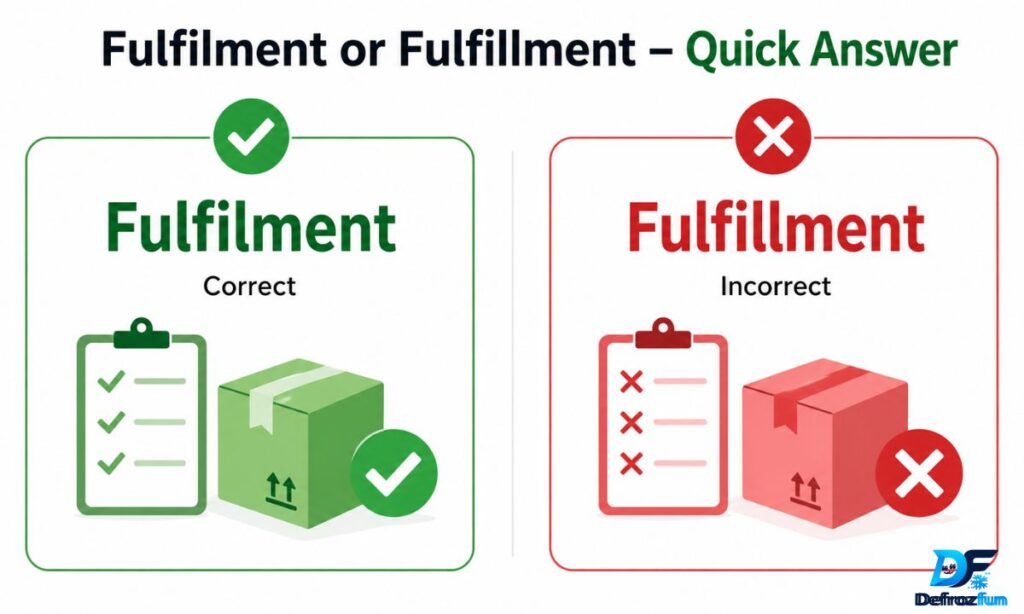
Fulfilment is the British English spelling. Fulfillment is the American English spelling. Both words carry the exact same meaning — there is zero difference in definition, only in spelling convention.
| Spelling | Variety | Used In |
| Fulfillment | American English | USA, Canada (often) |
| Fulfilment | British English | UK, Australia, New Zealand, India, South Africa |
Featured Snippet Answer: Fulfilment and fulfillment are two spellings of the same word. Use fulfillment in American English and fulfilment in British English. The meaning — a sense of satisfaction, or the act of completing something — is identical in both.
The Origin of Fulfilment/Fulfillment
The word traces back to Old English fullfyllan, which literally meant “to fill full” or “to fill up completely.” It was built from two parts: full (meaning complete) and fyllan (meaning to fill), which shares its root with the modern word fill.
By the 13th century, fullfyllan had expanded in meaning. It was used to describe carrying out prophecies, completing duties, and satisfying expectations — a sense still central to the word today. By around 1300, it also took on the emotional meaning of satisfaction and contentment.
The noun form — fulfilment/fulfillment — came later, formed by adding the Latin-derived suffix -ment to the verb fulfil/fulfill. This suffix, borrowed into English via Old French, turns verbs into nouns of action or state.
The word’s meaning has stayed remarkably stable for over 700 years. Whether you say “the fulfilment of a prophecy” or “personal fulfillment,” the core idea of completion and satisfaction remains unchanged.
British English vs American English Spelling
This is the heart of the confusion. English spelling diverged between Britain and America largely in the 18th and 19th centuries, influenced heavily by American lexicographer Noah Webster, who simplified many spellings in his 1828 dictionary.
Why the Double “L” Difference?
The verb form of the word is fulfil (British) and fulfill (American). British English keeps a single “l” in the base verb, while American English doubles it. When the suffix -ment is added:
- British: fulfil + ment = fulfilment (one “l”)
- American: fulfill + ment = fulfillment (two “l”s)
This pattern is consistent with other spelling differences between the two varieties:
| British English | American English |
| Fulfilment | Fulfillment |
| Colour | Color |
| Honour | Honor |
| Realise | Realize |
| Centre | Center |
Regional Quick Guide
- United States → fulfillment
- United Kingdom → fulfilment
- Australia → fulfilment (follows British rules)
- New Zealand → fulfilment
- India → fulfilment
- Canada → both spellings are acceptable; fulfillment is increasingly common
Which Spelling Should You Use?
The rule is simple: match your audience.
For Writers and Content Creators
- Writing for a US audience? Use fulfillment.
- Writing for a UK, Australian, or South Asian audience? Use fulfilment.
- Writing for a global audience? Pick one and stay consistent throughout the entire piece.
Mixing spellings in a single document looks careless and undermines credibility. Set your spell-checker to the appropriate English variant before you start writing.
For Businesses and Marketers
Regional spelling matters more than most people realize — especially online. Search engines like Google localize results. A US user searching order fulfillment will see American-spelled pages. A UK user searching order fulfilment will see British-spelled pages.
If you’re targeting both markets, consider:
- Creating separate pages for each region with the appropriate spelling
- Using the correct variant in your meta titles, headings, and body copy
- Checking your keyword tools (Ahrefs, SEMrush) for region-specific search volume
For Academic and Formal Writing
Follow the style guide required by your institution or publication. British journals use fulfilment; American journals use fulfillment. When in doubt, check the guide explicitly.
Also Read This: Blankie or Blanky: What’s The Difference (2026)
Common Mistakes with Fulfilment/Fulfillment
Even experienced writers slip up. Here are the most common errors to avoid:
1. Mixing Spellings in the Same Document
Using fulfillment in one paragraph and fulfilment in the next is inconsistent and unprofessional. Choose one and apply it throughout.
2. Confusing the Verb Forms
The verb forms are fulfil (British) and fulfill (American). However, the past tense and participles — fulfilled and fulfilling — use double “l” in both varieties. This trips many writers up.
| Form | British English | American English |
| Verb | fulfil | fulfill |
| Noun | fulfilment | fulfillment |
| Past tense | fulfilled | fulfilled |
| Present participle | fulfilling | fulfilling |
| Adjective | fulfilling | fulfilling |
So fulfilled and fulfilling are the same in both dialects. Only the base verb and noun differ.
3. Spelling It “Fullfillment” or “Fullfilment”
Neither of these is correct. The word does not start with full — it starts with ful- (British) or ful- (American base), regardless of dialect.
4. Thinking the Meanings Are Different
Some people assume fulfilment relates to emotional achievement and fulfillment to logistics or business. This is false. The meaning is identical in both spellings.
Fulfilment/Fulfillment in Everyday Examples
Seeing the word in context helps cement the right usage. Here are natural examples across different topics:
Personal and Emotional Context
- She found real fulfilment in her work as a nurse. (British)
- He described fatherhood as his greatest fulfillment. (American)
- Volunteering gave her a deep sense of fulfilment.
- Career fulfillment doesn’t always come with a high salary.
Professional and Business Context
- The fulfilment of contractual obligations is non-negotiable.
- Order fulfillment times improved after they upgraded their warehouse.
- The fulfilment centre processed over 10,000 orders last week.
- Fast fulfillment is a key competitive advantage in e-commerce.
Academic and Formal Context
- The fulfilment of the prophecy was documented in ancient texts.
- The research examines the fulfillment of social expectations in modern society.
- Self-fulfillment has been a central concept in humanistic psychology since Maslow.
Self-Development Context
- Personal fulfilment requires aligning your actions with your values.
- Many people chase success but miss out on genuine fulfillment.
- She left her corporate job in search of a more fulfilling life.
Fulfilment or Fulfillment – Google Trends & Usage Data
Google Trends data reveals a clear regional divide:
- “Fulfillment” dominates searches in the United States, with consistently higher search volume driven by e-commerce and business usage.
- “Fulfilment” shows stronger relative performance in the United Kingdom, Australia, and South Asia.
- Globally, fulfillment (American spelling) has higher raw search volume, largely because the US has a massive English-speaking internet user base.
What This Means for SEO
If you’re writing web content, regional keyword targeting is essential:
- Use fulfillment center for US-based e-commerce content.
- Use fulfilment centre for UK or Australian audiences.
- Both spellings can be referenced in a single authoritative article (like this one) to capture traffic from both regions.
Google understands both spellings refer to the same concept and may rank pages for both — but exact-match keywords still carry weight, especially for local search intent.
Conclusion
The difference between fulfilment and fulfillment comes down to one letter and one simple rule: British English uses one “l”; American English uses two. There is no difference in meaning, and neither spelling is wrong — they just belong to different sides of the Atlantic.
The key takeaway for writers, marketers, and students:
- Know your audience and match your spelling to their dialect.
- Stay consistent within any single document or website.
- Remember that fulfilled and fulfilling are the same in both varieties.
Whether you’re writing about personal growth, order logistics, or biblical prophecy, the word carries the same core meaning it has held since Old English: the state of being completely satisfied, or the act of carrying something through to completion.

Daniel Brooks is a passionate writer and digital content creator dedicated to sharing insightful, engaging, and informative articles across multiple niches. With a strong interest in technology, lifestyle, trending topics, and online media, Daniel Brooks focuses on delivering well-researched and reader-friendly content that inspires and informs audiences worldwide.