

If you have ever paused mid-sentence wondering whether to write prefer or perfer, you are far from alone. This is one of the most searched spelling confusions in English grammar, especially among students, ESL learners, and even native speakers typing fast on mobile. The good news? There is a definitive answer, and once you understand it, you will never second-guess yourself again.
This guide covers the correct spelling, the word’s Latin origin, grammar usage rules, real-world examples, and a comparison of keyword variations so you leave with full clarity.
Prefer or Perfer – Quick Answer
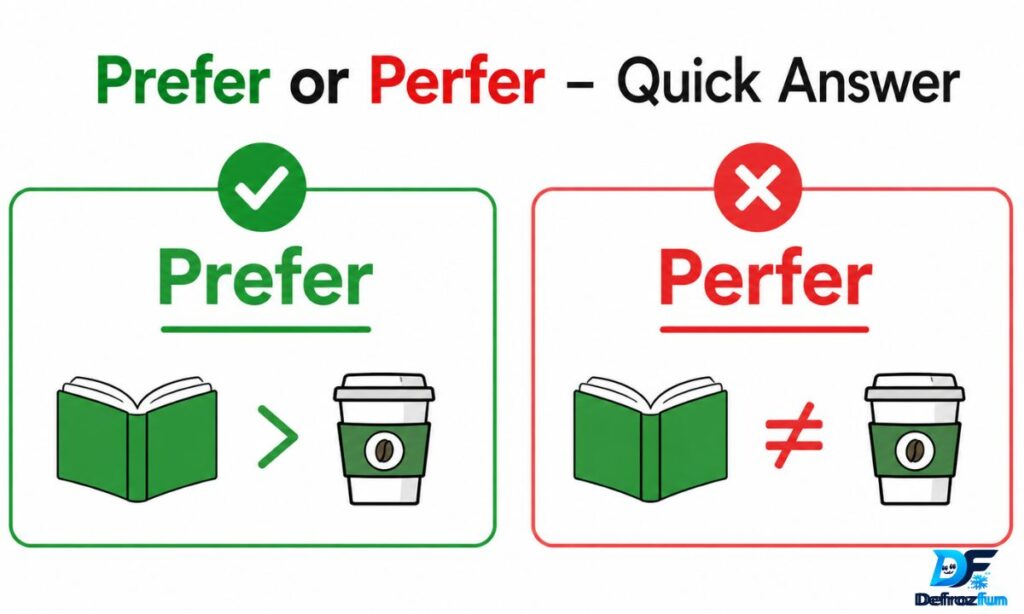
The correct spelling is prefer. Perfer is a misspelling and does not exist in the English language. It should never be used in formal, academic, or professional writing.
| Word | Status | Meaning |
| Prefer | Correct | To like or choose one thing over another |
| Perfer | Incorrect (misspelling) | Not a real English word — avoid entirely |
Quick rule to remember: Think of the prefix pre — as in preview, predict, and prepare. The word starts with pre, not per.
The Origin of Prefer
Understanding where a word comes from helps you remember how to spell it correctly.
Prefer traces back to the Latin verb praeferre, which is built from two parts: prae (meaning before or in front) and ferre (meaning to carry or to bring). Together, praeferre meant to carry forward or to choose ahead of others.
From Latin, the word passed into Old French as preferer, and then into Middle English as prefer. At every stage of its history, the spelling maintained the pre structure at the front. The form perfer never appeared in the word’s evolution — it is purely a modern typing error caused by letter transposition.
This origin story is also your memory trick: pre comes first, just like the prefix pre always comes at the beginning of a word.
British English vs American English Spelling
Many English words differ between British and American spelling. Think of colour vs color, or travelling vs traveling. Prefer is not one of those words.
| English Variant | Correct Spelling | Notes |
| American English | Prefer | Standard spelling across all contexts |
| British English | Prefer | Identical — no regional variation |
| Australian English | Prefer | Same spelling used throughout |
| Canadian English | Prefer | No difference from other variants |
Whether you are writing for a US audience, a UK publication, or an international platform, prefer is always spelled the same way. There is zero regional justification for writing perfer.
Which Spelling Should You Use?
Always use prefer. There is no context — formal, informal, academic, or conversational — where perfer is acceptable.
When to Use Prefer
- In formal essays, reports, and business emails
- In everyday conversation and casual text messages
- In social media captions and blog posts
- In academic writing and school assignments
- In any English content regardless of the audience’s region
Perfer, on the other hand, should never appear in any written content. If your spell checker flags it, that is the correct response — replace it with prefer.
Common Mistakes with Prefer
Spelling is only part of the picture. Even writers who spell prefer correctly sometimes use it grammatically wrong. Here are the most common mistakes and how to fix them.
Mistake 1: Using perfer instead of prefer
| Incorrect | Correct |
| I perfer tea over coffee. | I prefer tea over coffee. |
| She perfers working from home. | She prefers working from home. |
| They perferred the earlier flight. | They preferred the earlier flight. |
Mistake 2: Using prefer than instead of prefer to
This is a very common grammar error, especially for ESL learners.
| Incorrect | Correct |
| I prefer coffee than tea. | I prefer coffee to tea. |
| She prefers reading than watching TV. | She prefers reading to watching TV. |
| I prefer to walk than drive. | I prefer to walk rather than drive. |
The correct structure when comparing two things is prefer X to Y. If you use a verb, the structure becomes prefer doing X to doing Y, or prefer to do X rather than do Y.
Mistake 3: Forgetting the -s in third person singular
| Incorrect | Correct |
| She prefer coffee in the morning. | She prefers coffee in the morning. |
| He prefer the window seat. | He prefers the window seat. |
Prefer in Everyday Examples
Below are natural, real-world sentences that show how prefer is correctly used across different situations and grammatical patterns.
Prefer + Noun
- I prefer green tea in the morning.
- Most students prefer online classes.
- My sister prefers quiet environments for studying.
Prefer + Gerund (verb + -ing)
- He prefers working early rather than staying late.
- They prefer cooking at home to eating out.
- I prefer hiking to cycling on weekends.
Prefer + To-Infinitive
- She prefers to read before sleeping.
- I would prefer to travel by train.
- My manager prefers to hold meetings on Monday mornings.
Would Prefer (Polite Requests and Choices)
- I would prefer a window seat, please.
- Would you prefer coffee or tea?
- She would prefer not to discuss it right now.
Each of these patterns is grammatically correct. The key is to pair prefer with to when comparing two things, or with rather than when the second option is a verb phrase.
Prefer – Google Trends & Usage Data

Search data gives us a clear picture of how real users interact with this spelling question.
| Data Point | Finding |
| Global monthly searches: prefer | High-volume — consistently searched for grammar and usage |
| Global monthly searches: perfer | Appears mostly as a typo in search queries, not as intentional usage |
| Top searching regions | United States, United Kingdom, India, Canada, Australia |
| Search intent | Spelling clarification, grammar usage, ESL learning |
| Spelling confusion spikes | Common among students, bloggers, and ESL learners |
According to usage data across major English corpora, prefer appears millions of times in published books, articles, and academic papers. The word perfer essentially does not appear in any legitimate published source — confirming it is purely a typing or cognitive error, not a regional or historical variant.
Keyword Variations Comparison
Different users search for this spelling question in slightly different ways. Here is how the most common keyword variations relate to each other.
| Search Query / Variation | Correct Word | Usage Context |
| prefer vs perfer | Prefer | Spelling confusion — which is correct? |
| perfer or prefer | Prefer | Direct comparison query |
| how to spell prefer | Prefer | Spelling verification |
| prefer spelling | Prefer | Quick spelling check |
| preferred spelling | Preferred | Past tense / adjective form |
| preference spelling | Preference | Related noun form |
| preferable meaning | Preferable | Adjective — more desirable |
| preferably in a sentence | Preferably | Adverb form |
| I prefer to vs I prefer | Prefer to | Grammar usage question |
| prefer X over Y vs prefer X to Y | Both acceptable | Preposition usage |
All roads lead to the same answer: prefer is the only valid spelling in every variation. Its related word forms — preferred, preference, preferable, and preferably — all retain the pre spelling pattern, which makes the entire word family easy to remember once you learn the root.
Conclusion
The answer to prefer vs perfer is simple and absolute: prefer is correct, and perfer is not a word. No dictionary — British, American, or otherwise — recognizes perfer as a valid spelling. It is a typing error that happens when letters get transposed, but it has no historical, regional, or grammatical basis.
To keep it straight: think of the Latin root prae (before) and the English prefix pre. That pre pattern stays consistent across all related words — prefer, preferred, preferring, preference, preferable, and preferably.
Use prefer confidently in every context. Whether you are writing a university essay, a professional email, or a quick text message, prefer is always the right choice. And now that you know why, you have no reason to hesitate.

Daniel Brooks is a passionate writer and digital content creator dedicated to sharing insightful, engaging, and informative articles across multiple niches. With a strong interest in technology, lifestyle, trending topics, and online media, Daniel Brooks focuses on delivering well-researched and reader-friendly content that inspires and informs audiences worldwide.