

If you have ever typed “tornados” and then second-guessed yourself, you are not alone. This is one of the most common spelling questions in English, and the confusion is completely understandable. Both forms appear in reputable newspapers, weather reports, and grammar guides. So which one is actually correct? The short answer may surprise you.
Tornados or Tornadoes – Quick Answer
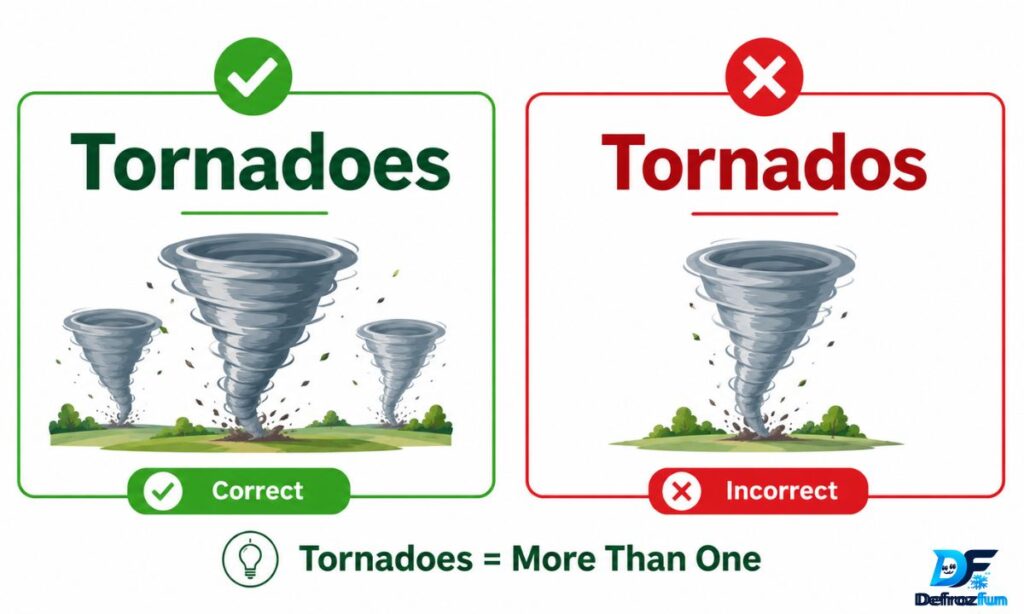
Both spellings are correct. “Tornadoes” and “tornados” are accepted plural forms of the word “tornado.” However, “tornadoes” is the more widely used and recommended spelling in modern standard English, particularly in formal writing, journalism, and scientific contexts.
| Form | Correct? | Usage Level |
| Tornadoes | ✅ Yes | Most common – preferred in formal writing |
| Tornados | ✅ Yes | Accepted – less common, used informally |
| Tornadose | ❌ No | Incorrect – not a real word |
| Tornado’s | ❌ No (as plural) | Incorrect – apostrophe signals possession, not plural |
The Origin of Tornados or Tornadoes
Understanding the word’s history helps explain why two spellings exist.
The word “tornado” first appeared in English during the 16th–17th century to describe violent windstorms over the tropical Atlantic Ocean. It was an altered borrowing from the Spanish word “tronada” (meaning thunderstorm), which itself came from “tronar” (to thunder). It may also have roots in the Spanish verb “tornar,” meaning “to turn” — a fitting description for a spinning funnel cloud.
The word entered English as “tornade” before settling into its modern form, “tornado.” Because it traveled through Spanish and Latin before landing in English, writers have debated its plural ever since. Spanish nouns ending in “-o” take “-os” in plural form (tornado → tornados), but English pluralization rules often add “-es” to words ending in “-o” — especially when the word has Latin or Spanish roots — giving us tornadoes.
Both historical paths are valid, which is why both plurals survived into modern English.
British English vs American English Spelling
Spelling preferences for this word do vary slightly by region.
| Region | Preferred Spelling | Notes |
| American English | Tornadoes | Used in news media, weather services, scientific writing |
| British English | Both accepted | Neither form is dominant; usage is flexible |
| Commonwealth English | Both accepted | Tornadoes is more common in published writing |
| Scientific/Academic | Tornadoes | Consistent with major style guides and dictionaries |
American English strongly favors “tornadoes.” Major U.S. publications, weather agencies like the National Weather Service, and academic journals almost always use this form. The word “tornado” is primarily an American weather phenomenon in terms of frequency, which is likely why the American English spelling has become the global default.
In British English, both forms are used, and neither is considered an error. Writers in the UK, Australia, and Canada can safely use either without being flagged for incorrect grammar.
Which Spelling Should You Use?
The safest and most universally accepted choice is tornadoes. Here is a simple guide based on your writing context:
- Formal writing, academic papers, reports → Use tornadoes
- Journalism and news articles → Use tornadoes (AP Style standard)
- Casual writing, social media, personal blogs → Either form is fine
- SEO content targeting global audiences → Use tornadoes (higher search volume)
- British or Commonwealth context → Either is acceptable
Tornadoes or Tornados – AP Style
The AP Stylebook, the industry standard for American journalism, clearly states that the plural of tornado is tornadoes. This is the preferred form for all news writing, press releases, and professional editorial content. If you write for a publication or create content for media audiences, always follow AP Style and use “tornadoes.”
A useful memory trick: the scale used to measure tornado intensity is called the Enhanced Fujita (EF) Scale — both the scale and the word share the letter “e.” There is an E in tornadoes.
Also Read This: Blankie or Blanky: What’s The Difference (2026)
Common Mistakes with Tornados or Tornadoes
Even fluent English speakers make predictable errors with this word. Here are the most common ones to watch out for:
1. Using an apostrophe for the plural
- ❌ Incorrect: Tornado’s caused widespread damage.
- ✅ Correct: Tornadoes caused widespread damage.
An apostrophe makes the word possessive (belonging to a tornado), not plural. This is one of the most frequent punctuation mistakes in English.
2. Spelling it “tornadose” or “tornadoses”
- ❌ Incorrect: Multiple tornadoses were reported.
- ✅ Correct: Multiple tornadoes were reported.
“Tornadose” is not a word in any form of English.
3. Mixing both spellings in one document If you use “tornadoes” in paragraph one and “tornados” in paragraph five, it looks inconsistent. Pick one and stick with it throughout the document.
4. Assuming only one form is correct Many people believe “tornados” is a misspelling. It is not. It is a recognized, dictionary-listed variant. Correcting someone who uses “tornados” is itself an error.
5. Using “tornado” as a plural
- ❌ Incorrect: Three tornado hit the town.
- ✅ Correct: Three tornadoes hit the town.
The singular and plural forms are not the same. Always add “-s” or “-es” when referring to more than one.
Tornados or Tornadoes in Everyday Examples
Seeing both spellings used correctly in real sentences helps solidify the difference.
Using “tornadoes” (more common):
- The National Weather Service confirmed that three tornadoes touched down in Texas overnight.
- Tornadoes in the United States are most frequent in the region known as Tornado Alley.
- Meteorologists tracked several tornadoes moving northeast across the state.
- Around 77% of tornadoes in the U.S. are classified as weak, rated EF-0 or EF-1.
Using “tornados” (accepted alternative):
- Animals reportedly grew restless before the tornados arrived.
- The documentary covered the deadliest tornados of the last century.
- Some tornados are on the ground for only a few seconds.
Using the singular “tornado”:
- A tornado touched down near the city limits just before midnight.
- The tornado caused an estimated $10 million in property damage.
Both plural forms are interchangeable in all of these contexts. The meaning does not change, the pronunciation does not change (/ˈtɔːr.neɪ.doʊz/ in both cases), and no reader will be confused.
Tornados or Tornadoes – Google Trends & Usage Data
Data from major language corpora and search tools shows a clear preference pattern.
Google search volume comparison (approximate global monthly searches):
| Keyword | Monthly Search Volume | Trend |
| Tornadoes | Significantly higher | Dominant and growing |
| Tornados | Lower | Stable but secondary |
| Tornadoes vs tornados | Moderate | Curiosity-driven searches |
Dictionary listings:
- Merriam-Webster: Lists “tornadoes” as the primary plural; “tornados” as a variant
- Oxford English Dictionary: Lists both; “tornadoes” appears first
- Cambridge Dictionary: Recognizes both forms as correct
The data strongly favors “tornadoes” for anyone writing with SEO or reach in mind. If you want your content to match what readers are searching for, “tornadoes” is the clear winner.
Conclusion
The debate between “tornados or tornadoes” has a clear, practical answer: use “tornadoes.” It is the spelling recognized first by Merriam-Webster and Oxford, preferred by the AP Stylebook, used by the National Weather Service, and searched more often by readers worldwide.
That said, “tornados” is not wrong. It is a perfectly valid English plural that has been in use for centuries and appears in formal dictionaries. If you are writing casually or following a regional style that accepts it, there is nothing incorrect about using it.
The key takeaway is consistency. Whichever form you choose, stick with it throughout your document. And if you are ever in doubt — especially for formal writing, journalism, or SEO content — go with “tornadoes” every time. It is the safest, most recognized, and most universally accepted choice.

Daniel Brooks is a passionate writer and digital content creator dedicated to sharing insightful, engaging, and informative articles across multiple niches. With a strong interest in technology, lifestyle, trending topics, and online media, Daniel Brooks focuses on delivering well-researched and reader-friendly content that inspires and informs audiences worldwide.