
If you have ever typed “scepter or sceptre” into Google, you are not alone. Thousands of people search this every month. Both spellings look right, but which one should you actually use? The short answer is: both are correct — but they belong to different regions. This guide covers spelling, meaning, origin, Bible usage, pronunciation, and common mistakes so you never get confused again.
Scepter or Sceptre — Quick Answer
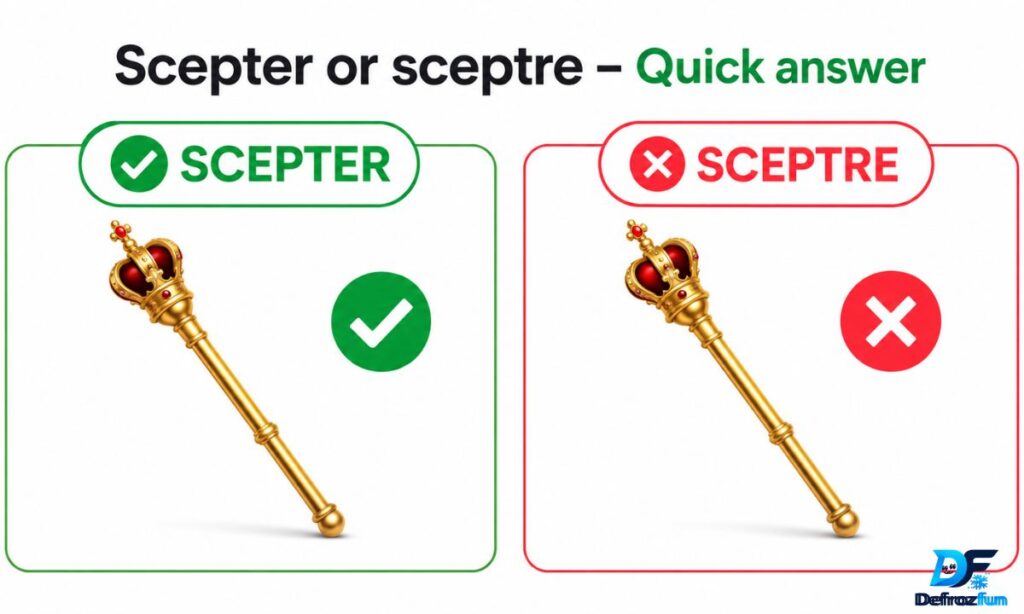
Both scepter and sceptre refer to the same thing: a royal staff or rod carried by a monarch as a symbol of power and authority.
The only difference is regional spelling:
- Scepter = American English (US)
- Sceptre = British English (UK, Australia, Canada, New Zealand)
Same meaning. Same pronunciation. Different spelling based on your audience.
What Does Scepter or Sceptre Mean?
A scepter is an ornate ceremonial staff, usually made of precious metal, carried by a king or queen during formal occasions such as coronations. It symbolizes royal authority, divine right to rule, and sovereign power.
It is not a weapon. It is a symbol.
Examples:
- The king raised his scepter before addressing the crowd.
- The queen’s sceptre was encrusted with diamonds and gold.
- The sceptre was displayed alongside the crown at the coronation.
The Origin of Scepter or Sceptre
The word has a long history that explains why two spellings exist today.
| Stage | Form | Language |
| Ancient | skeptron (staff/rod) | Greek |
| Classical | sceptrum | Latin |
| Medieval | sceptre | Old French |
| British English | sceptre | Standard UK form |
| American English | scepter | Simplified by Noah Webster |
Greek rulers carried the skeptron as a sign of authority. The word passed into Latin as sceptrum, then into Old French as sceptre. English borrowed it from Old French, keeping the -re ending.
In the late 18th and early 19th centuries, American lexicographer Noah Webster launched a spelling reform movement. He wanted to simplify English and make it more phonetic. Words like centre became center, theatre became theater, and sceptre became scepter. His 1806 dictionary standardized these changes across the United States.
Britain kept the original French-derived endings as a matter of tradition and national identity.
Scepter vs Sceptre vs Spectre — Are They the Same?
No. These are three different words. Many writers confuse them because of visual similarity.
| Word | Meaning | Spelling |
| Scepter | Royal staff (US spelling) | American English |
| Sceptre | Royal staff (UK spelling) | British English |
| Spectre | Ghost or phantom (UK spelling) | British English |
| Specter | Ghost or phantom (US spelling) | American English |
Scepter/sceptre = symbol of royal power. A king holds it.
Spectre/specter = a ghost, phantom, or looming threat. “The spectre of war” means the threat or fear of war.
They sound completely different and have entirely different meanings. Never mix them in your writing.
British English vs American English Spelling
The scepter/sceptre divide is part of a much broader pattern in English spelling. Noah Webster’s reforms created a consistent split between American and British conventions.
Common examples of the same pattern:
| British English | American English |
| sceptre | scepter |
| centre | center |
| theatre | theater |
| fibre | fiber |
| metre | meter |
| spectre | specter |
In all of these, British English preserves the French-derived -re ending, while American English reverses it to -er for simplicity and phonetic clarity.
Which Spelling Should You Use?
The answer depends on your audience and context.
Use scepter if:
- You are writing for an American audience
- Your content follows US style guides (AP, Chicago)
- You are publishing on a US-based platform
Use sceptre if:
- You are writing for a British, Australian, Canadian, or Commonwealth audience
- You are covering UK royalty, British history, or the Crown Jewels
- You are following British style guides
One golden rule: never mix both spellings in the same document. Pick one and stay consistent throughout.
Also Read This: Practising or Practicing: Which Spelling Is Correct? Complete Guide (2026)
Common Mistakes with Scepter or Sceptre
Writers often make these errors:
| Mistake | Correct Form |
| sceptor | scepter (US) or sceptre (UK) |
| sceptere | scepter (US) or sceptre (UK) |
| cepter | scepter |
| sceptre (in US context) | scepter |
| scepter (in UK context) | sceptre |
| confusing with spectre | spectre = ghost, not a royal staff |
The most common typo is sceptor — adding an “o” that does not belong. Both correct spellings end in either -er or -re, never -or.
Scepter Meaning in the Bible
The scepter appears multiple times throughout the Bible. In scripture, it is translated from the Hebrew word shebheT, which broadly means a rod, staff, or club. It was also used for a shepherd’s crook, a ruler’s baton, and a symbol of divine authority.
The KJV (King James Version) uses both “sceptre” and “rod” depending on the passage context.
Key Bible Verses About the Scepter
Genesis 49:10 (KJV) “The sceptre shall not depart from Judah, nor a lawgiver from between his feet, until Shiloh come; and unto him shall the gathering of the people be.”
This is one of the most significant prophecies in the Old Testament. It points to the Messianic lineage coming through the tribe of Judah, with many scholars seeing it as a foreshadowing of Jesus Christ.
Numbers 24:17 (KJV) “There shall come a Star out of Jacob, and a Sceptre shall rise out of Israel, and shall smite the corners of Moab.”
This prophetic verse uses the scepter to symbolize a coming ruler from Israel.
Esther 4:11 (KJV) “Whosoever, whether man or woman, shall come unto the king into the inner court, who is not called, there is one law of his to put him to death, except such to whom the king shall hold out the golden sceptre.”
Here the golden scepter of the Persian king represents mercy and access to the throne — a powerful image of grace.
Esther 5:2 (KJV) “The king held out to Esther the golden sceptre that was in his hand. So Esther drew near, and touched the top of the sceptre.”
Psalm 45:6 (KJV) “Thy throne, O God, is for ever and ever: the sceptre of thy kingdom is a right sceptre.”
This verse, quoted again in Hebrews 1:8, applies to Jesus Christ and declares that His scepter — His divine rule — is righteous and eternal.
Isaiah 14:5 (KJV) “The LORD hath broken the staff of the wicked, and the sceptre of the rulers.”
Here a broken scepter symbolizes lost authority and judgment upon corrupt rulers.
What Does the Scepter Represent in the Bible?
In the Bible, the scepter carries deep symbolic weight:
- Divine authority — God’s rule over creation (Psalm 45:6, Hebrews 1:8)
- Messianic prophecy — The coming ruler from Judah (Genesis 49:10)
- Mercy and access — The king extending his scepter to Esther (Esther 5:2)
- Judgment — A broken scepter means fallen power (Isaiah 14:5)
- Royal lineage — The symbol of kingship passed through generations
The scepter of God, as described in scripture, speaks of His absolute and eternal sovereignty over kings, nations, and all of creation.
Sceptre Pronunciation
Both scepter and sceptre are pronounced exactly the same way, regardless of spelling.
Pronunciation: SEP-ter
The “c” is completely silent. You do not say “sk-sep-ter.” The word sounds exactly as it reads phonetically: sep + ter.
This is why Noah Webster felt the -re spelling was unnecessary — the word already sounds like “-er,” so the American spelling simply reflects actual pronunciation.
| Spelling | Pronunciation | Region |
| scepter | SEP-ter | American English |
| sceptre | SEP-ter | British English |
Scepter or Sceptre — Google Trends & Usage Data
Google Trends data consistently shows a clear geographic divide in how people search for this word.
- “Scepter” dominates searches in the United States
- “Sceptre” dominates searches in the United Kingdom, Australia, and Canada
- Both terms spike in search volume during royal events, coronations, and historical content coverage
Usage data from corpus analysis (Google Books Ngram) confirms that both spellings have maintained steady usage since the 19th century, with scepter holding roughly 53% of global digital usage and sceptre at 47%, reflecting the large American English-speaking internet population.
Complete Comparison Table — Scepter vs Sceptre
| Feature | Scepter | Sceptre |
| Region | American English | British, Australian, Canadian English |
| Spelling origin | Noah Webster (1806) | Old French / traditional |
| Pronunciation | SEP-ter | SEP-ter |
| Meaning | Royal ceremonial staff | Royal ceremonial staff |
| Bible (KJV) | Used in some editions | Standard KJV spelling |
| Formal writing | US style guides | UK/Commonwealth style guides |
| Common error | sceptor, cepter | sceptere, sceptore |
| Related word confusion | specter (ghost) | spectre (ghost) |
Conclusion
The debate between scepter vs sceptre has a simple answer: both are correct. The only difference is geography. American writers use scepter; British, Australian, and Commonwealth writers use sceptre. Same word, same meaning, same pronunciation — just different regional spelling conventions shaped by Noah Webster’s 19th-century reforms.
In the Bible, the scepter carries powerful symbolic meaning — representing God’s eternal authority, the Messianic promise in Genesis 49:10, divine mercy in the book of Esther, and the righteous kingship of Christ in Psalm 45:6 and Hebrews 1:8.
Whatever spelling you choose, make sure it matches your audience and stays consistent. That is all it takes to use this word with confidence.
May God’s scepter of justice and grace guide your study of His Word.

Daniel Brooks is a passionate writer and digital content creator dedicated to sharing insightful, engaging, and informative articles across multiple niches. With a strong interest in technology, lifestyle, trending topics, and online media, Daniel Brooks focuses on delivering well-researched and reader-friendly content that inspires and informs audiences worldwide.