
If you’ve ever typed “layed” and paused to wonder whether it looks right — trust that instinct. This is one of the most common spelling errors in English, made by native speakers and learners alike. The short answer: “layed” is not a standard English word. “Laid” is always correct.
But let’s go deeper so you never mix them up again.
Quick Answer
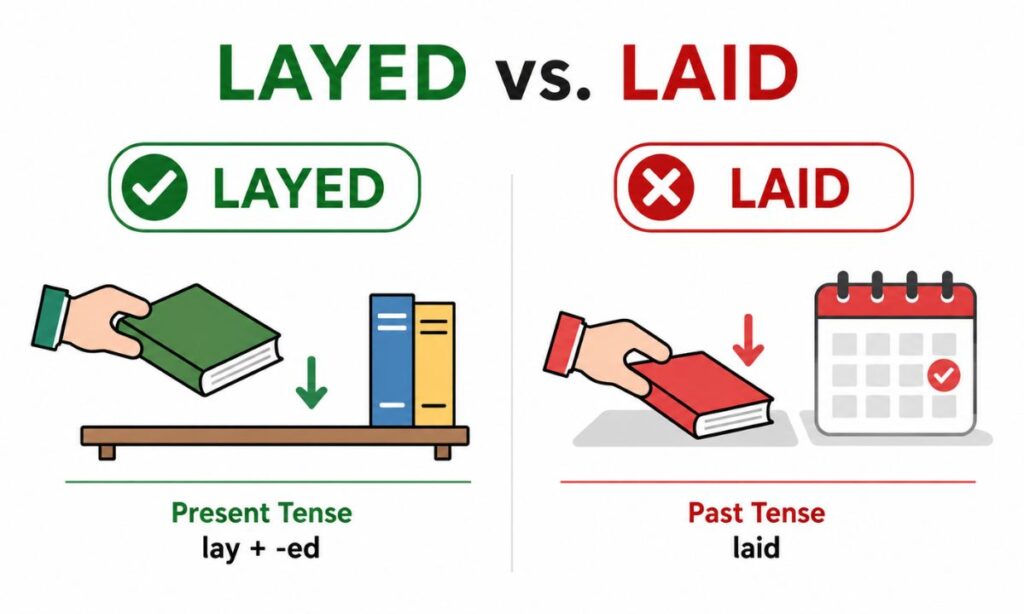
“Laid” is correct. “Layed” is incorrect.
“Laid” is the past tense and past participle of the verb “lay,” which means to put or place something down. “Layed” does not exist in modern standard English — it is a misspelling caused by applying a regular verb pattern to an irregular verb.
| Word | Status | Example |
| Laid | ✅ Correct | She laid the book on the table. |
| Layed | ❌ Incorrect | ~~She layed the book on the table.~~ |
Meaning Explained
The verb “lay” means to put or place something down in a flat or careful manner. It always requires a direct object — something being placed.
- Present tense: I lay the keys on the counter every day.
- Past tense: I laid the keys on the counter yesterday.
- Past participle: I have laid the keys on the counter.
“Laid” carries all these same meanings as its past form:
- To place something down → He laid the papers on the desk.
- To produce eggs → The hen laid three eggs.
- To prepare or set → They laid out a plan.
- To put someone to rest → She laid the baby in the crib.
Layed vs Laid Difference
Here’s a clean side-by-side comparison:
| Feature | Laid | Layed |
| Correct spelling | ✅ Yes | ❌ No |
| Modern English usage | ✅ Yes | ❌ No |
| Past tense of “lay” | ✅ Yes | ❌ No |
| Found in dictionaries | ✅ Yes | ❌ No |
| Archaic/historical use | Rare | Extremely rare |
| British English | Laid | Not accepted |
| American English | Laid | Not accepted |
There is no difference between British and American English here. Both use laid, and both reject layed.
The Grammar Rule Behind Lay and Laid
“Lay” is an irregular verb. That means it does not follow the standard “-ed” rule that most English verbs use to form the past tense.
Regular verb pattern:
- Play → Played
- Call → Called
- Walk → Walked
Irregular verb pattern (lay follows this):
- Pay → Paid
- Lay → Laid
- Say → Said
Notice the pattern: pay, lay, and say all drop the “y” and add “-id” or “-aid” — not “-ayed.” This is the historical sound change that locked “laid” into place centuries ago.
Full Conjugation of “Lay”
| Tense | Form | Example |
| Present | lay / lays | I lay the mat down every morning. |
| Past | laid | She laid the mat down yesterday. |
| Past participle | laid | He has laid the mat down before. |
| Present participle | laying | They are laying the mat down now. |
Why People Write “Layed” Instead of “Laid”
The brain loves patterns. Because most English verbs form their past tense by adding “-ed,” it feels natural to write:
- Stay → Stayed
- Play → Played
- Lay → Layed ← this is where the brain goes wrong
But “lay” is irregular. It evolved from Old English lecgan, meaning to place something, and its past tense changed over centuries through natural sound shifts — giving us “laid,” not “layed.”
In short: the “-ed” rule doesn’t apply to “lay,” just like it doesn’t apply to “pay” (we never write “payed” for the financial meaning — we write “paid”).
Grammar Rule Depth
Lay vs. Lie — The Bigger Confusion
Part of the “layed” problem comes from confusing lay and lie. Here’s the breakdown:
| Verb | Meaning | Object needed? | Past tense | Past participle |
| Lay | to place something | Yes | laid | laid |
| Lie | to recline yourself | No | lay | lain |
This overlap causes a lot of confusion because “lay” is both the present tense of lay and the past tense of lie.
- I lie down every afternoon. (present)
- I lay down yesterday afternoon. (past of “lie”)
- I laid the blanket on the sofa. (past of “lay”)
The key test: Is there an object? If you’re placing something, use lay/laid. If you’re reclining yourself, use lie/lay/lain.
Also Read This: Infact or In Fact? Which Is Correct? Grammar Rules, Examples & Common Mistakes (2026)
Real World Usage of Laid
Laid in Everyday Examples
- She laid her phone face-down on the table.
- The nurse laid the infant in the bassinet.
- He laid the groundwork for the whole project.
- They laid carpet tiles throughout the office floor.
- I laid my clothes out the night before.
Layed vs Laid Eggs
When talking about birds or reptiles producing eggs, the correct word is always laid:
- ✅ The hen laid four eggs this morning.
- ❌ The hen layed four eggs this morning.
This is one of the most searched combinations online. The answer is always the same — laid.
Laid in Professional Writing
In formal and professional writing, “laid” appears in several common constructions:
- The foundation was laid in 2019.
- The company laid off 50 employees last quarter.
- She laid out her argument clearly in the report.
- New cables were laid underground along the route.
Never use “layed” in professional, academic, or formal writing. It will signal a grammar error immediately.
Laid in Social Media and Conversation
Even in casual writing — tweets, texts, captions — “laid” is correct:
- Just laid out all my makeup for tomorrow 💄
- They laid the best table at this restaurant.
- I laid in bed all day and it was perfect honestly
Layed or Laid in Bed
This is another very common search. The correct phrase is “laid in bed” when someone placed themselves or was placed in bed. However, if you’re talking about reclining on your own, the verb “lie” is more technically precise:
- She laid the child in bed. (placed the child — “laid” is correct)
- I lay in bed all morning. (past tense of “lie” — reclining yourself)
Both “laid in bed” and “lay in bed” can be correct depending on meaning, but “layed in bed” is always wrong.
Common Mistakes with Layed vs Laid
Here are the errors writers make most often:
Mistake 1 — Using “layed” as past tense:
- ❌ He layed his jacket on the chair.
- ✅ He laid his jacket on the chair.
Mistake 2 — Using “layed off” in business writing:
- ❌ Ten employees were layed off.
- ✅ Ten employees were laid off.
Mistake 3 — Using “layed out” in planning contexts:
- ❌ She layed out the agenda before the meeting.
- ✅ She laid out the agenda before the meeting.
Mistake 4 — Using “laid” as past tense of “lie”:
- ❌ Yesterday, I laid on the couch all evening. (if you mean reclining)
- ✅ Yesterday, I lay on the couch all evening. (past tense of “lie”)
Related Words and Similar Verb Confusions

| Pair | Common Error | Correct Form |
| Lay / Lie | Using lay when lie is needed | I need to lie down. |
| Laid / Lain | Using laid for past participle of lie | I have lain here for hours. |
| Laid / Lied | Confusing “laid” with past of “lie” (to fib) | He lied about being there. |
| Paid / Payed | Using “payed” for financial payment | She paid the bill. |
Note: “Payed” is actually valid in one nautical context (to pay out rope/chain), just as “layed” has a tiny historical footprint — but for all everyday purposes, avoid both.
Tips to Remember the Correct Word
Tip 1 — The Pay/Lay Trick Pay → Paid. Lay → Laid. Same pattern. If you wouldn’t write “payed the bill,” don’t write “layed the carpet.”
Tip 2 — Ask “Laid What?” If you can answer the question with an object, use “laid.” She laid the envelope on the desk. The envelope = the object.
Tip 3 — The Rhyme “If you write LAYED, your spelling gets SLAYED.” Silly, but it sticks.
Tip 4 — Object Check Placing something → lay/laid (needs an object). Reclining → lie/lay/lain (no object).
Layed vs Laid in Modern English Usage
Usage Patterns and Language Trends
“Layed” shows up constantly in informal writing — social media posts, online comments, even published articles. But this doesn’t make it correct. Grammar checkers across platforms (Grammarly, Quillbot, Microsoft Word) all flag “layed” as an error and auto-correct it to “laid.”
Language databases show “layed” has zero legitimate presence in modern published books or academic writing. It survives only as a widespread spelling mistake — not as an accepted variant.
The bottom line: even if you see “layed” online often, it remains wrong in every writing context — formal or informal.
Exercise 1 — Choose the Correct Word
Choose the right word for each sentence:
- The builder ______ the bricks in neat rows. (layed / laid)
- She ______ her bag on the kitchen counter. (layed / laid)
- The bird ______ five eggs in the nest. (layed / laid)
- He has ______ the foundation for the project. (layed / laid)
- They ______ out the design plans on the table. (layed / laid)
Answers: All five answers are laid.
Exercise 2 — Correct the Sentence
Rewrite each sentence using the correct word:
- ❌ She layed the document on his desk. ✅ She laid the document on his desk.
- ❌ The workers layed a new floor in the hallway. ✅ The workers laid a new floor in the hallway.
- ❌ He layed off the extra staff last month. ✅ He laid off the extra staff last month.
- ❌ The hen has layed six eggs this week. ✅ The hen has laid six eggs this week.
Conclusion
The layed vs. laid debate has one clear winner: laid. Every time, in every context, for every speaker of modern English.
“Layed” is a natural mistake — the “-ed” pattern is so common that the brain applies it everywhere. But “lay” is an irregular verb that follows the pay → paid pattern, giving us lay → laid.
Use this quick mental check before you write:
- Placing something in the past? → laid
- Reclining in the past (yourself)? → lay (past of “lie”)
- Never, ever: layed
Keep this rule in mind and one common grammar error disappears from your writing for good.

Daniel Brooks is a passionate writer and digital content creator dedicated to sharing insightful, engaging, and informative articles across multiple niches. With a strong interest in technology, lifestyle, trending topics, and online media, Daniel Brooks focuses on delivering well-researched and reader-friendly content that inspires and informs audiences worldwide.