

If you have ever typed “planing a trip” instead of “planning a trip,” you already know how one missing letter can change an entire sentence. These two words sound almost identical when spoken quickly, and they look nearly the same on paper, yet they belong to completely different worlds of meaning.
This guide breaks down everything you need to know: definitions, grammar rules, real examples, common mistakes, and simple tricks to remember which word fits which situation.
Quick Answer
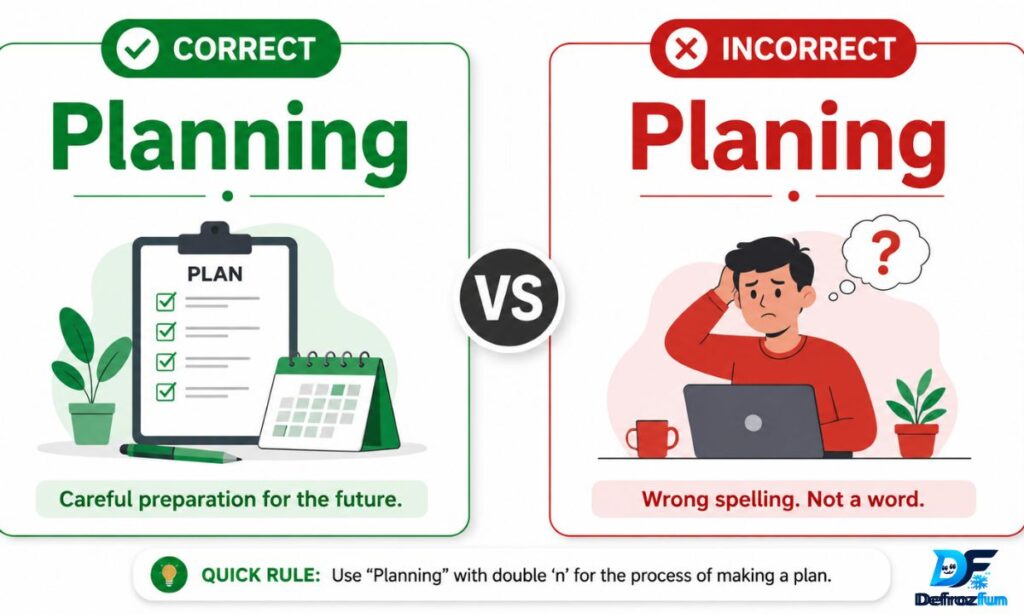
Planning means preparing, organizing, or thinking ahead about something you intend to do. Planing means smoothing or shaping a surface, most often wood, using a tool called a plane. If you are talking about goals, schedules, or events, use planning. If you are talking about carpentry, woodworking, or a boat skimming across water, use planing.
Planning vs Planing Meaning
Planning is the noun and gerund form of the verb “to plan.” It describes the mental or organizational process of deciding what will happen before it happens, such as planning a wedding or planning a budget.
Planing is the gerund form of the verb “to plane.” It has two main uses: shaving thin layers off a wooden surface to make it flat and smooth, and the action of a boat or aircraft gliding or skimming across a surface rather than pushing through it.
Planning vs Planing Difference
| Feature | Planning | Planing |
| Base verb | plan | plane |
| Letter count | double “n” | single “n” |
| Core meaning | preparing or organizing | smoothing wood or gliding |
| Common field | business, travel, education | carpentry, boating, dentistry |
| Frequency of use | very common | rare, technical |
Grammar Rule Depth
English has a spelling pattern called the doubling rule. When a short verb ends in a single vowel followed by a single consonant, and the stress falls on that final syllable, the consonant is doubled before adding “-ing.” “Plan” ends in a single vowel plus “n,” so it becomes “planning.”
“Plane” already ends in a silent “e,” so that “e” is simply dropped before “-ing,” giving “planing,” not a doubled consonant.
Why People Confuse Planning and Planing
Most confusion comes down to speed. When typing quickly on a phone or in a chat, it is easy to drop one letter without noticing, especially since autocorrect does not always flag “planing” as wrong, because it is a real English word. The two terms also sound close in casual speech, which reinforces the visual mix-up in writing.
The Origin of Planning and Planing
“Plan” traces back to the French word “plan,” meaning a flat drawing or diagram, which itself comes from Latin “planus,” meaning flat or level. “Plane,” the woodworking tool and verb, comes from the same Latin root “planus” through Old French “plaine.” Interestingly, both words share a common ancestor tied to flatness, one referring to a flat diagram of intent and the other to a physically flattened surface.
Planning in Everyday English
Planning shows up constantly in daily conversation and writing:
- “We are planning our summer vacation.”
- “She spends every Sunday planning her week.”
- “The city is planning a new transport system.”
It applies to almost any context involving forethought, from personal goals to national policy.
Planing in Technical Contexts
Planing is mostly confined to specialized fields:
- Carpentry: smoothing rough wood boards with a hand or electric planer.
- Boating: a hull “planing” across the water at speed instead of pushing through waves.
- Dentistry: “root planing” is a procedure that smooths tooth root surfaces to treat gum disease.
Planning vs Planing in Professional Writing
In business reports, resumes, and project documents, planning is almost always the correct word, since it relates to strategy, timelines, and organization. Planing would only appear in professional writing tied to construction, manufacturing, or dental health documentation.
Planning vs Planing in Emails
Emails about meetings, projects, deadlines, or trips should always use planning. A misplaced “planing” in a business email can look like a careless typo and slightly undercut your credibility, so a quick proofread before sending is worthwhile.
Planning vs Planing in Social Media
Social captions move fast, and that is exactly where this mistake appears most. “Planing my next trip” is a common typo on travel and lifestyle posts. Since captions get less editing than formal writing, this is the environment where the extra “n” is most often forgotten.
Common Mistakes with Planning vs Planing
- Writing “planing” when discussing future events or goals.
- Assuming spellcheck will always catch the error, since both are valid words.
- Mixing up “plane” (the tool or aircraft) with “plan” when forming the “-ing” version.
- Using “planing” outside carpentry, boating, or dental contexts.
Related Words and Expressions
- Plan (noun/verb), planned, planner, planner-friendly
- Plane (noun/verb), planer, planed, hand plane
- Root planing (dental term)
- Planing hull (marine engineering term)
Also Read This: Batton vs Baton: Meaning, Difference, Correct Spelling & Examples (2026)
Real World Examples of Planning
- “Careful planning helped the team finish the project early.”
- “Financial planning is essential before buying a home.”
- “Event planning requires attention to every small detail.”
Planning or planing wood
This exact phrase trips a lot of people up. If you are describing preparation, such as scheduling a woodworking project, you would write “planning a wood project.” If you are describing the actual smoothing of a board, the correct phrase is “planing wood,” not “planning wood.”
Real World Examples of Planing
- “The carpenter spent the morning planing the tabletop.”
- “The speedboat was planing smoothly across the lake.”
- “The dentist recommended scaling and root planing for gum health.”
Which Word Should You Use
Ask yourself one question: is this about the future, or is this about a physical surface being smoothed? Future, goals, schedules, and organization point to planning. Wood, boats, or a specific dental procedure point to planing.
Memory Trick for Planning vs Planing
Think of the double “n” in planning as standing for “next steps,” since planning always looks ahead. For planing, remember that a “plane” (the tool) has only one “n,” and so does the word describing its action.
Planning vs Planing Usage Trends
Search and usage data consistently show planning appears far more often than planing across books, news, and the web, since it applies to nearly every area of life, while planing stays limited to a handful of technical trades.
Planning vs planing grammar
Grammatically, both are present participles or gerunds formed by adding “-ing” to their base verbs. The only structural difference is the doubling of the final consonant in “plan” versus the dropped silent “e” in “plane,” which is what produces the single versus double “n.”
Comparison Table
| Word | Part of Speech | Meaning | Example Sentence |
| Planning | Gerund/Noun | Organizing or preparing for the future | “They are planning a wedding.” |
| Planing | Gerund/Noun | Smoothing wood or gliding over a surface | “He is planing the door edge.” |
Planning Idioms and Expressions
- “Fail to plan, plan to fail” — a reminder that preparation prevents problems.
- “Planning ahead” — thinking about the future in advance.
- “In the planning stages” — an idea that is still being developed.
Planing Tools and Equipment
- Hand plane: a manual tool for shaving wood surfaces.
- Electric planer: a powered tool for faster, even smoothing.
- Jointer planer: used to flatten and square rough lumber edges.
Why Correct Spelling Matters
Small spelling errors like this one can distract readers, weaken professional credibility, and even confuse the meaning of a sentence entirely. In business writing especially, accuracy signals attention to detail, which readers and clients quietly notice.
Exercises
Exercise 1 Choose the Correct Word
- She is _____ her birthday party. (planning/planing)
- He spent the afternoon _____ the wooden shelf. (planning/planing)
- Good _____ can prevent last-minute stress. (planning/planing)
- The boat was _____ across the water. (planning/planing)
Answers: 1. planning, 2. planing, 3. planning, 4. planing
Exercise 2 Correct the Sentence
- “We are planing our vacation for next month.” → We are planning our vacation for next month.
- “The carpenter is planning the rough board.” → The carpenter is planing the rough board.
Conclusion
The difference between planning and planing comes down to a single letter, but that letter changes everything. Planning belongs to the world of goals, schedules, and preparation, while planing belongs to workshops, boats, and dental chairs. Once you connect planning to “next steps” and planing to the “plane” tool, the correct choice becomes second nature, whether you are writing an email, a caption, or a business report.

Daniel Brooks is a passionate writer and digital content creator dedicated to sharing insightful, engaging, and informative articles across multiple niches. With a strong interest in technology, lifestyle, trending topics, and online media, Daniel Brooks focuses on delivering well-researched and reader-friendly content that inspires and informs audiences worldwide.