
If you’ve ever typed “forward” and then second-guessed yourself and added an “s,” you’re not alone. This is one of the most common word-choice questions in English, and the honest answer is: both words are correct, but they aren’t always interchangeable.
This guide breaks down exactly when to use forward, when forwards works too, and why native speakers in different countries don’t always agree on the answer.
Quick Answer
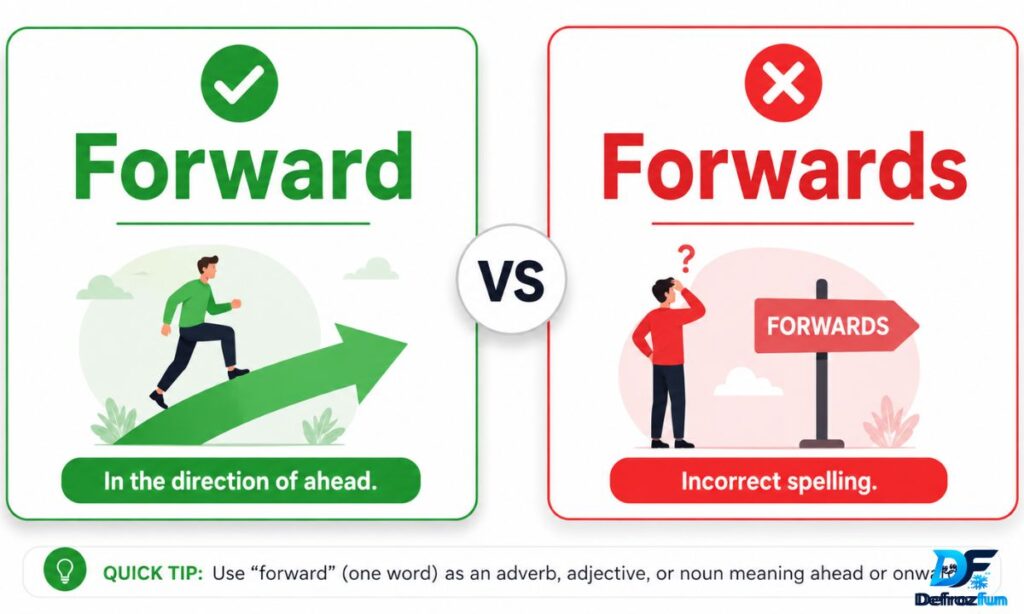
- Forward is correct in almost every situation, in both American and British English. It works as an adjective, a verb, a noun, and an adverb.
- Forwards only works as an adverb (describing movement or direction), and it’s mostly used in British, Australian, and Canadian English.
- American English almost never uses “forwards.” If you’re writing for a US audience, drop the “s” every time.
- When a word comes right before a noun (a forward pass, a forward motion), it must be forward — never forwards.
If you remember nothing else from this article, remember this: forward is always safe. Forwards is only safe as an adverb, and only in certain dialects.
Why People Confuse Forward vs Forwards
The confusion isn’t random. It comes from a few overlapping factors:
- They sound almost identical and mean the same thing in casual speech, so the ear doesn’t naturally flag a difference.
- Similar word pairs behave differently. English already has “toward/towards” and “backward/backwards,” where both forms are widely accepted on both sides of the Atlantic. People assume forward/forwards follows the same pattern, but it doesn’t split evenly — forward carries far more grammatical weight.
- Regional English varies. A word that sounds perfectly natural in London might look like a typo in New York, and vice versa.
- Autocorrect and spellcheck tools are inconsistent, sometimes flagging “forwards” as an error even in contexts where British English would accept it.
- The verb form only ever loses the “s” in the base form, which trips people up when they’re conjugating sentences quickly.
Once you separate the word by its grammatical role — adjective, verb, noun, or adverb — the confusion mostly disappears.
Grammar Rules Explained in Depth
Forward vs Forwards: The Core Rule
English grammar treats “forward” as the base word and “forwards” as a variant limited to one job: describing direction or movement as an adverb.
Forward can be:
- An adjective (describing a noun): a forward position, forward planning, forward motion
- A verb (to send something on): Please forward this email.
- A noun (a position in sports): She plays forward for the national team.
- An adverb (describing movement): He leaned forward.
Forwards can only be:
- An adverb (describing movement or direction), and even then, mainly in British-style English: She stepped forwards.
- A verb conjugation in third-person singular present tense: He forwards every report to his manager.
- A plural noun in sports contexts: The forwards trained hard before the match.
The key takeaway: as soon as “forward” sits next to a noun and describes it, or acts as a verb or noun itself, the “s” disappears. It only reappears in adverb usage (and in verb conjugation or pluralization, which follow separate grammar rules entirely).
Forward as an Adjective
When forward comes directly before a noun, it is always “forward,” never “forwards.”
- The team made forward progress this quarter.
- He has a forward-thinking approach to business.
- The plane’s forward cabin was fully booked.
There is no dialect, formal or informal, where “forwards” is acceptable here. This is the rule with zero exceptions.
Forward as a Verb
To forward something means to send it on to someone else, most often used with emails, messages, letters, or packages.
- I’ll forward the invoice to accounting.
- She forwarded the message without reading it fully.
- He forwards customer complaints to the support team.
Notice that the “s” only shows up in third-person singular present tense (he forwards), which is standard subject-verb agreement — not a stylistic choice about direction.
Forward as a Noun
In sports, “forward” refers to an attacking player position.
- He was named team captain and starting forward.
- The forwards dominated possession in the second half.
Here, “forwards” is simply the plural noun, following ordinary pluralization rules — again, unrelated to the adverb debate.
Forward/Forwards as an Adverb
This is the only place where both words genuinely compete for the same job: describing movement toward the front, or progress in time.
- She moved forward / She moved forwards.
- Let’s push forward / Let’s push forwards.
- Looking forward to the weekend / Looking forwards to the weekend.
Both are grammatically valid as adverbs. Which one to pick largely comes down to regional preference, which we cover next.
British English vs American English Usage
| Context | American English | British English |
| Adjective (before a noun) | forward | forward |
| Verb (to send on) | forward | forward |
| Noun (sports position) | forward / forwards (plural) | forward / forwards (plural) |
| Adverb (movement/direction) | forward | forward or forwards |
| Common style guide preference | Forward almost exclusively | Forwards accepted, forward still common |
American publications, style guides, and grammar checkers overwhelmingly favor “forward” in every context, including as an adverb. British English is more relaxed — both forms appear in adverb usage, though “forward” remains dominant in formal and fixed expressions even in the UK.
Australian and Canadian English tend to lean toward British conventions, so “forwards” shows up more often in casual speech and writing in those regions too, though “forward” is still widely accepted and often preferred in professional contexts.
Also Read This: Sueing vs Suing: Meaning, Difference, Grammar Rules, Examples, and Correct Usage
Forward vs Forwards Grammar: Which One Should You Use
Here’s a simple decision process:
- Is it directly describing a noun (adjective)? Use forward.
- Is it a verb meaning “to send on”? Use forward (or forwards only for third-person singular present tense).
- Is it a plural noun in sports? Use forwards.
- Is it describing movement or direction (adverb)?
- Writing for an American audience → use forward.
- Writing for a British, Australian, or Canadian audience → either works, though forward is still the safer, more universally accepted choice.
- Not sure who your audience is? Default to forward. It’s correct everywhere and never looks wrong.
For anyone writing professionally — resumes, business emails, academic papers, or global content — forward is the lower-risk choice in virtually every case.
Forward vs Forwards in Real-World Usage
Here’s how the two show up in everyday and professional writing:
- Business email: “Please forward this to the entire team.” (Never forwards, even in the UK.)
- Fitness/sports coaching: “Step forward with your left foot.” (American) vs. “Step forwards with your left foot.” (British, informal)
- Legal and formal writing: Always forward — formal writing in both dialects tends to avoid “forwards” almost entirely.
- Everyday British speech: “The car rolled forwards slowly.” (Natural in casual British English.)
- Sports commentary: “Our forwards controlled the midfield all game.” (Plural noun, unrelated to the adverb debate.)
Common Mistakes and Corrections
| Mistake | Correction | Why |
| The forwards motion startled everyone. | The forward motion startled everyone. | Adjective before a noun always drops the “s.” |
| Please forwards this document. | Please forward this document. | Base verb form never takes an “s.” |
| He is a forwards thinker. | He is a forward thinker. | Adjective use — no “s” allowed. |
| She forward the email yesterday. | She forwarded the email yesterday. | Needs past tense, not the adverb rule. |
| The team has two forward on the bench. | The team has two forwards on the bench. | Plural noun needs the “s.” |
Looking Forward vs Forwards
“Looking forward to” is by far the most searched version of this confusion, especially in emails and formal correspondence.
- “I look forward to hearing from you” is the standard, universally accepted phrase in both American and British English, and it’s the safest choice for professional writing.
- “I look forwards to hearing from you” appears occasionally in informal British English, but most British style guides and grammar authorities still favor “forward” here as well.
For any formal letter, cover letter, or business email, always use “looking forward,” without the “s.” This single fixed expression is one of the few places where American and British usage almost fully agree.
Advanced Usage Notes
- Fixed expressions almost always use “forward”: forward-thinking, forward planning, forward pass, forward slash, carry forward, going forward, put forward. These idioms rarely, if ever, take the “s,” regardless of dialect.
- “Going forward” (meaning “from now on”) is a fixed business phrase and never becomes “going forwards.”
- Style guides matter more than instinct. If you write for a company, publication, or academic institution, check their house style guide — many explicitly instruct writers to use “forward” across the board, even for British audiences, to keep content consistent for global readers.
- Search engines and AI writing tools increasingly default to “forward” as the standard spelling, which is worth knowing if you’re optimizing content for search visibility or working with editing software.
Related Word Confusions
The forward/forwards pattern isn’t unique — English has several similar adjective-adverb pairs where American English simplifies to one form:
- Toward vs Towards – same rule: American English prefers “toward,” British English commonly uses “towards.”
- Backward vs Backwards – American English favors “backward” as both adjective and adverb; British English often uses “backwards” as the adverb.
- Upward vs Upwards – follows the identical American/British split.
- Downward vs Downwards – same pattern applies here too.
If you learn the forward/forwards rule, you’ve essentially learned the rule for this entire family of words.
Practice Exercises
Choose the correct word for each sentence:
- She took a step ______ before the interview began. (forward)
- The company plans to move ______ with the new product launch. (forward)
- He was praised for his ______ thinking during the crisis. (forward)
- Could you please ______ this file to the design team? (forward)
- The rugby ______ scored twice in the final match. (forwards)
- I look ______ to seeing you next week. (forward)
- The children ran ______ toward the playground. (forward or forwards, depending on dialect)
Conclusion
The forward vs forwards debate looks confusing on the surface, but it comes down to one simple principle: forward is the all-purpose word that works everywhere, while forwards is a regional variant limited strictly to adverb use. If you’re writing for American readers, drop the “s” entirely.
If you’re writing for a British, Australian, or Canadian audience, forwards is acceptable in casual, direction-based sentences — but forward still remains the safer, more widely accepted choice across formal writing, business communication, and global content.

Daniel Brooks is a passionate writer and digital content creator dedicated to sharing insightful, engaging, and informative articles across multiple niches. With a strong interest in technology, lifestyle, trending topics, and online media, Daniel Brooks focuses on delivering well-researched and reader-friendly content that inspires and informs audiences worldwide.