

One letter. Two completely different meanings. If you have ever typed “interment” when you meant “internment” (or vice versa), you are not alone. These two words trip up writers, journalists, and even native English speakers every day. This guide clears up the confusion for good.
Quick Answer
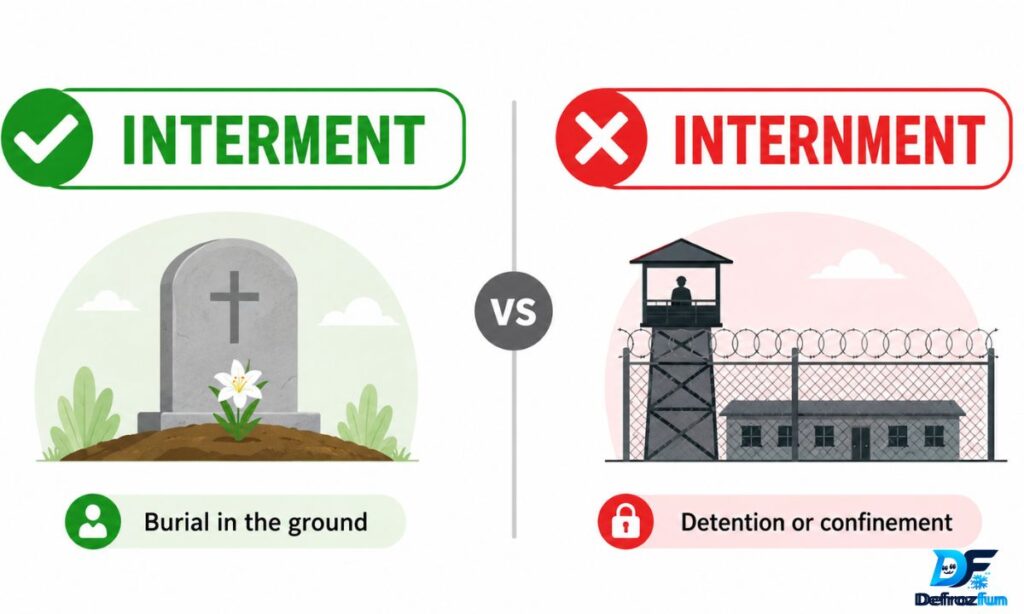
Interment = burial of a dead body in a grave, tomb, or niche.
Internment = confinement or imprisonment of people, usually during wartime or political conflict.
The core difference is simple: interment involves the dead; internment involves the living.
Interment or Internment: Quick Answer
| Word | Meaning | Used for |
| Interment | Act of burial | Funerals, graves, ashes |
| Internment | Act of confinement | War, politics, detention camps |
A quick memory trick: Interment contains the word “inter,” which comes from the Latin terra (earth). Think: putting someone into the earth. Internment comes from internus (inside), meaning keeping someone inside a place against their will.
Also Read This: Wearing or Waring? Stop Confusing These Words in 2026
Pronunciation of Interment and Internment
The two words sound nearly identical, which is part of why they are so often confused.
Interment: in-TUR-ment
Internment: in-TURN-ment
The difference is very subtle. In “internment,” you hear a slight “n” sound before the “-ment” ending. Saying them out loud slowly can help you hear the distinction.
Pronunciation Guide for Urdu Speakers
For Urdu speakers, both words can be hard to differentiate because the “r” and “rn” sounds at the end are very close in spoken English.
- Interment: آئن-ٹَر-مَنٹ (in-tar-ment)
- Internment: آئن-ٹَرن-مَنٹ (in-tarn-ment)
The key is the extra “n” in internment. Say “turn” in the middle, not just “ter.”
The Origin of Interment and Internment
Where Does Interment Come From?
Interment comes from the Latin words in (in) and terra (earth). The verb is “to inter,” which means to bury a body. This is the same root that gives us words like:
- Terrain
- Territory
- Terrarium
- Terrier (literally “dog of the earth”)
The word has been used in English since the 14th century, almost always in the context of funerals and burial rites.
Where Does Internment Come From?
Internment comes from the French word interner, meaning “to send to the interior” or “to confine.” Its Latin root is internus, meaning “inside.” The Oxford English Dictionary records the phrase “internment camp” appearing as early as 1904 in The Observer newspaper, describing camps for Russian refugees.
The word gained widespread use during World Wars I and II, especially in relation to the internment of Japanese Americans in the United States.
Also Read This: Organised or Organized? Key Differences, Correct Usage & Common Mistakes Explained (2026)
British English vs American English Spelling
This is an important point that many articles miss: there is no spelling difference between British and American English for these two words.
Both countries spell them the same way:
- Interment (not “internement” or any other variant)
- Internment (not “internement” or any other variant)
The confusion between interment and internment is a meaning problem, not a regional spelling problem. Choosing the right word depends entirely on your context, not your audience’s location.
Interment or Internment of Ashes
This is one of the most common searches on this topic, and the answer is clear.
The correct term is interment of ashes.
When a family places cremated remains (ashes) into a niche, columbarium, grave, or other final resting place, that act is called interment. It has nothing to do with imprisonment or detention.
Using “internment of ashes” is incorrect and does not make sense, as internment refers only to confining living people.
Which Spelling Should You Use?
Use this simple rule:
- Talking about a funeral, grave, burial, or ashes? Use interment.
- Talking about war, prisoners, detention, or confinement? Use internment.
There is no overlap. These words describe two completely different situations. Context always makes the correct choice clear.
Common Mistakes with Interment or Internment
Mixing up these words is not just a minor typo. It can cause real problems.
Example of a serious mistake:
Wrong: “The victims were taken for interment.” (This implies they were buried, not imprisoned.)
Right: “The victims were taken for internment.” (This correctly states they were detained.)
Because both are real English words, spellcheck tools will not flag the error. This makes human awareness of the difference especially important in:
- Journalism and news writing
- Legal and official documents
- History books and academic papers
- Funeral announcements and obituaries
Interment or Internment in Everyday Examples
Interment (Burial) Examples
- The interment ceremony followed the church service.
- Military honors were given at the soldier’s interment.
- The place of interment is marked with a granite headstone.
- Family members gathered for a private interment at the cemetery.
- The interment of ashes took place at a coastal memorial park.
Internment (Confinement) Examples
- During World War II, thousands faced internment in government camps.
- Historians still debate the long-term effects of wartime internment.
- The internment of political prisoners drew international criticism.
- He wrote a memoir about life inside an internment camp.
- The government’s internment policy was later ruled unconstitutional.
How Do You Spell Interment?

The correct spelling is I-N-T-E-R-M-E-N-T.
Common misspellings include:
- Interrment (double r, incorrect)
- Inturment (wrong vowel)
- Interement (extra e, incorrect)
- Internment (this is a different word entirely)
Remember: the root word is “inter” (to bury), so the spelling follows naturally: inter + ment = interment.
Interment vs Burial
People often ask: are interment and burial the same thing?
They are very similar but not identical.
Burial is the broad act of placing a body or remains in the ground. It is a physical act.
Interment is a more formal, ceremonial term. It refers to the official act or ceremony of burying someone, and it can also include placing ashes in a niche or columbarium (not just ground burial).
| Term | Scope | Tone |
| Burial | Physical act of placing remains in earth | Informal, general |
| Interment | Formal ceremony of final placement | Formal, ceremonial |
In practice, both words are used in obituaries and funeral planning. Interment is the more formal choice.
Interment or Internment of Ashes
As cremation becomes more common worldwide, the phrase “interment of ashes” comes up more frequently in funeral planning. With cremation rates rising significantly in countries like the US, UK, and Pakistan, many families are choosing to inter ashes rather than bury a body.
Interment of ashes can mean:
- Placing an urn in a niche or columbarium
- Burying an urn in a cemetery plot
- Scattering and placing ashes at a memorial site
The word “internment” is never appropriate in any of these situations. Always use interment of ashes.
Interment or Internment Meaning in Urdu
Interment Meaning in Urdu
Interment in Urdu means: تدفین (Tadfeen) or دفن کرنا (Dafan karna)
It refers to the burial of a body, which in Islamic tradition is an important religious act carried out as soon as possible after death.
Example in Urdu: تدفین کی رسم مسجد کے بعد قبرستان میں ادا کی گئی۔
(The interment ceremony took place at the cemetery after the mosque service.)
Internment Meaning in Urdu
Internment in Urdu means: نظربندی (Nazarbaandi) or قید (Qaid)
It refers to the detention or confinement of people, often without trial.
Example in Urdu: جنگ کے دوران ہزاروں افراد کو نظربندی کیمپوں میں رکھا گیا۔
(During the war, thousands of people were held in internment camps.)
Comparison Table
| Feature | Interment | Internment |
| Meaning | Burial or final placement of remains | Confinement or detention of people |
| Root word | Latin terra (earth) | Latin internus (inside) |
| Verb form | To inter | To intern |
| Used in | Funerals, obituaries, burial rites | War, politics, law |
| Applies to | The deceased | Living people |
| Example | “The interment was held at noon.” | “The internment lasted three years.” |
| British/American spelling | Same in both | Same in both |
| Ashes | Yes (interment of ashes) | No |
| Urdu meaning | تدفین (Tadfeen) | نظربندی (Nazarbaandi) |
Conclusion
The difference between interment and internment comes down to one letter but carries a world of meaning. Interment belongs to the language of grief, funerals, and final rest. Internment belongs to the language of history, war, and human rights.
When in doubt, ask yourself: is the sentence about death and burial, or about detention and confinement? That single question will always point you to the right word.
For anyone planning a funeral or memorial service, the correct term is always interment, whether for a casket or for ashes. Using the right word shows care, accuracy, and respect for the occasion.

Daniel Brooks is a passionate writer and digital content creator dedicated to sharing insightful, engaging, and informative articles across multiple niches. With a strong interest in technology, lifestyle, trending topics, and online media, Daniel Brooks focuses on delivering well-researched and reader-friendly content that inspires and informs audiences worldwide.