

If you’ve ever paused mid-sentence wondering whether to write “sueing” or “suing,” you’re not alone. This is one of the most common spelling slip-ups in English, and it trips up native speakers and learners alike. The confusion makes sense: the base verb “sue” ends in a silent “e,” and most people assume that “e” should stick around when you add “-ing.” It shouldn’t.
This guide breaks down the correct spelling, the grammar rule behind it, real examples, common mistakes, and everything else you need to use this word with total confidence.
Quick Answer
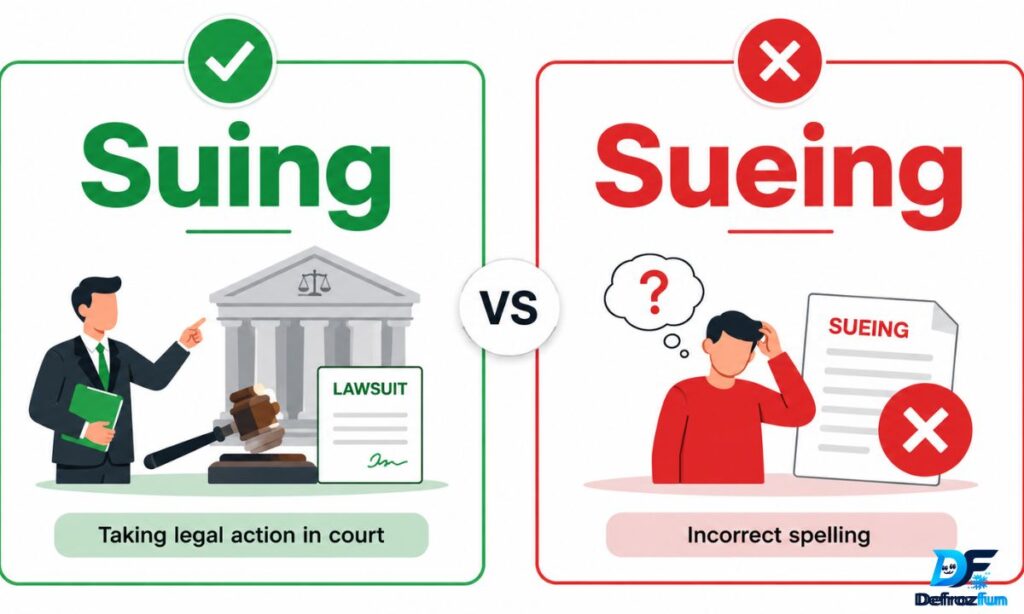
“Suing” is correct. “Sueing” is not a word.
The verb “sue” follows a standard English spelling rule: when a verb ends in a silent “e,” you drop that “e” before adding “-ing.” So sue → suing, not sue → sueing. No dictionary, style guide, or grammar authority recognizes “sueing” as an accepted spelling, in either British or American English.
Sueing vs Suing: Meaning
Before comparing the two spellings, it helps to understand what the correct word actually means.
Suing is the present participle and gerund form of the verb “sue.” It refers to the act of taking legal action against a person, company, or organization, typically to resolve a dispute, claim damages, or enforce a legal right through a civil court.
- As a present participle: She is suing her former employer.
- As a gerund (acting like a noun): Suing isn’t always the fastest way to resolve a dispute.
Sueing has no accepted meaning in standard English. It’s simply a misspelling that happens when writers mistakenly keep the silent “e” from “sue” before adding “-ing.”
Sueing vs Suing: Difference
The difference isn’t about meaning — it’s entirely about correctness. Here’s a side-by-side breakdown:
| Feature | Suing | Sueing |
| Correct spelling | ✅ Yes | ❌ No |
| Found in dictionaries | ✅ Yes (Merriam-Webster, Cambridge, Oxford) | ❌ No |
| Follows spelling rule | ✅ Drops silent “e” before “-ing” | ❌ Keeps silent “e” incorrectly |
| Used in legal/formal writing | ✅ Standard | ❌ Never appropriate |
| Common cause | Correct grammar application | Confusion with spelling pattern |
There’s no situation — formal, informal, legal, or casual — in which “sueing” is the right choice. Whenever you mean “taking legal action,” the answer is always “suing.”
Grammar Rule Depth
The rule governing this spelling isn’t unique to “sue.” It’s a general pattern in English morphology:
Rule: When a verb ends in a silent “e,” drop the “e” before adding a suffix that begins with a vowel (like “-ing” or “-ed” in some cases).
This keeps pronunciation consistent and avoids awkward double-vowel combinations. Compare:
- make → making (not makeing)
- like → liking (not likeing)
- hope → hoping (not hopeing)
- sue → suing (not sueing)
Notice that “sue” already ends in a vowel-based silent “e” pattern, so the rule applies just as cleanly as it does with “make” or “hope.” There’s no special exception for “sue” — it’s a textbook case of the rule in action.
Why the “u” Doesn’t Change the Rule
Some learners assume that because “sue” ends in “ue” rather than a consonant + “e” (like “like” or “hope”), the rule might work differently. It doesn’t. The silent “e” is still dropped regardless of what precedes it — the same logic applies to words like “argue” → “arguing” and “continue” → “continuing.”
Verb Forms of Sue
Here are all the standard conjugated forms of the verb “sue”:
| Form | Word | Example |
| Base form | sue | They may sue the company. |
| Present participle / Gerund | suing | He is suing for damages. |
| Simple past | sued | She sued her landlord last year. |
| Past participle | sued | The case has been sued to a close. |
| Third-person singular present | sues | He sues at the slightest provocation. |
There is no correct verb form of “sue” that includes “sueing.” Every conjugated form either drops the silent “e” (suing) or adds a suffix directly after it (sued, sues).
The Origin of Sue
“Sue” traces back to Middle English forms like seuen and sewen, borrowed from Anglo-Norman suer and Old French sivre, meaning “to follow after” or “to pursue.” That root ultimately comes from the Latin verb sequī (“to follow”) — the same root behind “sequence” and “pursue.”
Over time, the meaning narrowed from general “pursuing” to the specific legal sense used today: pursuing a claim through the courts. An older, now-archaic meaning was “to court” or “to woo” someone — a sense that survives faintly in the word “suitor.”
Also Read This: Thier or Their? Learn the Correct Spelling, Grammar Rules, and Examples (2026)
Why People Write Sueing Instead of Suing
If the rule is so consistent, why does “sueing” show up so often online? A few reasons stand out:
- Visual instinct: writers see “sue” and want to preserve the full spelling before adding a suffix, the way “see” becomes “seeing.”
- Confusion with different vowel patterns: words ending in a stressed double vowel (see, agree, free) do keep both letters before “-ing.” Since “sue” also ends in two vowels, writers mistakenly group it with that pattern instead of the silent-“e” pattern it actually follows.
- Autocorrect and spellcheck gaps: some tools don’t flag “sueing,” especially in fast or informal typing.
- Repetition of the error: once a misspelling spreads in casual writing, others copy it without checking.
Understanding that “sue” behaves like “hope” and “like,” not like “see” and “agree,” is the fastest way to fix this for good.
Real World Usage of Suing
“Suing” appears constantly in legal journalism, business news, and everyday conversation:
- News headline: “Customer Suing Airline Over Lost Luggage”
- Legal correspondence: “Please be advised that our client is suing for breach of contract.”
- Everyday conversation: “I heard she’s suing her old roommate over the deposit.”
Suing in Everyday Examples
- The tenant is suing the landlord for failing to make repairs.
- They were suing over a workplace injury before settling out of court.
- Would you actually consider suing a friend over something like this?
- The company has spent millions suing competitors for patent infringement.
- I’d rather negotiate than end up suing someone I used to trust.
Suing Synonym
Depending on tone and context, several words and phrases can substitute for “suing”:
- Taking legal action
- Filing a lawsuit
- Litigating
- Bringing a case (against someone)
- Prosecuting (in a civil sense)
- Pursuing legal remedies
- Taking someone to court
These aren’t always perfect one-word swaps, but they work well when you want to vary your sentence structure in legal or journalistic writing.
Common Mistakes with Sueing vs Suing
Watch out for these frequent errors:
- Writing “sueing” in any context — there’s no exception; it’s always incorrect.
- Assuming legal documents are more forgiving — formal writing demands more precision, not less.
- Mixing up “sue” with double-vowel verbs like “see” or “free”, which follow a different pattern.
- Using “suing” as an awkward noun, e.g. “The suing was filed yesterday” instead of “The lawsuit was filed yesterday.”
- Confusing “sued” with “suede” — unrelated words that sometimes get typo-swapped.
Related Words and Legal Terms
Since “suing” lives primarily in legal contexts, it helps to know a few related terms:
| Term | Meaning |
| Plaintiff | The person or party who initiates a lawsuit (the one suing) |
| Defendant | The person or party being sued |
| Lawsuit | A formal legal action brought before a court |
| Litigation | The overall process of taking legal action through the courts |
| Damages | Monetary compensation sought or awarded in a lawsuit |
| Settlement | An agreement reached to resolve a dispute without going to trial |
Sue Past Tense
The simple past tense and past participle of “sue” is sued, not “sueed” or “sued” with any variation.
- Simple past: She sued the company for wrongful termination.
- Past participle (with auxiliary verb): He has sued three former business partners.
Just like “suing,” the past tense form doesn’t retain the silent “e” issue in a confusing way — “sued” is formed simply by adding “-d,” which is the standard pattern for verbs already ending in “e.”
Suing in Different Contexts
“Suing” isn’t limited to courtroom drama — it shows up across several settings:
- Personal disputes: neighbors suing over property lines, roommates suing over unpaid rent.
- Business and corporate law: companies suing competitors over patents or breach of contract.
- Employment: employees suing employers for wrongful termination or unpaid wages.
- Consumer protection: customers suing businesses over faulty products or false advertising.
- Family law: rare, but possible in disputes over contracts or shared finances.
The spelling stays the same in every context: suing.
Usage Trends
Published writing, news archives, and dictionaries treat “suing” as the dominant and essentially exclusive form. “Sueing” appears almost only in informal, unedited text — social posts, forum comments, quick messages — where spellcheck may miss it. In edited, professional, and academic writing, “sueing” essentially doesn’t appear.
Exercise 1: Choose the Correct Word
Choose “suing” or “sueing” for each sentence.
- She is __________ her employer for unfair dismissal.
- They were __________ over a contract dispute.
- Is he seriously __________ his own brother?
- The company is __________ for damages after the accident.
- I don’t think __________ is the right solution here.
Answers: 1. suing 2. suing 3. suing 4. suing 5. suing
Exercise 2: Correct the Sentence
Rewrite each sentence, fixing the spelling error.
- The customer is sueing the store for false advertising.
- He mentioned sueing his landlord next month.
- They ended up sueing each other over the property.
Corrected:
- The customer is suing the store for false advertising.
- He mentioned suing his landlord next month.
- They ended up suing each other over the property.
Conclusion
The takeaway here is simple: “suing” is correct, and “sueing” is a spelling mistake with no place in standard English. The rule behind it — dropping a silent “e” before adding “-ing” — is one of the most consistent patterns in English grammar, and “sue” follows it exactly the way “hope,” “like,” and “make” do.
Whether you’re drafting a legal letter, writing a news headline, or just texting a friend about a dispute, remembering this one rule will keep your writing accurate and polished every time.

Daniel Brooks is a passionate writer and digital content creator dedicated to sharing insightful, engaging, and informative articles across multiple niches. With a strong interest in technology, lifestyle, trending topics, and online media, Daniel Brooks focuses on delivering well-researched and reader-friendly content that inspires and informs audiences worldwide.