

Few word pairs trip up writers as often as rational and rationale. They look almost identical, they sound close when spoken quickly, and both connect to the idea of logic and reasoning. Yet one is an adjective and the other is a noun, and mixing them up in an email, essay, or business report can quietly undercut your credibility.
This guide breaks down everything you need to know: definitions, grammar rules, pronunciation, real world examples, common mistakes, synonyms, and simple memory tricks so you never confuse them again.
Quick Answer
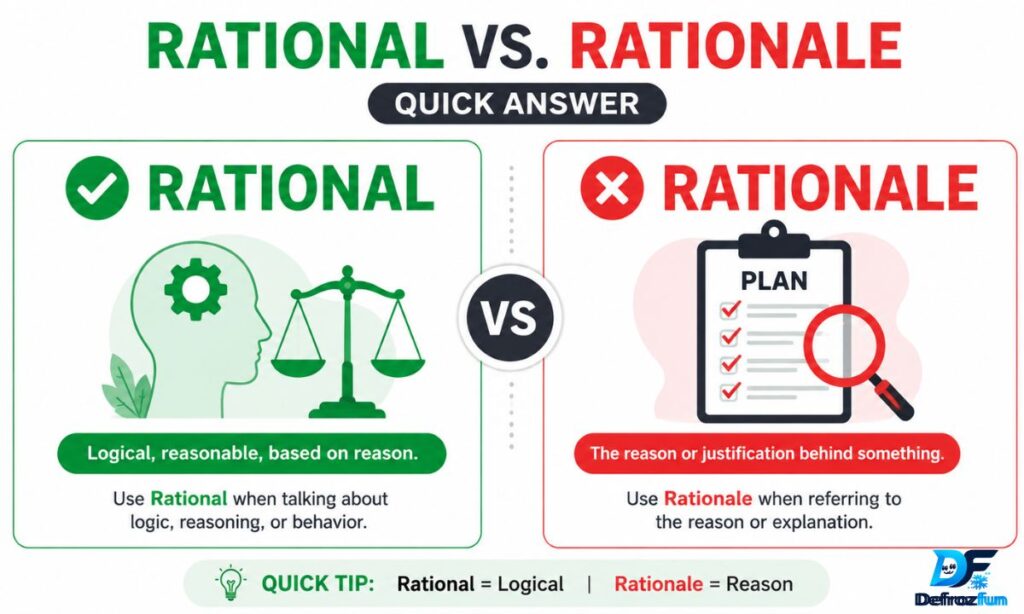
Rational is an adjective that describes a person, decision, or idea as logical, sensible, or based on reason. Rationale is a noun that names the set of reasons or the logical basis behind a decision, belief, or action.
| Word | Part of Speech | Meaning | Example |
| Rational | Adjective | Logical, sensible, reasonable | She made a rational choice. |
| Rationale | Noun | The reasoning or justification behind something | Explain the rationale for the plan. |
Understanding the Meaning of Rational
Rational describes thinking, behavior, or people guided by logic rather than emotion. A rational person weighs evidence, considers consequences, and reaches sound conclusions instead of acting on impulse.
Typical uses include:
- Rational thought – thinking clearly and logically
- Rational decision – a choice grounded in evidence
- Rational explanation – a sensible account of events
- Rational number – in mathematics, a number expressible as a fraction
Example sentences:
- The board reached a rational conclusion after reviewing every report.
- It is hard to stay rational when emotions run high.
- His argument was rational, well structured, and easy to follow.
Because rational is an adjective, it always modifies a noun. It answers the question “what kind?” rather than “why?”
Understanding the Meaning of Rationale
Rationale is a noun that refers to the underlying reasons, justification, or logical basis behind a decision, policy, or belief. When someone asks for your rationale, they want to know why you did something, not just what you did.
Typical uses include:
- Rationale for a decision – the reasoning that supports it
- Rationale behind a policy – the justification for a rule
- Business rationale – the strategic reasoning for an action
- Study rationale – the justification section in academic research
Example sentences:
- The manager explained the rationale behind the new schedule.
- Researchers must state a clear rationale in the introduction of a paper.
- What is the rationale for cutting the marketing budget?
Rationale never describes a noun directly. It functions as the subject or object of a sentence, standing in for the explanation itself.
Grammar Rules Explained Clearly
The simplest way to tell these words apart is to check their grammatical role.
- Rational is an adjective. It sits before a noun (a rational decision) or after a linking verb (the decision was rational).
- Rationale is a noun. It can be the subject of a sentence (the rationale was sound) or the object of a preposition (behind the rationale).
- Watch the prepositions. Phrases like “the rationale for,” “the rationale behind,” and “explain the rationale” almost always require the noun form, not rational.
- Check what follows the word. If a noun immediately follows (rational approach, rational thinking), the adjective is correct. If the word stands alone as the point of the sentence, use rationale.
A fast test: try replacing the word with “logical” (for rational) or “reasoning” (for rationale). If “logical” fits, use rational. If “reasoning” fits, use rationale.
Also Read This: Seeing or Seing? Meaning, Spelling, Grammar Rules & Examples (2026)
Pronunciation Differences
Although only one letter separates them in spelling, rational and rationale are pronounced differently, which is one reason confident speakers still misspell them.
| Word | Pronunciation | Syllables |
| Rational | RASH-uh-nuhl | 3 |
| Rationale | rash-uh-NAL | 3 |
The key difference is the final syllable. Rational ends in a soft, unstressed “nuhl” sound, while rationale ends with a stressed “nal,” rhyming with words like “pal” or “shall.” Saying both words aloud a few times helps train your ear to catch the difference before it appears in writing.
Why People Confuse Rational vs Rationale
Several factors make this pair especially tricky:
- Shared root: Both words come from the Latin “rationalis,” related to reason and calculation, so their meanings feel connected.
- Near identical spelling: Only the final syllable differs, making typos easy, especially when typing quickly or relying on autocorrect.
- Similar sound: Fast speech can blur the final syllables, so listeners may not register the difference.
- Formal contexts: Both words appear frequently in academic, business, and legal writing, where a small error stands out more than in casual conversation.
Rational vs Rationale in Real-Life Usage
Seeing both words in everyday contexts makes the distinction easier to internalize.
- Workplace: “The rationale for the merger was cost savings, but not everyone thought it was a rational move.”
- Academic writing: “The study’s rationale is outlined in the first chapter, supported by rational analysis of prior research.”
- Everyday conversation: “I don’t understand your rationale, but I’ll admit your reasoning sounds rational.”
- Legal writing: “The court requested a clear rationale before accepting the rational basis of the claim.”
Which One Should You Use
Ask yourself these three quick questions before choosing a word:
- Am I describing a person, idea, or decision? Use rational.
- Am I explaining the reasons behind something? Use rationale.
- Does a noun follow the word directly? If yes, rational. If the word stands alone as the main idea, rationale.
Common Mistakes and Corrections
| Incorrect | Correct | Why |
| The rational for the study was unclear. | The rationale for the study was unclear. | Needs a noun, not an adjective |
| She gave a rationale explanation. | She gave a rational explanation. | Needs an adjective before “explanation” |
| His decision was rationale. | His decision was rational. | Describing a decision requires the adjective |
| Explain your rational behind this plan. | Explain your rationale behind this plan. | “Behind” signals the noun form is needed |
Rational vs Rationale in Extended Examples
- Correct: A rational thinker considers all sides before forming an opinion.
- Correct: The rationale behind the layoffs was never fully explained to staff.
- Incorrect: The company’s rational was to cut costs. (should be rationale)
- Incorrect: He is a rationale person who avoids drama. (should be rational)
Rational vs Rationale Pronunciation Recap
Practicing minimal pairs out loud, such as “national and rational” versus “locale and rationale,” can help reinforce the correct stress pattern for each word.
Synonyms of Rational
- Logical
- Sensible
- Reasonable
- Sound
- Practical
- Level-headed
Synonyms of Rationale
- Reasoning
- Justification
- Basis
- Explanation
- Grounds
- Logic
Rational vs Rationale Grammar Snapshot
| Feature | Rational | Rationale |
| Part of speech | Adjective | Noun |
| Modifies a noun | Yes | No |
| Common prepositions | N/A | for, behind, of |
| Plural form | N/A | rationales |
Practice Exercises
Choose the correct word for each sentence.
- The teacher asked for a clear _______ (rational/rationale) behind the essay topic.
- It is not always easy to remain _______ (rational/rationale) under pressure.
- Their _______ (rational/rationale) for the price increase made sense.
- He is known as a highly _______ (rational/rationale) thinker.
Answers: 1. rationale, 2. rational, 3. rationale, 4. rational
Advanced Usage in Academic Writing
In research papers, the rationale usually appears early, often in the introduction or methodology section, to justify why the study matters and what gap it fills. A strong rationale connects existing literature to the researcher’s chosen approach. Meanwhile, rational is used sparingly in academic writing, typically to describe reasoning, choices, or approaches as logically sound, such as “a rational model of decision making.”
Rational vs Rationale in Business Strategy
In corporate settings, a business rationale explains why a company pursues a merger, budget cut, or new product line. Executives are frequently asked to present the rationale to stakeholders before approval. On the other hand, rational is used to describe the thinking process itself, such as a “rational approach to risk management” or a “rational pricing strategy.” Confusing the two in a boardroom document can weaken an otherwise strong proposal, so proofreading for this specific pair is worth the extra minute.
Memory Trick to Remember the Difference
Here is a simple trick: rationale ends the same way as “tale,” and a tale is a story you tell to explain something, which mirrors how a rationale tells the story behind a decision. Rational, on the other hand, sounds closer to “national,” reminding you that it is a describing word, just like “national” describes a park, anthem, or holiday.
Conclusion
Rational and rationale may share a common origin, but they serve very different purposes in a sentence. Rational is your go to word when describing logical thinking, sensible decisions, or reasonable behavior.
Rationale is what you reach for when explaining the reasons, justification, or logic behind a choice. Keep the grammar test in mind: if a noun follows, use rational; if the word stands as the main idea, use rationale. With a bit of practice and the tricks covered in this guide, you will never second guess which one to use again.

Daniel Brooks is a passionate writer and digital content creator dedicated to sharing insightful, engaging, and informative articles across multiple niches. With a strong interest in technology, lifestyle, trending topics, and online media, Daniel Brooks focuses on delivering well-researched and reader-friendly content that inspires and informs audiences worldwide.