

If you have ever shopped for a furnace part, read a car manual, or Googled a spelling before hitting send on an email, you have probably run into this exact problem: is it ignitor or igniter? Both spellings show up constantly online, in product listings, and even in technical manuals, which makes the confusion completely understandable.
The short version is that both words are real and both are used to describe the same kind of device. But there is a right context for each, and knowing it will make your writing look sharper and more professional. This guide breaks down the meaning, origin, and correct usage of ignitor and igniter, with practical examples and quick exercises so you never second guess yourself again.
Quick Answer
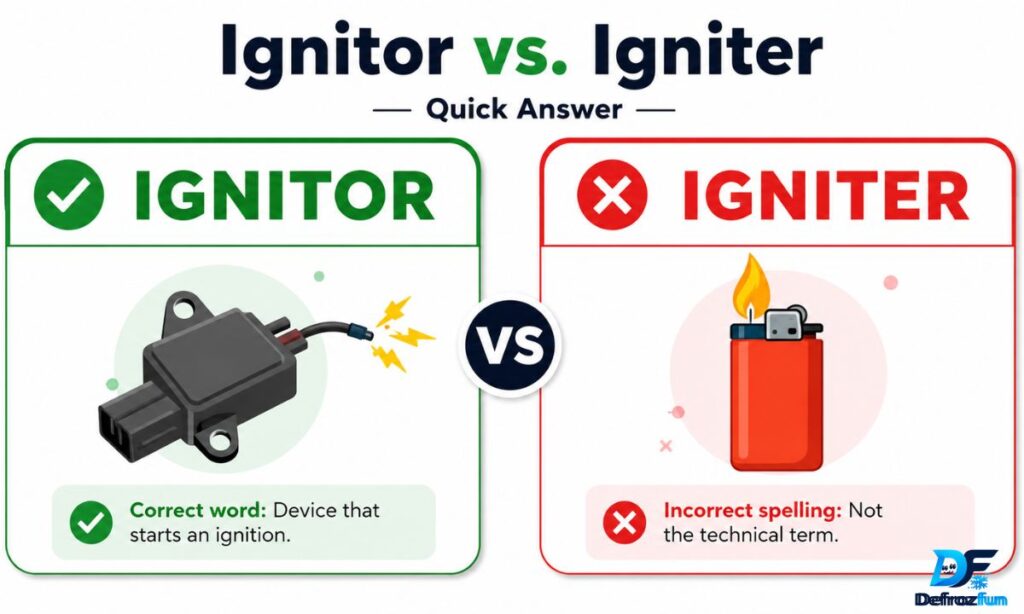
Igniter is the standard, widely accepted spelling used in modern English, everyday appliances, and general writing. Ignitor is a variant spelling that shows up mostly in older technical documents, patents, and specific industries like automotive and aerospace engineering.
In everyday writing, emails, blog posts, and product descriptions, go with igniter. Use ignitor only if you are matching a specific industry term, a brand name, or a technical document that already uses that spelling.
| Term | Status | Common Setting |
| Igniter | Preferred, modern standard | Everyday appliances, general writing, most industries |
| Ignitor | Accepted variant | Automotive parts, aerospace, older technical manuals |
Ignitor vs Igniter Meaning
Both words describe the same basic thing: a device or component that starts combustion by producing a spark, heat, or flame. Whether it is lighting the burner on a gas stove or firing up the fuel mixture in a car engine, the job of an ignitor or igniter is the same.
An igniter (or ignitor) typically works in one of these ways:
- Producing an electric spark to ignite gas or fuel
- Generating enough heat to trigger combustion directly
- Sending a pulse of energy that sets off a chemical reaction, as in rocket engines or fireworks
So when someone asks “what does igniter mean” or “what does ignitor mean,” the honest answer is: the same thing. The meaning does not change based on the spelling. What changes is how formal, technical, or regionally specific the word sounds.
Ignitor vs Igniter Difference
Since the meaning is identical, the real difference between ignitor and igniter comes down to spelling convention, not definition. Here is a side-by-side look at how the two typically diverge in real-world use.
| Feature | Igniter | Ignitor |
| Meaning | Device that starts combustion | Device that starts combustion |
| Suffix type | “-er” (agent noun, common in English) | “-or” (agent noun, often Latin-influenced) |
| Frequency of use | More common overall | Less common, more specialized |
| Typical industries | Appliances, HVAC, home products, general tech | Automotive ignition systems, aerospace, some legacy engineering documents |
| Formality | Neutral to modern | Slightly more formal or technical tone |
| Dictionary standing | Primary listed spelling in most modern dictionaries | Often listed as a variant of “igniter” |
The takeaway: there is no meaning-based reason to pick one over the other. It is purely a spelling and context decision, similar to choosing between “advisor” and “adviser.”
The Origin of Ignitor and Igniter
Both words trace back to the Latin verb ignire, meaning “to set on fire,” which itself comes from ignis, the Latin word for “fire.” As the word moved into English, it picked up an agent noun ending, the part of a word that tells you it describes “a person or thing that does something.”
English actually has two competing agent suffixes:
- “-er”, as seen in words like starter, heater, printer, and lighter
- “-or”, as seen in words like actor, advisor, and inventor, often carrying a slightly more formal or Latin-rooted feel
Because “ignite” entered English during a period when both suffix patterns were actively used, it ended up with two accepted spellings. Over time, as combustion technology developed in cars, furnaces, and appliances, the “-er” version gradually became the everyday default, while “-or” stuck around in more specialized or older technical writing.
Why Igniter Is More Common
If you compare usage across dictionaries, style guides, and modern product manuals, igniter wins by a clear margin. A few reasons explain why:
- Simpler, more familiar pattern: English speakers are used to “-er” endings on device names (blender, toaster, printer), so igniter feels natural and easy to read.
- Manufacturer and brand adoption: Most appliance and automotive brands today print “igniter” on packaging, manuals, and websites, which reinforces it as the default.
- Dictionary preference: Major dictionaries list igniter as the primary entry, with ignitor noted as a secondary or regional variant.
- Search and content trends: General audiences searching for parts, definitions, or troubleshooting tips overwhelmingly type “igniter,” which has made it the standard term across consumer content.
Ignitor has not disappeared, though. It survives in specific technical corners, particularly automotive ignition systems and aerospace or rocketry contexts, where older documentation and industry habit keep the “-or” spelling alive.
Which Spelling Should You Use
Here is a simple way to decide:
- Writing for a general audience? Use igniter. It is the modern, widely recognized spelling.
- Referring to a specific automotive or aerospace part? Check the manufacturer’s documentation. If the official part name uses ignitor, match it exactly.
- Quoting or citing a technical source? Keep the original spelling used in that source for accuracy.
- Unsure? Default to igniter. It is correct in nearly every context and will not look out of place.
A helpful memory trick: think of igniter like other everyday “-er” device names such as heater, printer, and toaster. If those feel natural to you, igniter will too.
Common Mistakes with Ignitor vs Igniter
Even confident writers slip up here. Watch out for these common errors:
- Mixing spellings in the same document. Pick one and stay consistent throughout.
- Assuming one spelling is “wrong.” Both are valid English words; the issue is context, not correctness.
- Using ignitor in casual writing just to sound technical. It can come across as overly formal or like a typo to general readers.
- Ignoring official part names. If a manufacturer labels a part “ignitor,” changing it to “igniter” in a repair guide can cause ordering confusion.
- Assuming spelling reflects function. Neither spelling implies a different mechanism, spark type, or voltage.
Also Read This: Lended vs. Lent: Meaning, Difference, Grammar Rules, Examples, and Correct Usage (2026 Guide)
Ignitor vs Igniter in Everyday Examples
Seeing both words in context makes the distinction click faster.
Using igniter:
- The gas grill igniter clicked but failed to produce a spark.
- Our technician replaced the furnace igniter during the routine service visit.
- The oven igniter glows red before the burner ignites.
Using ignitor:
- The vehicle’s distributor-based ignitor needed replacement after years of wear.
- Engineers tested the rocket’s ignitor sequence before the launch simulation.
- The vintage water heater still uses its original ignitor assembly.
Notice that in each pair, the sentence structure and meaning stay identical. Only the spelling shifts based on the setting.
Ignitor vs Igniter Usage Trends
Across published writing, product documentation, and everyday communication, igniter has steadily pulled ahead as the dominant form:
- American English leans heavily toward igniter in consumer and appliance contexts.
- Legacy and technical industries, especially automotive ignition systems and aerospace, still favor ignitor in official parts catalogs.
- Search behavior shows most people typing “igniter” when looking up parts or troubleshooting guides.
- Style guides generally recommend igniter unless quoting a technical source or brand name.
If you are writing for a broad audience, igniter is the safer, more future-proof choice.
Exercise 1: Choose the Correct Word
Fill in the blank with either “igniter” or “ignitor.”
- The stove’s ______ clicked several times before the burner lit.
- The mechanic ordered a replacement ______ for the classic car’s ignition system.
- Our furnace ______ needs cleaning before winter.
- The rocket team double checked the ______ wiring before ignition.
(Answers: 1. igniter, 2. ignitor, 3. igniter, 4. ignitor — though igniter also works correctly in most of these unless matching a specific technical term.)
Exercise 2: Correct the Sentence
Rewrite each sentence using the more appropriate spelling for a general audience.
- “The grill ignitor stopped sparking.”
- “I need a new igniter for my car’s old ignition system.”
- “The technician checked the oven ignitor before the repair.”
(Suggested corrections: 1. “The grill igniter stopped sparking.” 2. “I need a new ignitor for my car’s old ignition system.” 3. “The technician checked the oven igniter before the repair.”)
Conclusion
Ignitor and igniter are two spellings of the same word, both rooted in the Latin term for fire and both describing a device that starts combustion. Igniter has become the modern standard across everyday writing, appliances, and general communication, while ignitor holds its ground in specific technical fields like automotive and aerospace engineering.
When in doubt, reach for igniter. It reads naturally, matches most dictionaries and style guides, and works in nearly any context. Save ignitor for situations where you are matching an official part name or a technical source that already uses that spelling. Either way, now you can write and speak with confidence, knowing exactly why both words exist and when each one belongs.

Daniel Brooks is a passionate writer and digital content creator dedicated to sharing insightful, engaging, and informative articles across multiple niches. With a strong interest in technology, lifestyle, trending topics, and online media, Daniel Brooks focuses on delivering well-researched and reader-friendly content that inspires and informs audiences worldwide.