

If you have ever paused mid-sentence wondering whether to write “I was laying on the couch” or “I was lying on the couch,” you are not alone. This is one of the most commonly confused word pairs in the English language, and even experienced writers slip up. The good news is that once you understand one simple rule, the confusion disappears for good.
This guide breaks down the grammar rules, verb forms, and real-world examples you need to use “laying” and “lying” correctly every time — with no jargon and no guesswork.
Laying or Lying Quick Answer
Here is the short version before we go deeper:
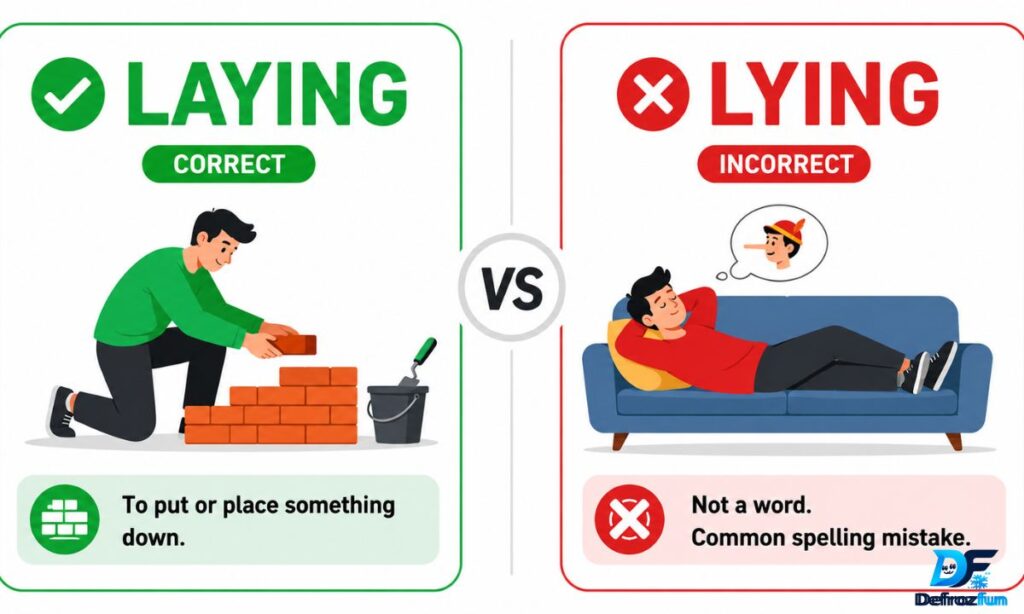
- Lie means to recline or rest in a flat position. It does not take a direct object. Its -ing form is lying.
- Lay means to place or put something down. It requires a direct object. Its -ing form is laying.
So if you are talking about a person or animal resting, use lying: “The dog is lying on the rug.”
If you are talking about placing something somewhere, use laying: “She is laying the blanket on the bed.”
A quick trick: if you can replace the word with “placing” or “putting,” use laying. If you cannot, use lying.
Grammar Rules Explained Clearly
The confusion between these two verbs comes down to one grammatical concept: the direct object.
A direct object is the noun or pronoun that receives the action of the verb. Ask yourself: is the subject doing something to an object, or is the subject simply resting?
| Verb | Meaning | Takes an Object? | Base Form | -ing Form |
| Lie | To recline or rest | No | lie | lying |
| Lay | To place or put down | Yes | lay | laying |
If there is an object in the sentence — something being placed — you need a form of “lay.” If the subject itself is the one resting, you need a form of “lie.”
Examples:
- I lie down every afternoon. (no object — correct use of “lie”)
- I lay the book on the table. (object: “the book” — correct use of “lay”)
- The cat lies in the sun. (no object)
- The cat lays her paw on my hand. (object: “her paw”)
Also Read This: Thier or Their? Learn the Correct Spelling, Grammar Rules, and Examples (2026)
Why People Confuse Laying or Lying
There are three main reasons this pair trips people up so often:
- Overlapping past tense forms. The past tense of “lie” is “lay,” which is also the base form of the other verb. This overlap is the single biggest source of confusion.
- Similar spelling and sound. Both words look and sound alike, so the brain often autocorrects one to the other in casual speech.
- Common informal usage. In everyday conversation, many native speakers say “lay down” instead of “lie down.” This nonstandard use is so widespread that it starts to feel correct, even though it is not accepted in formal writing.
Understanding these root causes makes it easier to catch yourself before making the mistake.
Laying or Lying in Bed
This is one of the most searched examples of this confusion, and it has a clear answer.
- Correct: “I am lying in bed.” (You are resting — no object.)
- Incorrect: “I am laying in bed.” (This would only be correct if you were placing something in bed, such as “I am laying the baby in bed.”)
So the next time you want to describe resting under the covers, remember: you lie in bed, you don’t lay in bed — unless you’re putting something there.
Deep Grammar Breakdown With Objects
The clearest way to master this rule is to test every sentence with the “object check.”
Step-by-step test:
- Look at the verb in question.
- Ask: “Is something being placed or put down?”
- If yes, identify the object receiving the action.
- If an object exists, use a form of “lay.” If not, use a form of “lie.”
Examples with objects (use “lay”):
- She lays the napkin beside the plate. (object: napkin)
- He is laying tile in the kitchen. (object: tile)
- They laid their weapons on the ground. (object: weapons)
Examples without objects (use “lie”):
- The papers lie scattered across the desk.
- I like to lie down after lunch.
- The town lies at the base of the mountain.
Notice that “lie” can also describe the position of an inanimate object, like papers or a town, as long as nothing is actively placing it there.
Verb Forms Comparison Table
Because both verbs are irregular, their forms change across tenses. This table is the fastest way to check yourself.
| Tense | Lie (to recline) | Lay (to place) |
| Base form | lie | lay |
| Present participle | lying | laying |
| Past tense | lay | laid |
| Past participle | lain | laid |
| Example (present) | I lie down. | I lay the keys down. |
| Example (past) | I lay down yesterday. | I laid the keys down yesterday. |
| Example (past participle) | I have lain down. | I have laid the keys down. |
Real World Usage Examples
Seeing these verbs in natural sentences helps the rule stick.
- The hikers were lying in the shade after the long climb.
- The contractor is laying the foundation this week.
- She lay awake for hours before finally falling asleep.
- He laid the newspaper on the porch every morning.
- The old house has lain empty for years.
- The workers have laid new pipes under the street.
Laying or Lying Past Tense
Past tense is where most mistakes happen, so it deserves its own spotlight.
- Lie → lay (past tense): “Yesterday, I lay on the beach for hours.”
- Lay → laid (past tense): “Yesterday, I laid my towel on the sand.”
Notice that “lay” is the past tense of “lie,” which is exactly why people often mix the two up in past-tense sentences. The safest fix is to always run the object check before finalizing your sentence.
Common Mistakes and Corrections
| Incorrect | Correct | Why |
| I am laying down. | I am lying down. | No object — subject is resting |
| She laid on the sofa. | She lay on the sofa. | Past tense, no object |
| The dog is laying by the door. | The dog is lying by the door. | No object |
| He has laid there for hours. | He has lain there for hours. | Past participle, no object |
| I lay my keys on the counter. | I lay my keys on the counter. (correct as is in present tense) | Object present: “my keys” |
A simple habit that helps: before you write “lay” or “laying,” pause and ask if there is an object right after it. If not, switch to a form of “lie.”
Memory Tricks to Remember
These mnemonic devices make the rule stick long-term:
- “Lay” needs a “leg” to stand on — think of “lay” as always needing an object to lean on, just like a table leg supports the table.
- L-I-E has no object, just like “I.” The word “lie” is short and self-contained, describing something the subject does alone.
- Substitute “place” or “put.” If “place” or “put” fits naturally in the sentence, use “lay.” If it sounds wrong, use “lie.”
- Chickens lay eggs. This classic phrase is a great anchor: eggs are the object being placed, so it’s always “lay,” never “lie.”
Related Grammar Confusions
“Laying” versus “lying” is not the only verb pair that causes trouble. A few closely related confusions worth knowing:
- Lie (to recline) vs. lie (to tell a falsehood): These are two completely different verbs that happen to share a spelling. “To tell a falsehood” is a regular verb: lie, lied, lied.
- Sit vs. set: Follows a similar pattern — “sit” doesn’t take an object (“I sit down”), while “set” does (“I set the plate down”).
- Rise vs. raise: “Rise” is intransitive (“The sun rises”), while “raise” requires an object (“I raise my hand”).
Learning these patterns together makes the underlying grammar concept — transitive versus intransitive verbs — much easier to apply across the board.
Laying or Lying on the Floor
Another frequently searched phrase, and the rule stays consistent:
- Correct: “The kids are lying on the floor watching TV.” (no object)
- Correct: “She is laying the towels on the floor to dry.” (object: towels)
If nothing is being placed down by the subject, always default to “lying.”
Practice Exercises
Test yourself with these sentences. Choose the correct verb form.
- I need to (lay/lie) down for a few minutes.
- Please (lay/lie) the documents on my desk.
- Yesterday, the cat (lay/laid) on the windowsill all afternoon.
- The construction crew has (laid/lain) new flooring in the lobby.
- He (lays/lies) awake every night thinking about work.
Answers:
- Lie (no object)
- Lay (object: documents)
- Lay (past tense of “lie,” no object)
- Laid (past participle of “lay,” object: flooring)
- Lies (no object)
Advanced Usage and Edge Cases
A few situations create extra confusion even for confident writers:
- “Lay” as a nonstandard synonym for “lie”: In casual speech, phrases like “I’m gonna lay down” are extremely common. This is widely accepted informally but is considered incorrect in formal writing, academic papers, and professional communication.
- “Lie” meaning “to be situated”: This use doesn’t involve a person resting at all. “The village lies near the river” describes location, not physical rest, but it still follows the intransitive rule.
- Passive constructions: “The blanket was laid across the bed” is correct because “laid” is the past participle of “lay,” and “the blanket” is the object receiving the action, even in passive voice.
- Compound and idiomatic phrases: Expressions like “lay low,” “lay it on thick,” or “lay down the law” all use “lay” because each involves placing or setting something down, even figuratively.
Conclusion
The difference between “laying” and “lying” comes down to a single question: is there an object being placed? If yes, use a form of “lay.” If no, use a form of “lie.” Once this rule becomes second nature, you will never second-guess yourself again, whether you’re writing about laying tile, lying in bed, or anything in between.
Keep the comparison table and memory tricks from this guide handy, and with a little practice, choosing between “laying” and “lying” will become automatic — helping you write with more clarity and confidence every time.

Daniel Brooks is a passionate writer and digital content creator dedicated to sharing insightful, engaging, and informative articles across multiple niches. With a strong interest in technology, lifestyle, trending topics, and online media, Daniel Brooks focuses on delivering well-researched and reader-friendly content that inspires and informs audiences worldwide.