Have you ever typed out the word and suddenly stopped — is it blankie or blanky? You are not alone. Thousands of parents, writers, and English learners search this exact question every month. Both spellings look right, sound the same, and mean the same thing. So what’s actually going on?
This guide breaks it down clearly: which spelling is correct, why both exist, how regional usage plays a role, and when to use each one confidently.
Blankie
Blankie is the most widely accepted and commonly used spelling. It is an informal noun that refers to a small, soft blanket — usually a child’s comfort blanket or security blanket. The word is formed by adding the affectionate “-ie” suffix to the root word blanket.
This “-ie” ending follows a well-established English pattern used to create warm, affectionate diminutive words:
- Doggie (dog)
- Sweetie (sweet)
- Cookie (cook)
- Blankie (blanket)
Most English dictionaries, parenting resources, children’s books, and product listings use blankie as the standard spelling. The Oxford English Dictionary records the earliest known use of blankie from 1899, making it the historically documented form.
Example: She won’t fall asleep without her blankie.
Blanky
Blanky carries the exact same meaning as blankie — a small comfort blanket, especially for young children. The only real difference is the suffix: “-y” instead of “-ie”.
This spelling is not wrong, but it is far less common. It appears occasionally in casual writing, older British literature, and informal online content. However, it is rarely recognized in standard dictionaries as the preferred form.
Blanky also has an interesting pop-culture connection: it is the name of the electric blanket character in the beloved animated film The Brave Little Toaster (1987).
Example: The toddler dragged his blanky across the floor.
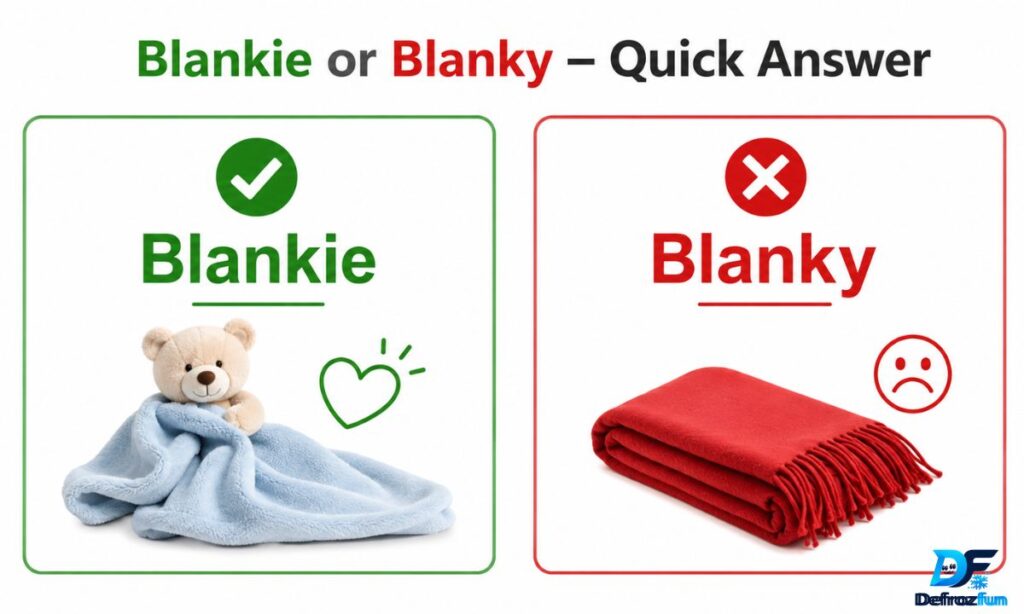
Blankie or Blanky – Quick Answer
| Feature | Blankie | Blanky |
| Spelling | Blankie | Blanky |
| Suffix | -ie | -y |
| Dictionary recognition | ✅ Yes (preferred) | ⚠️ Rare |
| Usage frequency | High | Low |
| Regional preference | US, global | Occasionally UK/AU |
| Formality | Informal | Informal |
| Meaning | Child’s comfort blanket | Same |
| Pronunciation | /ˈblæŋ.ki/ | /ˈblæŋ.ki/ |
Bottom line: Both words mean the same thing and sound identical. Blankie is the correct and preferred spelling in modern English. Use it for writing, parenting content, product listings, or social media.
The Origin of Blankie or Blanky
The story starts with the word blanket. It comes from Middle English blanchet, borrowed from Old French blanquet, meaning “little white” — referring to undyed woolen cloth.
Over time, English speakers began creating a diminutive form of “blanket” to use affectionately, especially when talking to or about young children. The result was blankie (or blanky) — a softer, smaller-sounding version of the word.
The Oxford English Dictionary places the earliest recorded use of blankie in 1899, found in Pedagogical Seminary, an academic journal focused on child development. This tells us the word was already part of everyday parenting language well over a century ago.
The term also aligns with what developmental psychologists call a transitional object — an item that helps young children manage separation anxiety and emotional stress. Dr. Donald Winnicott, a British pediatrician and psychoanalyst, introduced this concept in 1951. The blankie became the most recognizable example of such an object.
Early references to both spellings appear in:
- Children’s stories from the late 19th century
- Parenting manuals from the early 20th century
- North American childcare publications
The “-ie” ending gained broader use in North American English, while the “-y” ending occasionally surfaced in British and Australian writing.
Also Read This: Planing or Planning: A Complete Guide for Learners (2026)
British English vs American English Spelling
Many people assume this is a classic American vs British spelling debate — like color vs colour or favorite vs favourite. It is not quite that simple.
There is no official rule that assigns blankie to American English and blanky to British English. Both spellings appear in both dialects. However, usage data does show some patterns:
| Region | Preferred Spelling | Notes |
| United States | Blankie | Dominant in parenting blogs, product listings |
| United Kingdom | Blankie (mostly) | Blanky appears occasionally in older texts |
| Australia / NZ | Blankie | Follows US digital influence |
| Global online use | Blankie | Standard across social media and e-commerce |
The real reason blankie wins is not geography — it is linguistics. English naturally favors the “-ie” suffix when forming affectionate or diminutive words. Words like auntie, birdie, kiddie, and selfie all follow this same pattern. The “-y” ending is also used (think funny, sunny), but when it comes to warm, child-friendly nouns, “-ie” feels more natural to most speakers.
Which Spelling Should You Use?
Use blankie in almost every situation. Here is a simple guide:
Use blankie when:
- Writing parenting blogs or articles
- Creating product descriptions for baby items
- Posting on social media
- Writing children’s books or stories
- Communicating with a global or American audience
Blanky is acceptable when:
- Writing dialogue that reflects a character’s personal style
- Referencing regional or older usage
- The context is highly casual or creative
Avoid these incorrect spellings entirely:
- ~~Blankee~~ – not recognized in any major dictionary
- ~~Blanckie~~ – not a real variant
- ~~Blankey~~ – uncommon and not standard
If you are unsure, blankie is always the safe choice.
Common Mistakes with Blankie or Blanky
Even native English speakers make errors with this word. Here are the most frequent ones:
Mistake 1: Using “blankee” ❌ We bought a new blankee for the baby. ✅ We bought a new blankie for the baby.
Mistake 2: Treating “blanky” as the standard spelling ❌ Every night, she needs her blanky to feel safe. (not wrong, but not preferred) ✅ Every night, she needs her blankie to feel safe.
Mistake 3: Using it in formal writing ❌ The subject’s blankie was used as a transitional object in the study. ✅ The subject’s security blanket was used as a transitional object in the study.
Mistake 4: Capitalizing it unnecessarily ❌ She lost her Blankie at the park. ✅ She lost her blankie at the park.
Quick rule: Think of words like selfie, doggie, and sweetie — they all use “-ie.” So does blankie.
Blankie or Blanky in Everyday Examples
Seeing these words used naturally in sentences helps lock in the right spelling. Here are real-life examples across different contexts:
Parenting and childcare:
- Don’t forget to pack her blankie for the daycare trip.
- He cried for ten minutes until we found his blankie.
Children’s stories and books:
- Little Max carried his blankie everywhere he went.
- The dragon’s blankie was stitched with golden thread.
Social media and casual conversation:
- I still have my childhood blankie — no shame.
- Toddlers and their blankies are the cutest thing on earth.
Product listings and marketing:
- Our organic cotton blankie is soft, washable, and baby-safe.
- Personalized blankies make perfect newborn gifts.
Figurative or humorous use:
- Coffee is my adult blankie.
- He treats that old hoodie like a blankie.
Notice how blankie feels warm and natural in every one of these sentences. That emotional softness is exactly what the “-ie” suffix is designed to create.
Blankie or Blanky – Google Trends & Usage Data
Search data and online usage consistently support blankie as the dominant form. Here is what the data shows:
| Metric | Blankie | Blanky |
| Google Search Volume (approx.) | High | Low |
| Dictionary entries | Multiple major dictionaries | Rare |
| Parenting website usage | Dominant | Minimal |
| Social media hashtag use | #blankie | Less common |
| Oxford English Dictionary | ✅ Listed (from 1899) | ❌ Not separately listed |
| Children’s product listings | Standard term | Rarely used |
According to Google Trends, blankie consistently outperforms blanky in search interest across the United States, United Kingdom, Canada, and Australia. The search term blankie also appears more frequently in featured snippets, product titles, and parenting forum discussions.
This means if you are writing content for SEO, marketing baby products, or building a parenting brand — blankie is your keyword.
Keyword Variations Comparison Table
| Term | Status | Notes |
| Blankie | ✅ Correct & preferred | Standard spelling, widely recognized |
| Blanky | ⚠️ Acceptable variant | Less common, same meaning |
| Blankee | ❌ Incorrect | Not found in standard dictionaries |
| Blankey | ❌ Incorrect | Non-standard, avoid in writing |
| Security blanket | ✅ Formal alternative | Used in academic/clinical contexts |
| Comfort blanket | ✅ Formal alternative | Common in British English |
| Transitional object | ✅ Technical/clinical term | Used in psychology and child development |
| Lovey | ✅ Related term | Broader — any comfort object, not just a blanket |
| Wubby | ✅ Regional variant | Common in parts of the northeastern US |
Conclusion
The debate between blankie or blanky is simpler than it seems. Both words refer to the same thing — a child’s soft, comforting blanket — and both are pronounced exactly the same way. The only difference is spelling.
Blankie is the correct, preferred, and most widely used spelling. It follows a natural English pattern for affectionate diminutives (-ie), it appears in major dictionaries including the Oxford English Dictionary, and it dominates in parenting content, product listings, and everyday writing worldwide.
Blanky is an acceptable variant, but it is far less common and rarely recognized in dictionaries as the standard form.
The safe, SEO-friendly, and reader-recognized choice is always blankie.
Whether you are a parent writing a daycare note, a blogger covering child development, or a brand selling baby products — stick with blankie. It is the word your readers will recognize, the word search engines expect, and the word that carries that warm, comforting feeling built right into its spelling.

Daniel Brooks is a passionate writer and digital content creator dedicated to sharing insightful, engaging, and informative articles across multiple niches. With a strong interest in technology, lifestyle, trending topics, and online media, Daniel Brooks focuses on delivering well-researched and reader-friendly content that inspires and informs audiences worldwide.