

Are you unsure whether to write analysing or analyzing? You are not alone. This is one of the most common spelling questions in English, and the answer is simpler than you might think.
Both spellings are correct. The one you should use depends entirely on your audience — American English uses analyzing, while British English prefers analysing. Neither is wrong; they just belong to different spelling systems.
Analysing or Analyzing – Quick Answer
| Region | Correct Spelling |
| American English (US, Canada) | Analyzing |
| British English (UK, Australia, India) | Analysing |
| Oxford English (UK formal) | Analyse / Analysing |
Rule: Use analyzing for US audiences. Use analysing for UK or Commonwealth audiences. Never mix both in the same document.
Analysing or Analyzing Meaning
Both words are the present participle of the verb analyze (US) or analyse (UK). The meaning is identical:
To examine something carefully and in detail in order to understand or explain it.
Whether you write analysing or analyzing, you are describing the same action — breaking something down to study its parts, patterns, or structure.
The Origin of Analysing or Analyzing
The word traces back to the Greek word analusis, meaning a breaking up or resolving into parts. It entered English in the 16th century through the French spelling analyser.
In the 19th century, American lexicographer Noah Webster pushed for spelling reforms that simplified and standardized American English. He favoured -ize endings over -ise, which is why American English today uses analyze, organize, and recognize — while British English retains analyse, organise, and recognise.
This is the historical root of the entire British vs American spelling divide.
British English vs American English Spelling

The -ise vs -ize pattern runs across many common English words. Here is how the divide looks:
| Word (US) | Word (UK) | Meaning |
| Analyzing | Analysing | Examining in detail |
| Organizing | Organising | Arranging in order |
| Recognizing | Recognising | Identifying |
| Realizing | Realising | Becoming aware |
| Categorizing | Categorising | Classifying |
One useful memory trick: “British” contains an “s” — and so does “analyse.”
Analyse or Analyze UK
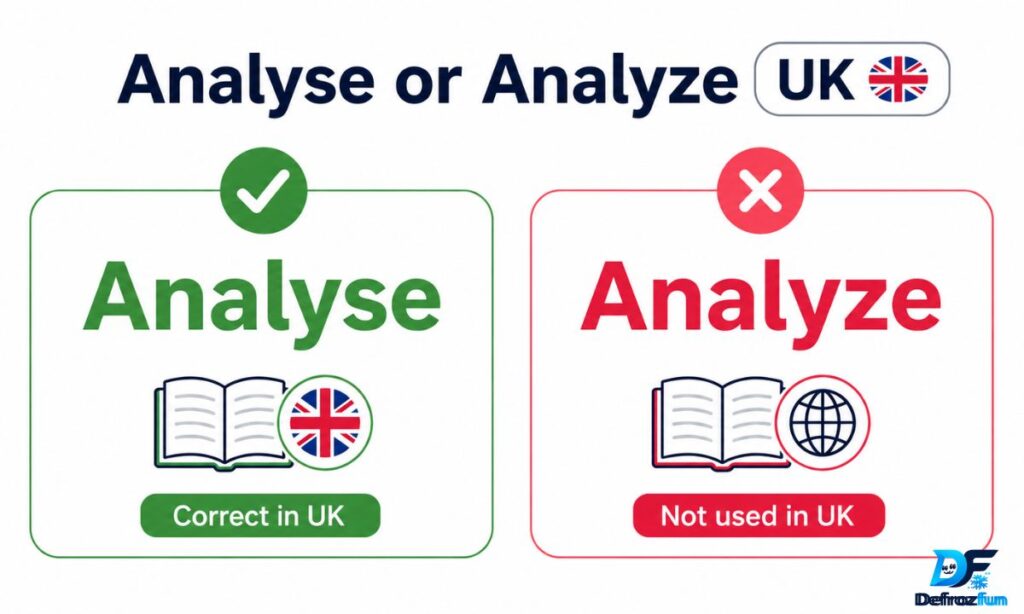
In the UK, analyse is the preferred verb form, and analysing is its present participle. British style guides, academic journals, and news outlets like the BBC and The Guardian consistently use this spelling.
However, UK English does permit analyze — it is not technically wrong. That said, most British editors, teachers, and publishers will default to analyse, and mixing the two within a single document is considered unprofessional.
Australian, Indian, South African, and New Zealand English follow British conventions — so analysing is preferred in those regions too.
Also Read This: Organised or Organized: Common Mistakes Explained (2026)
Analyse or Analyze Oxford English
The Oxford English Dictionary (OED) lists both spellings. Oxford has historically accepted the -ize ending even for British English, which is why some UK publishers use analyze. This is known as the Oxford spelling convention.
However, the Cambridge Dictionary and most mainstream UK style guides prefer analyse. For everyday writing in the UK, analyse/analysing is the safer, more widely accepted choice.
Analyze English
In American English, analyze is the only accepted standard spelling. Using analyse in US-style writing — whether in a report, an academic paper, or a news article — would be flagged as a spelling error by most American editors and grammar tools.
Common forms in American English:
- Base verb: analyze
- Present participle: analyzing
- Past tense: analyzed
- Noun: analysis
Analyze Noun
The noun form of analyze/analyse is analysis. This spelling is the same in both American and British English — there is no analyzis or analyssis.
Correct noun forms:
- The analysis was thorough. ✅
- Analysts completed their analysis last week. ✅
- The analyzis was thorough. ❌ (never correct)
The plural form is analyses (pronounced an-AL-ih-seez).
Analysis or Analyzis
This is a common confusion — but the answer is clear:
Analysis is always correct. Analyzis does not exist in English.
No matter which regional variety of English you write in, the noun is always analysis and its plural is analyses. The verb may change between analyze and analysed, but the noun form stays fixed.
Analysing or Analyzing Synonyms
If you want to vary your language, here are natural synonyms for analysing/analyzing:
- Examining
- Investigating
- Studying
- Evaluating
- Assessing
- Scrutinizing
- Reviewing
- Breaking down
- Dissecting
- Interpreting
These synonyms are useful for avoiding repetition in long-form content, academic writing, and reports.
Analyse or Analyze Pronunciation
Good news: the spelling difference does not affect pronunciation. Both analyze and analyse are pronounced the same way:
AN-uh-lyze /ˈæn.ə.laɪz/
Similarly, analyzing and analysing are both pronounced:
AN-uh-ly-zing /ˈæn.ə.laɪ.zɪŋ/
There is no regional accent difference in how these words sound — only in how they are written.
Analyzing Examples
Here are examples of analyzing used correctly in American English:
- The scientist spent months analyzing the soil samples.
- She is analyzing customer feedback to improve the product.
- The team is analyzing data from last quarter’s sales report.
- Students are analyzing the themes of the novel in class.
- The software is capable of analyzing large datasets in seconds.
Analysing or Analyzing Examples
Here are examples of both forms used correctly side by side:
| American English | British English |
| He is analyzing the results. | He is analysing the results. |
| We are analyzing market trends. | We are analysing market trends. |
| The lab is analyzing the sample. | The lab is analysing the sample. |
| They spent hours analyzing the data. | They spent hours analysing the data. |
Both are grammatically perfect — only the audience differs.
Analysing or Analyzing in English
In formal English writing — whether academic, professional, or journalistic — the key is consistency. Pick one regional standard and apply it throughout your entire document. This includes all related forms: analyze/analyse, analyzed/analysed, analyzer/analyser.
Grammar checkers and spell-check tools can help. Before writing, set your word processor’s language to English (US) or English (UK) so the software applies the right standard automatically.
Analysing or Analyzing Grammar
Grammatically, analysing and analyzing function identically. Both are the present participle of the verb analyze/analyse, used:
- In continuous tenses: “She is analyzing the report.”
- As a gerund (noun): “Analyzing data takes time.”
- As a participial adjective: “The analyzing process was automated.”
There is no grammatical difference between the two — only a spelling one tied to regional English conventions.
Common Mistakes with Analysing or Analyzing
Avoid these frequent errors:
- Mixing spellings in one document — using analyzing in paragraph 2 and analysing in paragraph 5 is inconsistent and unprofessional.
- Writing analyzis — the noun form is always analysis, never analyzis.
- Using analyse in American academic writing — US journals and institutions expect the -ize form.
- Assuming one spelling is wrong — both are correct in their respective contexts.
- Ignoring spell-check language settings — always set your document language before writing.
Analysing or Analyzing in Everyday Examples
This word appears across many real-world contexts:
- Academic papers: “The study focused on analyzing participant responses.”
- Business reports: “The team is analysing Q3 performance metrics.”
- Social media: “Been analysing my spending habits lately — eye-opening.”
- Journalism: “Analysts are analyzing the impact of the new trade policy.”
- Science: “Researchers spent weeks analyzing the chemical composition.”
Analysing or Analyzing – Google Trends & Usage Data
Search data confirms the regional split clearly:
- “Analyzing” dominates in the United States and Canada.
- “Analysing” leads in the United Kingdom, Australia, and South Asia.
- In academic databases like Google Scholar, American journals predominantly use analyzing, while British and Australian journals favour analysing.
- When converting documents from Word to PDF, spelling is preserved exactly — so the correct form must be set before writing, not after.
Google Scholar
Academic researchers should note that Google Scholar indexes both spellings independently. A search for “analysing data” may return different results than a search for “analyzing data” — even if the underlying research is identical. For comprehensive literature reviews, it is worth searching both spellings to avoid missing relevant papers.
Word to PDF
When converting a document from Word to PDF, spell-check settings do not carry over to correct the text. Whatever spelling exists in your Word document will appear exactly the same in the PDF. Always proofread for consistent analysing/analyzing usage before converting.
Behaviour or Behavior
The analysing/analyzing pattern mirrors many other British vs American spelling pairs. Behaviour (UK) and behavior (US) follow the same logic — same word, same meaning, different regional standard.
Other pairs include:
- Colour / Color
- Honour / Honor
- Centre / Center
- Favourite / Favorite
If you are writing for a mixed international audience, pick one regional standard and apply it consistently throughout.
AI Detector
Modern AI detection tools and grammar checkers are trained on large text datasets that include both spellings. These tools generally recognise both analysing and analyzing as correct, and flag them only as errors when your document’s language setting conflicts with the spelling used.
If you are writing content that needs to pass AI detection or grammar review, simply ensure your spelling is internally consistent and matches your declared language standard (US or UK English).
Which Spelling Should You Use?
Here is a simple decision framework:
- Writing for a US audience? → Use analyzing
- Writing for a UK, Australian, or Commonwealth audience? → Use analysing
- Writing for a global/mixed audience? → Pick one and be consistent; American English is generally the default for international business writing
- Academic writing? → Follow the style guide of your institution or journal
- SEO content? → Use the spelling that matches your target audience’s search behaviour
Comparison Table
| Feature | Analyzing (US) | Analysing (UK) |
| Region | United States, Canada | UK, Australia, India |
| Spelling standard | -ize ending | -ise ending |
| Noun form | Analysis | Analysis |
| Pronunciation | Same | Same |
| Formal writing | Correct for US | Correct for UK |
| Both wrong? | No | No |
Conclusion
Analysing and analyzing are two spellings of the same word — one for British English, one for American English. Neither is incorrect in its own context.
The key takeaways:
- Use analyzing in American English
- Use analysing in British and Commonwealth English
- The noun is always analysis — never analyzis
- Pronunciation is identical regardless of spelling
- Always stay consistent within a single document
Once you know your audience, the choice is straightforward. Set your language preference in your word processor, apply it consistently, and write with confidence.

Daniel Brooks is a passionate writer and digital content creator dedicated to sharing insightful, engaging, and informative articles across multiple niches. With a strong interest in technology, lifestyle, trending topics, and online media, Daniel Brooks focuses on delivering well-researched and reader-friendly content that inspires and informs audiences worldwide.