

If you have ever paused mid sentence wondering whether it is “batton” or “baton,” you are not alone. This mix up shows up in school essays, news articles, sports commentary, and even professional writing.
The good news is that the answer is simple once you understand where the confusion comes from and why one spelling has stuck around for centuries while the other never earned a real place in the dictionary.
This guide breaks down the meaning, grammar, pronunciation, and real world usage of baton, clears up the myth around “batton,” and gives you simple tricks so you never second guess the spelling again.
Quick Answer
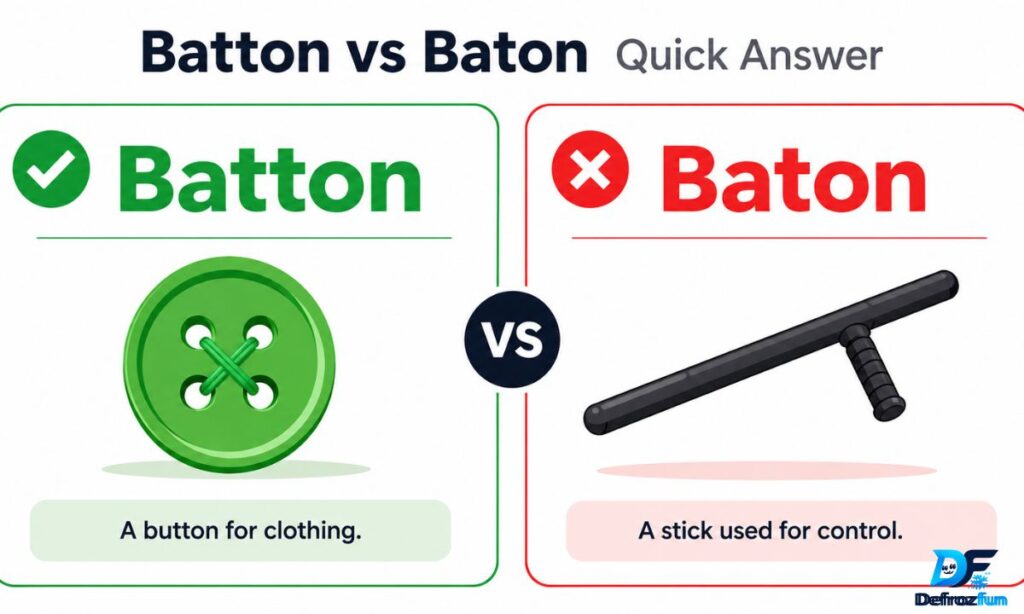
Baton is correct. Batton is not a recognized English word.
| Word | Status | Meaning |
| Baton | Correct, standard English | A stick, rod, or staff used in music, sports, law enforcement, or ceremonies |
| Batton | Incorrect spelling | Common misspelling of baton; sometimes confused with “batten” |
Whenever you are unsure, just remember: one T, French origin, and it always refers to a stick or rod of some kind.
Batton vs Baton Meaning
Baton is a noun that refers to a thin stick, rod, or staff used by a person for a specific purpose. Depending on the setting, it can mean:
- The stick a conductor uses to lead an orchestra
- The tube runners pass to each other in a relay race
- The stick carried by police officers or security personnel
- A ceremonial staff carried during parades or formal events
Batton, on the other hand, has no accepted meaning of its own. It is simply a spelling error that happens when writers add an extra “t” by habit or mishearing. Some dictionaries list it only as a rare surname, never as a common noun.
Batton vs Baton Difference
The core difference is not about meaning at all, since batton does not carry an independent meaning. The real difference is about correctness.
| Feature | Baton | Batton |
| Dictionary status | Standard, recognized word | Not recognized as standard English |
| Origin | French, from “bâton” | No true etymology of its own |
| Common use | Music, sports, law enforcement, ceremonies | Almost always a typing or spelling mistake |
| Acceptable in formal writing | Yes | No |
If your sentence needs a word for a stick or rod used by a runner, conductor, or officer, baton is always the word you want.
Grammar Rule Depth
English keeps quite a few double letter words such as “cotton,” “button,” and “kitten,” so it feels natural to assume baton should follow the same pattern. It does not.
A few grammar points worth remembering:
- Baton is a noun, and in everyday speech it is rarely used as a verb.
- When people do turn it into a verb, especially in woodworking or outdoor contexts, they usually mean “batten,” not “baton.” For example, “batten down the hatches” is a nautical phrase about securing something with strips of wood, and it has nothing to do with a conductor’s stick.
- The plural form is simply “batons,” with no extra letters added.
- Baton stays spelled the same whether it functions as subject or object in a sentence, since it does not change form.
Mixing up baton, batton, and batten is one of the most common small grammar slips in English content writing, so keeping these three words separate in your mind will clean up your writing instantly.
The Origin of Baton
Baton traces back to the French word “bâton,” meaning stick or staff. French itself borrowed the term from Latin roots connected to “bastum,” a word linked to sticks used for support or striking. English absorbed the word centuries ago, first in military and ceremonial contexts, then gradually into music and sports as those fields developed their own traditions around symbolic sticks and rods.
This French connection explains why the word keeps a single “t” and a soft final syllable in pronunciation, a pattern common in many English words borrowed from French.
Also Read This: Sueing vs Suing: Meaning, Difference, Grammar Rules, Examples, and Correct Usage
Why People Make This Mistake
There are a few clear reasons batton keeps showing up in casual writing:
- Phonetic guesswork: The word sounds like it could have a double consonant, similar to “cotton” or “button.”
- Autocorrect quirks: Some spell checkers and keyboards fail to flag the error consistently, especially on mobile devices.
- Confusion with batten: Since batten is a real word used in construction and sailing, writers sometimes blend the two and land on “batton.”
- Fast typing: Writing quickly, especially in casual chats or social media, makes it easy to slip in an extra letter without noticing.
Understanding these triggers makes it much easier to catch the mistake before hitting publish or submit.
Real World Usage of Baton
Baton shows up across several very different fields, and each context adds a slightly different flavor to the same core meaning of a handheld stick or rod.
Music
A conductor holds a baton to guide tempo, dynamics, and the overall flow of an orchestra or choir performance.
Sports
In track and field, a baton is the small tube that relay runners physically pass to their teammate at each exchange zone. Dropping the baton famously costs teams the entire race, no matter how fast each runner is individually.
Law Enforcement and Security
Police officers and security staff sometimes carry a baton as a defensive tool. Depending on the country, it may be called a nightstick, billy club, or truncheon.
Ceremonial and Leadership Use
Military parades, marching bands, and formal ceremonies often feature a baton as a symbol of authority or rhythm.
Baton in Everyday Examples
- “The conductor raised her baton and the orchestra fell silent.”
- “He dropped the baton during the final handoff, costing the team the race.”
- “The officer carried a baton clipped to his belt.”
- “After years of leading the project, she passed the baton to a younger colleague.”
That last example points to one of the most common figurative uses of the word: passing the baton, meaning to hand over responsibility, leadership, or a task to someone else. This phrase grew directly out of relay racing and is now common in business, politics, and everyday conversation.
Batton or Baton Pronunciation
Baton is pronounced differently depending on region:
- American English: buh-TAHN, with stress on the second syllable
- British English: BAT-uhn or buh-TON, often with a lighter stress pattern
There is no separate pronunciation for “batton” because it is not a standalone word. If someone pronounces it with a hard double T sound, they are usually just mispronouncing baton the way it looks when misspelled.
Common Mistakes with Batton vs Baton
- Writing “batton” in resumes, essays, or professional emails
- Confusing baton with batten in DIY, construction, or sailing content
- Using “batton down the hatches” instead of the correct “batten down the hatches”
- Assuming spellcheck will always catch the error, when many tools miss it
- Mixing plural forms, such as writing “battons” instead of “batons”
Baton in Different Contexts
| Context | Meaning of Baton |
| Music | Conductor’s stick for directing a performance |
| Track and field | Tube passed between relay runners |
| Law enforcement | Handheld defensive tool |
| Ceremony or military | Symbol of rank or leadership |
| Figurative speech | Passing responsibility or leadership |
Related Words and Similar Terms
- Batten: A strip of wood or metal used in construction, flooring, or sailing to secure or reinforce a surface
- Wand: A slender stick, often associated with magic or ceremony rather than authority
- Truncheon: A British term closely related to a police baton
- Staff: A longer stick used for support, walking, or symbolic authority
Knowing these related words helps you avoid pulling the wrong term into your writing, especially since batten and baton are the two most frequently confused.
Tips to Remember the Correct Spelling
- Think “one T, like a French seat,” since bâton keeps a single consonant just like many French loanwords.
- Picture a relay race baton as a smooth tube with no rough double letters.
- Remember that “batten” has the “en” ending and belongs to construction, while “baton” has the “on” ending and belongs to music, sports, and ceremony.
- If a spellchecker underlines “batton,” trust it and switch to baton.
Usage Trends
Search interest around this topic tends to spike alongside major sporting events such as the Olympics, when relay races bring the phrase “passing the baton” into daily conversation. Content around correct spelling and grammar also sees steady, year round interest from students, writers, and professionals looking to sharpen their English.
Exercise 1: Choose the Correct Word
Fill in the blank with baton or batton.
- The runner reached out to grab the ______ from her teammate.
- The conductor tapped his ______ twice before the symphony began.
- Please secure the loose wood with a ______ before the storm arrives. (Hint: this one is a trick question)
Exercise 2: Correct the Sentence
Rewrite each sentence with the correct spelling.
- “The officer carried a batton on his belt.”
- “She proudly passed the batton to the next runner.”
- “He raised the batton to start the orchestra.”
Conclusion
The confusion between batton and baton comes down to sound, habit, and a handful of similar looking English words. Once you remember that baton carries a single T and traces back to French, the correct spelling becomes second nature.
Whether you are writing about a relay race, an orchestra performance, or a leadership transition, baton is always the word you want, and batton belongs nowhere in polished, professional writing.

Daniel Brooks is a passionate writer and digital content creator dedicated to sharing insightful, engaging, and informative articles across multiple niches. With a strong interest in technology, lifestyle, trending topics, and online media, Daniel Brooks focuses on delivering well-researched and reader-friendly content that inspires and informs audiences worldwide.