

Have you ever typed “todays meeting” or “todays date” and wondered if you forgot something? That small apostrophe makes a bigger difference than most people realize. It’s one of those tiny grammar details that separates polished writing from careless mistakes — and it comes up every single day.
In this article, we’ll break down the difference between todays and today’s in plain, simple English. No grammar jargon, no confusion. By the end, you’ll know exactly which form to use, when to use it, and why the apostrophe matters more than you think.
Todays or Today’s – Quick Answer
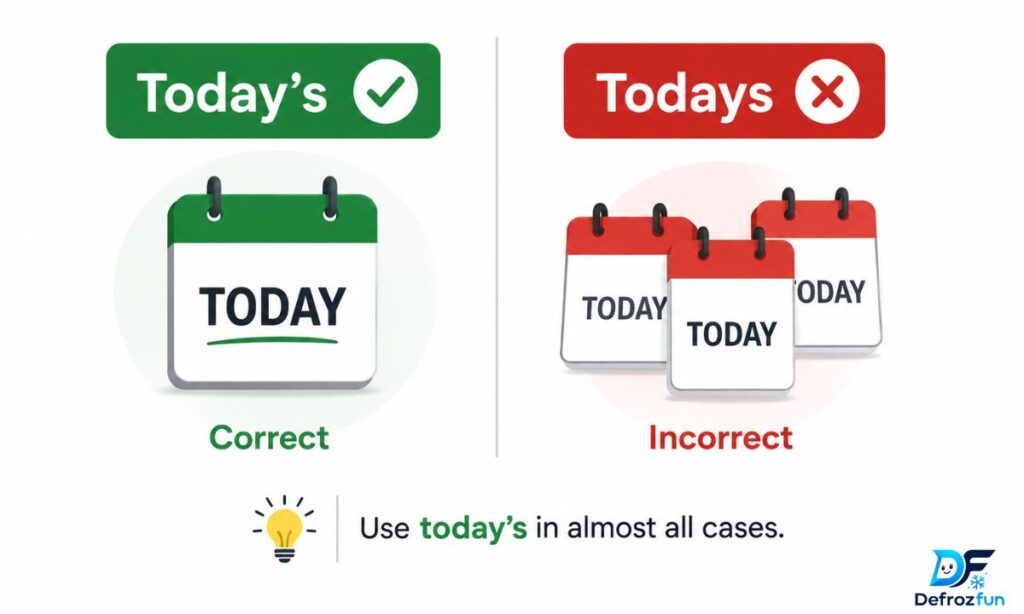
Today’s (with an apostrophe) is almost always the correct form. It is the possessive form of “today,” meaning something that belongs to or is associated with the present day.
Todays (without an apostrophe) is technically the plural of “today,” but it is rarely used and considered incorrect in standard writing.
Bottom line: Unless you are referring to multiple “todays” in a poetic or philosophical sense, always use today’s.
The Origin of Todays / Today’s

The word “today” comes from Old English “tō dæġe,” which literally meant “on [the] day.” Over centuries, as English evolved, the Germanic root was simplified. Dutch, German, and Swedish kept the hard “g” sound, but Modern English softened it into the familiar word “day.”
Because “today” is one of the oldest words in the English language, it functions both as a noun (referring to the present day) and as an adverb (describing when something happens). This dual role makes it flexible — and occasionally confusing when you add an apostrophe or an “s.”
British English vs American English Spelling
Good news: there is no difference between British English and American English when it comes to today’s vs todays. Both dialects follow the same rule — use today’s with an apostrophe for the possessive form.
The apostrophe rules for possession are universal across standard English, so you don’t need to worry about regional variation here.
Which Spelling Should You Use?
Here’s a simple decision guide:
| Situation | Correct Form | Example |
| Something belonging to the present day | today’s | Today’s weather is great. |
| Contraction of “today is” | today’s | Today’s Friday. |
| Plural of “today” (rare/poetic) | todays | Value our todays. |
| Formal or professional writing | today’s | Today’s meeting is at 3 PM. |
The rule is simple: If you can replace “today’s” with “of today” and the sentence still makes sense, use the apostrophe.
- “Today’s news” = “The news of today” ✅
- “Todays news” ❌
Today or Today’s Class
This is one of the most common micro-confusions. Which is correct — “today class” or “today’s class”?
The correct form is “today’s class.”
Here’s why: The class belongs to today — it is the class of today. You need the possessive apostrophe to show that relationship.
- ❌ Today class starts at 9 AM.
- ✅ Today’s class starts at 9 AM.
“Today” alone works as an adverb — for example, “Class starts today.” But when “today” comes directly before a noun to show ownership or association, the apostrophe is required.
Common Mistakes with Todays / Today’s
These are the three most common errors writers make:
1. Dropping the apostrophe entirely
- ❌ Don’t forget todays meeting.
- ✅ Don’t forget today’s meeting.
2. Placing the apostrophe after the “s” (todays’)
Some writers assume “todays'” is a plural possessive — it is not. “Today” has no standard plural form, so “todays'” is always wrong.
- ❌ Todays’ schedule has changed.
- ✅ Today’s schedule has changed.
3. Using “today morning” instead of “this morning”
Non-native English speakers sometimes write “today morning” by analogy with their first language. In English, the correct phrase is “this morning,” “this afternoon,” or “this evening.”
- ❌ I had a call today morning.
- ✅ I had a call this morning.
Todays / Today’s in Everyday Examples
Here are real-life sentences showing how today’s is used correctly:
- Today’s headlines are focused on the economy.
- She forgot to print today’s agenda.
- Today’s students are more tech-savvy than ever.
- I’m excited about today’s game.
- Today’s lesson covers apostrophes and possessives.
- Today’s traffic is worse than usual.
- Have you read today’s report?
And the rare but valid use of todays (plural, poetic/philosophical):
- “War heroes gave their yesterdays for our todays.”
- “Value our todays, for tomorrow is unknown.”
Notice that these sentences use “todays” to mean multiple instances of “today” across time — a literary device, not standard grammar.
Today’s or Today’s Date
This specific phrase trips up many writers. The correct form is always:
✅ Today’s date — with an apostrophe.
The date belongs to today, so the possessive form is required. Here are more examples:
- ✅ Today’s date is May 8, 2026.
- ❌ Todays date is May 8, 2026.
- ✅ Please write today’s date at the top of the page.
- ❌ Please write todays date at the top of the page.
If you remember nothing else from this article, remember this: “today’s date” always has an apostrophe. Always.
Todays or Today’s – Google Trends & Usage Data
Search data confirms that “today’s” is overwhelmingly more common than “todays” in both spoken and written English.
According to Google Ngram Viewer data, “today’s” has been the dominant form in published books and formal writing for over 200 years. The form “todays” appears only in rare, literary, or archaic contexts.
When people search for “todays date” or “todays weather,” it is almost always a typing error — they mean “today’s date” or “today’s weather.” Search engines are smart enough to interpret the intent, but your readers and editors may not be as forgiving.
Keyword Comparison Table
| Form | Part of Speech | Common Use | Correct? |
| today’s | Possessive noun | Today’s meeting, today’s date | ✅ Yes |
| today’s | Contraction | Today’s Friday (= Today is Friday) | ✅ Yes |
| todays | Plural noun | Our todays (rare/poetic) | ⚠️ Rarely |
| todays’ | Plural possessive | — | ❌ Never |
| today morning | — | — | ❌ Never |
Frequently Asked Questions
Is “todays” a real word?
Technically yes — it is the plural of “today” — but it is rarely used and almost always considered a spelling error in standard writing.
What does today’s mean in grammar?
It is the possessive form of “today,” meaning something that belongs to or is associated with the present day.
Is it “today’s date” or “todays date”?
Always “today’s date” with an apostrophe — no exceptions.
Can “today’s” be a contraction?
Yes. “Today’s Friday” is a contraction of “Today is Friday,” where the apostrophe replaces the letter “i.”
Is “todays'” (apostrophe after the s) correct?
No. “Todays'” is never correct because “today” does not have a standard plural form.
Which is correct — “today’s class” or “today class”?
“Today’s class” is correct. The apostrophe shows the class belongs to today.
Is there a difference between British and American English for this word?
No. Both use “today’s” with an apostrophe for the possessive form.
Why do people write “todays” without an apostrophe?
It is usually a typo or oversight — forgetting the apostrophe is one of the most common punctuation mistakes in English.
Conclusion
The answer is clear: today’s (with an apostrophe) is the correct form in almost every situation. Use it when something belongs to the present day, when you’re contracting “today is,” or when describing anything associated with the current day.
Todays without an apostrophe is the plural form of “today” — technically valid but so rare that using it in everyday writing will likely be read as a mistake.
A simple trick to remember: if you can say “of today” in place of “today’s” and the sentence holds up, you need the apostrophe. When in doubt, type today’s — and you’ll be right 99% of the time.

Daniel Brooks is a passionate writer and digital content creator dedicated to sharing insightful, engaging, and informative articles across multiple niches. With a strong interest in technology, lifestyle, trending topics, and online media, Daniel Brooks focuses on delivering well-researched and reader-friendly content that inspires and informs audiences worldwide.