

Have you ever paused mid-sentence, fingers hovering over the keyboard, unsure whether to type “studder” or “stutter”? You’re not the only one. This is one of the most commonly Googled spelling questions in the English language — and for good reason. The word sounds deceptively simple when spoken, yet trips up writers every single day.
In this article, we’ll clear up the confusion once and for all. You’ll learn the correct spelling, why the mistake happens so often, where the word originally came from, and how to use it properly in your writing. No fluff, no filler — just a straight, clear answer backed by grammar authorities and real usage examples.
Studder / Stutter – Quick Answer
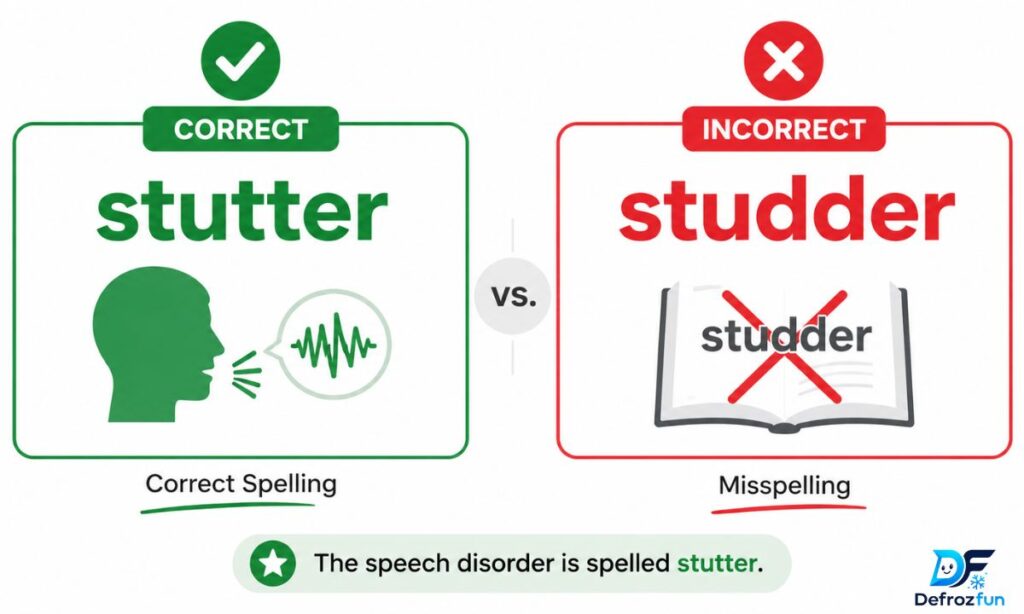
The correct spelling is “stutter.”
“Studder” is a misspelling of the word “stutter.” The only correct spelling for the speech disorder is “stutter.”
YourDictionary defines “studder” simply as a common misspelling of “stutter.” No major style guide, grammar authority, or medical resource recognizes “studder” as a valid word for the speech condition.
So if you’ve been writing “studder,” don’t worry — now you know. But the story behind why people make this mistake is worth understanding.
The Origin of “Stutter”
Understanding where a word comes from helps you remember how to spell it.
“Stutter” is onomatopoeic — a word that suggests the sound it describes — derived from the Middle English stutte or “stop.” Evidence of its early use appears in John Skelton’s 1529 verse: “Her fellow did stammer and stut.”
According to etymology research, “stutter” is supposedly Germanic in origin, a combination of stut(t) in English with the German word stossen (meaning “to strike against”). Stutter originated first as a verb in the 1560s.
The noun form of “stutter” is attested from 1854, meaning “marked stammer, broken and repetitive utterance.”
The double “t” in stutter isn’t random — it actually mirrors the repetitive, stop-and-start nature of the speech pattern it describes. Think of it as the spelling that matches the sound.
British English vs. American English Spelling
Here’s where things get slightly nuanced — not in spelling, but in word choice.
The distinction is primarily regional and linguistic: “Stutter” is the term most commonly used in American English, as well as in Australia and New Zealand. “Stammer” is preferred in British English and some other parts of the world.
There is no clinical difference between stutter and stammer. These words describe the same condition, which professionals often call speech disfluency.
So depending on where you are in the world:
- American English → stutter
- British English → stammer
But in both dialects, “studder” is incorrect. Neither British nor American English uses that spelling in any formal or medical context.
Which Spelling Should You Use?
Simple rule: always use “stutter.”
Here’s a quick memory trick: the word “stutter” has two t’s — just like the repetitive sounds a person makes when stuttering. The double-t reflects the very nature of the word itself.
Think of “stutter” as having two “t’s” like repeated sounds.
Whenever you’re writing about the speech disorder — whether in a formal document, a medical context, academic writing, or everyday communication — “stutter” is your word. “Studder” will flag as an error in spell-checkers and will undermine your credibility in professional writing.
Stuttering in Adults
Many people assume stuttering only affects children, but that’s a misconception.
Stuttering can occur in people of all ages, but it most commonly appears in children between the ages of 2 and 6. For many children, stuttering is a temporary condition that resolves on its own. However, for some individuals, stuttering may persist into adulthood.
The condition affects somewhere between 5 and 10 percent of children at some point, and over 3 million adults, according to the National Institutes of Health.
Adults who stutter often develop coping strategies over time, but the condition can still affect daily life. Stuttering can affect a person’s ability to communicate effectively, which can lead to social anxiety, low self-esteem, and other psychological issues. It may also limit their ability to participate in certain professions that require effective communication skills.
The good news: treatment works. Speech therapy has helped millions of adults improve fluency and confidence.
Common Mistakes with Studder / Stutter
Why do so many people misspell “stutter” as “studder”? There are a few reasons:
1. Phonetic spelling habits People often write what they hear. When spoken quickly, “stutter” can sound like it has a “d” in the middle. Your brain naturally tries to match spelling to sound.
2. Double consonant confusion English has many words with double consonants (ladder, better, matter). When guessing, people sometimes swap “tt” for “dd.”
3. Autocorrect gaps Some devices don’t flag “studder” immediately, so the mistake sticks.
4. No reinforcement Most people rarely write the word “stutter” in daily life, so they never build muscle memory for the correct spelling.
The fix is simple: just remember the double “t” and connect it to the word’s meaning — repeating, halting sounds.
Stutter in Everyday Examples

Seeing a word used in real sentences is one of the best ways to remember both its spelling and meaning. Here are clear, correct usage examples:
As a noun:
- He spoke with a noticeable stutter during the presentation.
- Her stutter improved significantly after six months of speech therapy.
- The child’s stutter worried his parents, but the doctor reassured them it was common.
As a verb:
- She began to stutter when the teacher called on her unexpectedly.
- He tends to stutter when he’s nervous or speaking in public.
- The engine stuttered and died — a metaphorical use of the word.
Incorrect usage (what to avoid):
- ❌ He couldn’t speak without a studder.
- ❌ Her studder was more noticeable under pressure.
- ✅ He couldn’t speak without a stutter.
- ✅ Her stutter was more noticeable under pressure.
The word stutter can also be used metaphorically to describe hesitations or interruptions in non-speech contexts, such as “the car stuttered to a halt.”
Studder / Stutter – Google Trends & Usage Data
Search data tells an interesting story. The word “studder” receives thousands of monthly searches — not because it’s correct, but because people are confused and looking for confirmation.
Most of those searches lead to the same conclusion: “stutter” is always right. Once people learn the correct spelling, they rarely return to “studder.”
This consistent search volume also tells us something useful: spelling confusion around this word is widespread and ongoing. Schools, writers, and content creators all benefit from clear, accessible guidance on the topic.
Comparison Table: Studder vs. Stutter
| Feature | Studder | Stutter |
| Correct spelling | ❌ No | ✅ Yes |
| Found in major dictionaries | ❌ No | ✅ Yes |
| Used in medical/clinical writing | ❌ No | ✅ Yes |
| Recognized in American English | ❌ No | ✅ Yes |
| Recognized in British English | ❌ No | ✅ Yes (as “stammer”) |
| Alternate meaning | Watch-part worker (rare) | Speech disorder |
| Passes spell-check | ❌ Often flagged | ✅ Yes |
Frequently Asked Questions
Is “studder” ever a real word?
Only in one rare, technical sense — a “studder” can refer to a watchmaking worker who inserts hairsprings into studs. In any speech-related context, it is not a valid word.
What is the difference between stutter and stammer?
They refer to the same condition — “stutter” is preferred in American English, while “stammer” is the British English equivalent.
Is stuttering a serious medical condition?
Yes, stuttering is classified as a fluency disorder that affects speech flow and can significantly impact a person’s social and professional life.
Can adults recover from stuttering?
Yes, many adults improve substantially through speech therapy, breathing techniques, and consistent practice.
Why does my autocorrect not catch “studder”?
Some spell-checkers don’t flag it immediately. Always manually verify if you’re unsure, or use a grammar tool like Grammarly.
How do you pronounce “stutter”?
“Stutter” rhymes with “butter,” “clutter,” and “gutter.”
Is stuttering caused by anxiety?
Anxiety can make stuttering worse, but it is not the root cause. Stuttering is linked to neurological and genetic factors.
What is the correct past tense of stutter?
The correct past tense is “stuttered” — not “studdered.”
Conclusion
The answer is clear and final: “stutter” is the only correct spelling. “Studder” is a phonetic misspelling that has no place in standard written English — whether you’re writing formally or casually.
Remember the double “t” — it mirrors the repetitive nature of the speech condition itself. Whether you’re discussing the medical disorder, using the word metaphorically, or simply want to write it correctly in a message, “stutter” is always your go-to spelling.
Now that you know the correct spelling, meaning, origin, and usage — you won’t second-guess yourself again.

Daniel Brooks is a passionate writer and digital content creator dedicated to sharing insightful, engaging, and informative articles across multiple niches. With a strong interest in technology, lifestyle, trending topics, and online media, Daniel Brooks focuses on delivering well-researched and reader-friendly content that inspires and informs audiences worldwide.