

Have you ever stopped mid-sentence wondering — is it curtsy or curtsey? You’re not alone. This is one of those spelling questions that trips up even careful writers. The good news? Both are correct. But one is clearly preferred, and knowing the difference can make your writing look more polished and professional.
This guide breaks it all down — meaning, spelling, origin, usage by region, and real examples — so you never second-guess yourself again.
Curtsy or Curtsey – Quick Answer
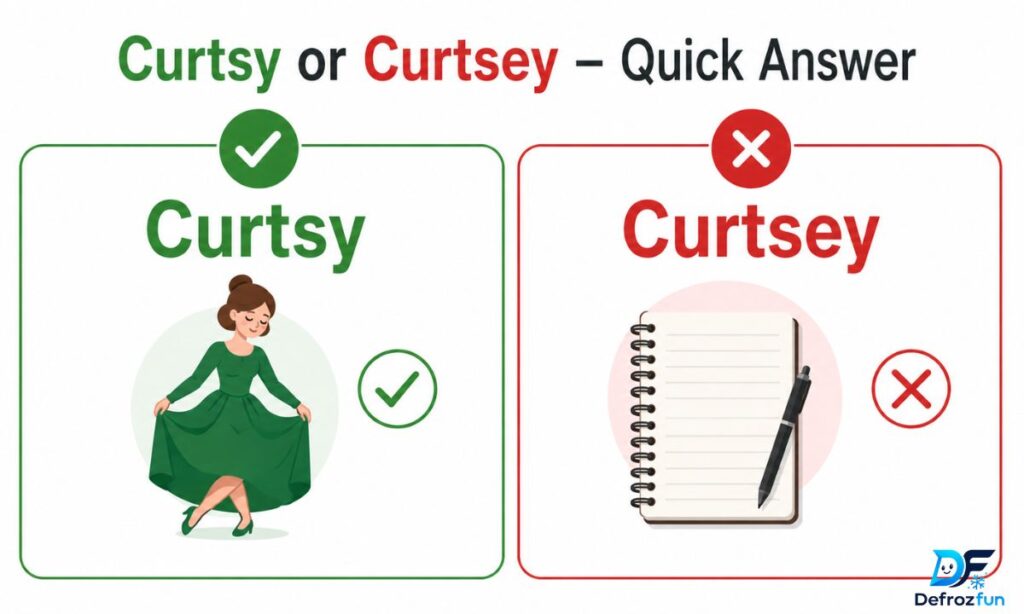
Both spellings are correct. Curtsy is the preferred and more widely used spelling in both American and British English. Curtsey is an accepted variant, especially in older British texts, but it is used far less frequently today.
- Curtsy → Standard, modern, widely accepted
- Curtsey → Accepted variant, less common, older British usage
When in doubt, go with curtsy. It’s the spelling recognized first by Merriam-Webster, the Cambridge Dictionary, and the Oxford English Dictionary.
The Origin of Curtsy or Curtsey
The word curtsy has a fascinating backstory rooted in Old French and Middle English.
Where Did the Word Come From?
Curtsy is a phonological shortening — called syncope in linguistics — of the word courtesy. In Middle English, courtesy (from Old French curteisie) referred to polite or respectful behavior shown to someone of higher rank.
Over time, the spoken form dropped syllables and evolved into curtsy, while the physical gesture it described became distinct from the broader concept of courtesy.
- Earliest recorded use as a noun: 1525 (Oxford English Dictionary)
- Earliest recorded use as a verb: circa 1533–1556 (Merriam-Webster / OED)
- Origin language: Old French curteisie → Middle English curtesie → curtsy
By the Elizabethan era (1558–1603), court etiquette had grown elaborate, and the curtsy had become a formalized gesture in royal and aristocratic settings. At the Palace of Versailles, deep curtsies to royalty were embedded into daily court life as part of a strict social hierarchy.
In 18th-century Britain, girls from upper-class families were trained in deportment schools where curtsying was taught alongside posture and general etiquette. It wasn’t just a gesture — it was a social skill.
British English vs American English Spelling
One of the most common reasons people get confused between curtsy and curtsey is regional spelling variation.
Which Spelling Do British and American Dictionaries Prefer?
| Dictionary | Preferred Spelling | Variant Listed? |
| Merriam-Webster (US) | curtsy | Yes (curtsey) |
| Cambridge Dictionary (UK) | curtsy | Yes (curtsey) |
| Oxford English Dictionary (UK) | curtsy | Yes (curtsey) |
| Dictionary.com | curtsy | Yes (curtsey) |
| Collins English Dictionary | curtsy | Yes (curtsey) |
Despite what many assume, British dictionaries do not prefer curtsey. Both Cambridge and Oxford list curtsy as the primary spelling. Curtsey appears more often in older British literature — think Charles Dickens, George Eliot, and Shakespeare — but modern British writing has largely shifted to curtsy.
Which Spelling Should You Use?
The answer depends on your context, but the general rule is simple:
Use curtsy in almost every situation.
Here’s a quick guide:
- Formal writing, academic work, journalism → curtsy
- American English → curtsy
- Modern British English → curtsy
- Historical fiction set in older Britain → curtsey can add authentic flavor
- Quoting older texts → keep the original spelling (curtsey)
The only real reason to choose curtsey today is stylistic preference or historical authenticity. In all other cases, curtsy is the safer, more recognized choice.
Common Mistakes with Curtsy or Curtsey
Writers make a few recurring errors with these words. Here’s what to avoid:
❌ Mistake 1: Spelling it “courtsey” or “courtsie”
Neither of these is a real word. The correct spellings are curtsy and curtsey — with a “u”, not an “o”.
❌ Mistake 2: Confusing “curtsy” with “courtesy”
These words look similar and share the same root, but they mean different things:
- Curtsy = a physical gesture of respect (bending the knees)
- Courtesy = polite behavior or a considerate act
She gave a curtsy to the ambassador. ✅ She showed great courtesy to all her guests. ✅
❌ Mistake 3: Using it as a gender-neutral term
Traditionally, a curtsy is performed by women and girls. The male equivalent is a bow. While modern usage is becoming more inclusive, classical and formal usage still treats these as distinct gestures by gender.
❌ Mistake 4: Wrong plural or conjugation
| Form | Curtsy | Curtsey |
| Plural (noun) | curtsies | curtseys |
| Past tense (verb) | curtsied | curtseyed |
| Present participle | curtsying | curtseying |
Also Read This: Lovable or Loveable: Which Spelling Is Correct? (2026)
Curtsy or Curtsey in Everyday Examples

Seeing words in context is one of the best ways to lock in correct usage. Here are natural examples of both spellings in action:
Using Curtsy in a sentence:
- She performed a graceful curtsy before presenting the bouquet to the princess.
- The young dancer took a deep curtsy as the audience applauded.
- Visitors were expected to bow or curtsy to the throne upon entering the room.
- She curtsied to the queen and then stepped back in line.
Using Curtsey in a sentence:
- The Victorian novel described how the maid gave a quick curtsey at the door.
- In her etiquette class, the girls were taught how to curtsey properly.
- She dropped him a curtsey which was grace itself.
Both are grammatically correct. In modern writing, editors will almost always prefer curtsy.
Curtsy or Curtsey – Google Trends & Usage Data
Search interest and published usage both confirm that curtsy dominates in the modern era.
Google Ngram & Search Trends Summary
- Curtsy has consistently outpaced curtsey in Google Books Ngram data across both British and American English corpora over the past century.
- Curtsey saw higher relative usage in 19th-century British texts but declined significantly through the 20th century.
- In 2024–2026 Google Search data, searches for “curtsy” significantly outnumber searches for “curtsey,” reflecting the modern preference.
This data reinforces what dictionaries already tell us: curtsy is the standard spelling of our time.
Comparison Table: Curtsy vs Curtsey
| Feature | Curtsy | Curtsey |
| Preferred spelling | ✅ Yes | ❌ No |
| American English | ✅ Standard | Rarely used |
| British English | ✅ Standard (modern) | Old-fashioned |
| Merriam-Webster | Primary entry | Listed as variant |
| Cambridge Dictionary | Primary entry | Listed as variant |
| Oxford Dictionary | Primary entry | Listed as variant |
| Used in formal writing | ✅ Recommended | Not preferred |
| Historical/literary use | Common | Very common |
| Plural | curtsies | curtseys |
| Past tense | curtsied | curtseyed |
Conclusion
The curtsy vs curtsey debate is simpler than it looks. Both spellings are valid, but curtsy is the clear winner in modern, everyday, and formal English — backed by every major dictionary from Merriam-Webster to Oxford to Cambridge.
Use curtsy when writing today. Reserve curtsey for historical fiction, quoting older texts, or stylistic purposes where older British flavor is intentional.
Understanding this distinction not only improves your spelling — it shows a grasp of how the English language evolves over time. And that kind of precision is always worth a respectful nod (or a curtsy).

Daniel Brooks is a passionate writer and digital content creator dedicated to sharing insightful, engaging, and informative articles across multiple niches. With a strong interest in technology, lifestyle, trending topics, and online media, Daniel Brooks focuses on delivering well-researched and reader-friendly content that inspires and informs audiences worldwide.