

If you’ve ever paused mid-sentence wondering whether to write lovable or loveable, you’re not alone. It’s one of the most searched spelling questions in English — and for good reason. Both forms appear in published books, major newspapers, and everyday writing. So which one is actually correct? This guide gives you a clear, definitive answer backed by grammar rules, dictionary authority, and real usage data.
Lovable or Loveable – Quick Answer
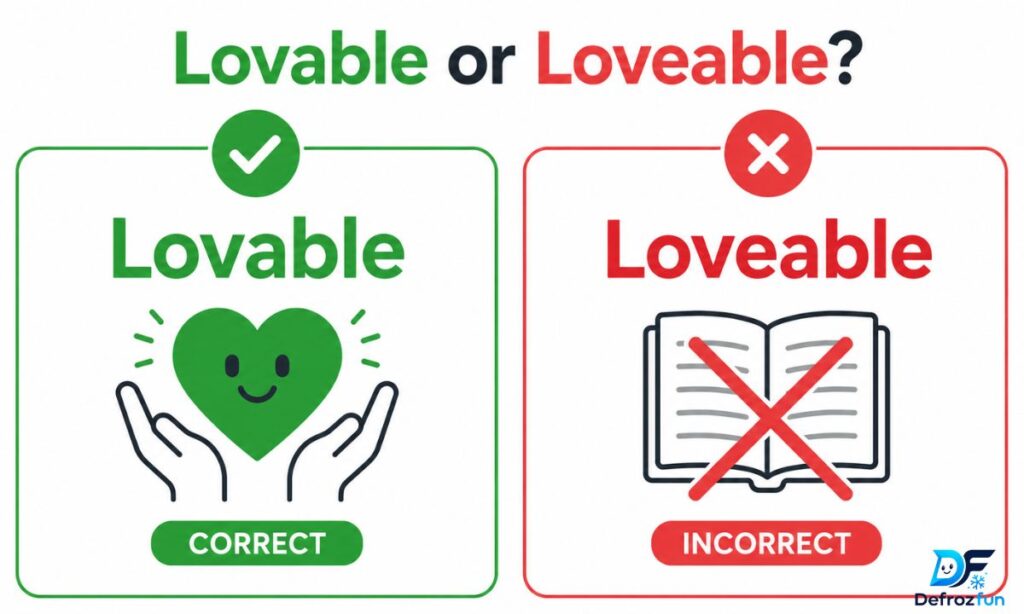
Both spellings are correct, but lovable is the standard and preferred form.
- Lovable = Standard spelling used in American English, formal writing, and most major style guides.
- Loveable = Accepted variant, more common in informal or British English contexts.
When in doubt — always choose lovable. It is recognized by every major dictionary, preferred by editors worldwide, and carries zero risk of being flagged as incorrect.
The Origin of Lovable or Loveable
The word comes from the root “love” combined with the suffix “-able,” meaning “capable of” or “worthy of.” This construction first appeared in English during the 16th century.
The key grammar rule here is the “drop the silent E” rule: when a vowel-starting suffix like -able is added to a word ending in silent -e, the e is typically dropped.
Examples of the rule in action:
- move → movable
- desire → desirable
- love → lovable
However, English has always had exceptions. Words like date → dateable and marriage → marriageable keep the e. This inconsistency is exactly why loveable also emerged as a valid variant — it never felt wrong, and it wasn’t. Both spellings have existed for centuries, with lovable gradually becoming dominant from the 19th century onward.
British English vs American English Spelling
Regional preference plays a big role in this debate. Here’s how the two variants break down across English-speaking regions:
| Region | Preferred Spelling | Notes |
| United States | Lovable | Overwhelmingly dominant (~25:1 ratio over loveable) |
| United Kingdom | Lovable | Still preferred, but loveable appears more (~2:1 ratio) |
| Canada | Lovable | Both used; lovable is more common |
| Australia | Loveable/Lovable | Leans British; both accepted |
| International/Formal | Lovable | Safest choice for global audiences |
According to usage data from 21st-century news publications, American English uses lovable roughly 25 times more often than loveable. Even in British publications, lovable still leads at a 2:1 ratio. The data is clear: lovable wins in every major market.
Which Spelling Should You Use?
The answer depends on your context and audience, but the general rule is simple:
Use lovable in almost every situation.
Here’s a quick decision guide:
- Formal writing (essays, business documents, academic papers) → lovable
- American English → lovable (always)
- British English, formal → lovable
- British English, casual/informal → loveable is acceptable
- Global or international audience → lovable (avoids confusion)
- Creative writing or fiction → either works; pick one and stay consistent
The bottom line: loveable is not wrong, but lovable is always right. There is no scenario where choosing lovable will be marked incorrect.
Common Mistakes with Lovable or Loveable
Even careful writers make errors around this word. Watch out for these:
1. Mixing spellings in the same document Using lovable in one paragraph and loveable in another looks like a typo. Pick one and stick with it throughout.
2. Assuming loveable is “more correct” in British English Some writers default to loveable for any British audience, but most British style guides still recommend lovable — especially in formal writing.
3. Confusing it with similar “-able” words Just because likeable keeps the e (and is widely accepted in British English) doesn’t mean loveable is equally preferred. The two words follow slightly different conventions.
4. Overthinking it Some writers spend too much time debating the spelling instead of simply going with the widely accepted lovable. Save the mental energy.
Lovable or Loveable in Everyday Examples
Here are natural, real-world sentences using both spellings — so you can see how they work in practice:
Using lovable:
- The rescue puppy had the most lovable personality in the entire shelter.
- She plays a lovable but clumsy character in the comedy series.
- His lovable sense of humor makes every room feel lighter.
- The children’s book features a lovable bear who gets into all kinds of trouble.
- Despite his flaws, he is genuinely lovable to everyone who meets him.
Using loveable (informal/British context):
- The loveable rogue charmed his way through the entire story.
- Everyone agreed the old dog was utterly loveable.
Both sentences are understood perfectly. The difference is purely one of spelling convention, not meaning.
Lovable or Loveable – Google Trends & Usage Data
Real-world data confirms what grammar guides recommend:
- Google Trends: “Lovable” consistently outperforms “loveable” in global search volume across all years on record.
- Google Books Ngram: From the 1800s onward, lovable has held a commanding lead over loveable in published English literature. The gap widened significantly through the 20th century and remains wide today.
- News publications: American outlets use lovable at a ~25:1 ratio; British outlets at ~2:1.
- Dictionary listings: Merriam-Webster, Oxford, Cambridge, and Collins all list lovable as the primary headword. Loveable appears as a secondary variant in some, and is absent in others.
The trend is consistent: the simpler spelling wins, and it has been winning for over 150 years.
Comparison Table: Lovable vs Loveable
| Feature | Lovable | Loveable |
| Correct spelling? | ✅ Yes | ✅ Yes (variant) |
| Standard form? | ✅ Yes | ❌ No |
| American English | ✅ Preferred | ❌ Rarely used |
| British English | ✅ Preferred | ⚠️ Acceptable informally |
| Formal writing | ✅ Always use this | ❌ Avoid |
| Dictionary headword | ✅ Primary entry | ⚠️ Secondary/variant |
| Spelling rule | Drops silent E (standard) | Retains silent E (exception) |
| Risk of error | None | Possible in formal contexts |
Conclusion
The answer to “lovable or loveable” is straightforward: use lovable. It is the standard spelling in American English, the preferred form in British formal writing, and the primary headword in every major dictionary. Loveable is not wrong — it’s a legitimate variant with centuries of use behind it — but it’s the less common, less expected choice in virtually every writing context today.
The grammar rule is clear: when adding -able to a word ending in a silent e, drop the e. Love → lovable. Follow that rule and follow the data, and you’ll never second-guess this spelling again.
Quick recap:
- ✅ Use lovable in all formal, professional, and academic writing
- ✅ Use lovable for American English audiences
- ✅ Use lovable when writing for international readers
- ⚠️ Loveable is acceptable in informal British English, but lovable is still safer
Now that you know the difference, go write something — and describe it as the lovable piece of work it is.

Daniel Brooks is a passionate writer and digital content creator dedicated to sharing insightful, engaging, and informative articles across multiple niches. With a strong interest in technology, lifestyle, trending topics, and online media, Daniel Brooks focuses on delivering well-researched and reader-friendly content that inspires and informs audiences worldwide.