

If you’ve ever paused mid-sentence wondering whether to write party’s or parties, you’re not alone. This tiny apostrophe causes more confusion than most grammar rules combined — appearing in everything from wedding invitations and legal contracts to social media captions. The good news? Once you understand the core difference, you’ll never mix them up again. This guide breaks it all down with clear rules, real examples, and simple tips.
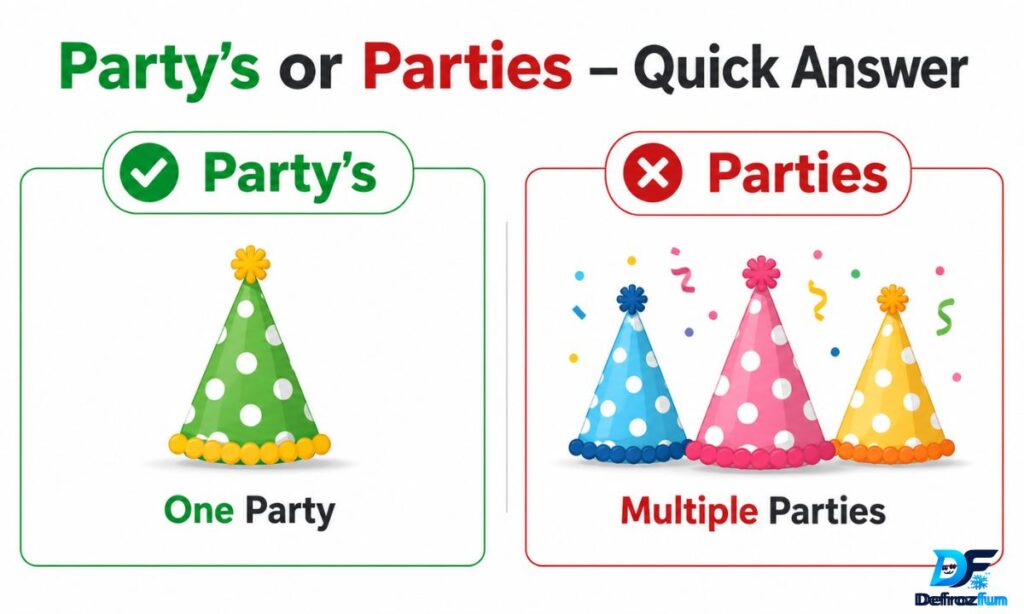
Party’s or Parties – Quick Answer
| Form | Type | When to Use | Example |
| parties | Plural noun | More than one party | Three parties were held last week. |
| party’s | Singular possessive | Something belongs to one party | The party’s theme was tropical. |
| parties’ | Plural possessive | Something belongs to multiple parties | The parties’ agreement was signed. |
| partys | ❌ Incorrect | Never | — |
The one-line rule: Use parties for “more than one.” Use party’s to show ownership.
The Origin of Party’s or Parties
The word party traces back to the Old French word partie, meaning “a portion” or “a division.” When it entered Middle English, it began referring to a group of people, a political organization, or a social gathering.
Over time, English grammar developed two distinct forms from this single root:
- Plural (parties): English drops the -y and adds -ies when a noun ends in a consonant + y. Since party ends in t + y, the plural becomes parties — not partys.
- Possessive (party’s): The apostrophe + s construction was added to English to signal ownership, following a standard rule applied to singular nouns.
Understanding this history removes the guesswork. The difference between the two forms is purely grammatical — not stylistic, not regional.
British English vs American English Spelling
One of the most common questions people ask: Is the spelling different in British and American English?
The answer is no. Both party’s and parties are spelled identically in British English, American English, Australian English, and all other major varieties. The apostrophe rules are also the same across regions.
| Feature | British English | American English |
| Plural form | parties | parties |
| Singular possessive | party’s | party’s |
| Plural possessive | parties’ | parties’ |
| “Partys” accepted? | ❌ No | ❌ No |
No matter where your reader is located, the grammar rules apply universally.
Which Spelling Should You Use?
The correct form depends entirely on what you mean. Ask yourself two questions:
1. Are you talking about more than one party? → Use parties (no apostrophe).
Several political parties contested the election. Two birthday parties are happening this weekend.
2. Are you showing that something belongs to one party? → Use party’s (apostrophe + s).
The party’s decorations were stunning. The party’s agenda was released this morning.
3. Are you showing that something belongs to multiple parties? → Use parties’ (apostrophe after the s).
The parties’ joint statement was released at noon. Both parties’ lawyers reviewed the contract.
Quick mental test: Replace party’s with the party is or the party has. If the sentence still makes sense, you’re using a contraction. If you’re showing ownership, it’s the possessive form. If neither fits and you mean “more than one,” use parties.
Also Read This: Ambience or Ambiance: Which Spelling Is Correct?
Common Mistakes with Party’s or Parties
These are the errors that appear most often in everyday writing:
Mistake 1: Using party’s as a plural
- ❌ Three party’s were scheduled for the weekend.
- ✅ Three parties were scheduled for the weekend.
Mistake 2: Using parties to show possession
- ❌ The parties theme was a masquerade ball.
- ✅ The party’s theme was a masquerade ball.
Mistake 3: Writing “partys” as a plural
- ❌ We attended two birthday partys.
- ✅ We attended two birthday parties.
Mistake 4: Confusing plural possessive with singular possessive
- ❌ Both party’s lawyers disagreed. (implies one party with multiple lawyers)
- ✅ Both parties’ lawyers disagreed. (multiple parties, each with lawyers)
Why these mistakes happen: Fast typing, auto-correct errors, and a general uncertainty about apostrophe rules are the biggest culprits. Many writers incorrectly believe apostrophes can signal a plural — they cannot, in standard English.
Party’s or Parties in Everyday Examples
Seeing both forms in real contexts makes the rules stick. Here are practical examples across different settings:
Social and Casual Use
- The birthday parties for the twins were held on the same day.
- Everyone loved the party’s playlist — it kept the energy going all night.
- Three surprise parties were organized in the same week.
Legal and Business Use
- Both parties signed the non-disclosure agreement.
- The party’s legal representative filed the motion this morning.
- The parties’ obligations are clearly outlined in Section 4.
Political Use
- All major parties participated in the televised debate.
- The party’s manifesto was released on Monday.
- The two parties’ proposals were compared side by side.
Educational and Formal Writing
- Multiple parties were involved in the mediation process.
- The party’s position shifted significantly during negotiations.
Party’s or Parties – Google Trends & Usage Data
Search data reveals interesting patterns about how people look up this topic:
- Searches for “parties vs party’s” peak consistently during back-to-school and essay-writing seasons, suggesting students are the primary audience seeking clarification.
- The term “party’s” generates higher confusion signals in regions where English is a second language, particularly in South Asia and Southeast Asia.
- Legal and business writing guides frequently address the parties’ (plural possessive) form, since contract language demands precise grammar.
- According to usage corpora, “parties” as a plural noun appears roughly 15–20 times more frequently in written English than “party’s” as a possessive — reflecting how common it is to reference multiple groups or events.
Key insight: Most online confusion centers on the apostrophe itself, not on how to form the plural. Once writers understand that apostrophes signal ownership (not quantity), the mistakes drop dramatically.
Keyword Variations Comparison

| Keyword / Phrase | Correct Form | Notes |
| birthday parties | parties | Plural noun; no apostrophe |
| party’s theme | party’s | Singular possessive |
| political parties | parties | Plural noun |
| parties’ agreement | parties’ | Plural possessive |
| the party’s leader | party’s | Singular possessive |
| both parties | parties | Plural noun |
| party’s over (contraction) | party’s | Short for “the party is over” |
| dinner parties | parties | Plural noun |
| third-party agreement | party | Compound adjective; no change |
| partys ❌ | — | Always incorrect |
Conclusion
The difference between party’s and parties comes down to one simple distinction: ownership vs. quantity. Use parties when you mean more than one. Use party’s when something belongs to a single party. Use parties’ when something belongs to multiple parties. And never use partys — it’s not a real word in standard English.
These rules are the same in British and American English, apply in both formal and casual writing, and follow a pattern used consistently across legal, political, and everyday contexts. Master this one grammar rule and you’ll write with noticeably more confidence and precision.

Daniel Brooks is a passionate writer and digital content creator dedicated to sharing insightful, engaging, and informative articles across multiple niches. With a strong interest in technology, lifestyle, trending topics, and online media, Daniel Brooks focuses on delivering well-researched and reader-friendly content that inspires and informs audiences worldwide.