

If you have ever typed “planing a trip” and felt something was off — you were right. The words planing and planning look nearly the same, but they mean completely different things. One extra letter changes everything.
This guide breaks down the difference between planing vs planning, explains the grammar rule behind it, and shows you exactly when to use each word. Whether you are a student, writer, or professional, this is the only reference you need.
Planing or Planning – Quick Answer
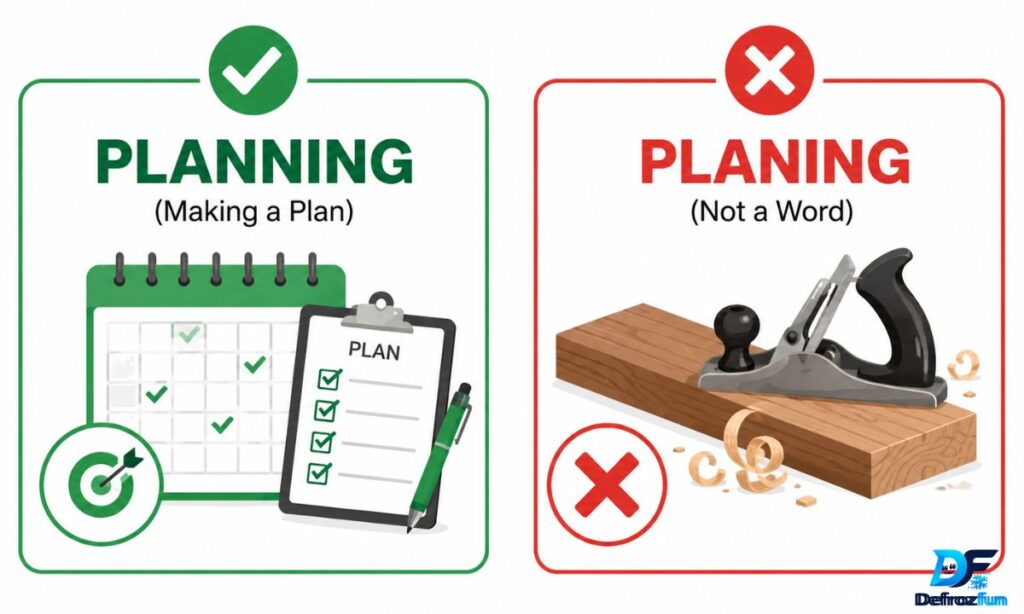
Planning (double “n”) is correct when you are talking about making plans, organizing tasks, or preparing for something.
Planing (single “n”) is correct only in technical contexts — specifically woodworking or carpentry — where it means smoothing a surface with a plane tool.
✅ “I am planning my schedule for next week.” ✅ “The carpenter is planing the wooden board.” ❌ “I am planing my vacation.” ← Incorrect
In everyday writing, planning is almost always the word you need.
The Origin of Planing/Planning
Understanding where these words come from makes the difference much easier to remember.
Planning comes from the noun plan, which traces back to the Latin word planum, meaning “flat surface” or “level ground.” The French later adopted it as plan, meaning a map or drawing. By the late 17th century, English speakers were using it to mean organizing ideas or preparing for the future.
Planing comes from the noun plane — the woodworking tool used by carpenters to shave and smooth timber. The verb to plane (meaning to use that tool) naturally produces the -ing form: planing.
So the two words share distant Latin roots but evolved along separate paths — one toward mental preparation, the other toward physical craftsmanship.
British English vs American English Spelling
One common question: does the spelling change between British and American English?
The answer is no. Both varieties of English follow the same doubling rule and use the same spellings:
| Region | “Making plans” | “Smoothing wood” |
| American English | planning | planing |
| British English | planning | planing |
| Australian English | planning | planing |
| Canadian English | planning | planing |
This is one area where British and American English are in complete agreement. No regional variation exists for these two words.
Also Read This: Grate or Great – Which One Is Correct? (2026)
Which Spelling Should You Use?
The answer depends entirely on the context. Ask yourself one simple question:
Are you talking about organizing something, or smoothing a surface?
Use “Planning” when:
- Making a plan for an event, trip, or project
- Describing preparation or decision-making
- Talking about strategy, goals, or schedules
- Using it as a noun (“the planning stage”)
Examples:
- We are planning a company retreat for March.
- Urban planning requires careful consideration of infrastructure.
- She spent months planning her wedding.
- The planning committee will meet on Friday.
Use “Planing” when:
- Describing the use of a carpenter’s plane tool
- Talking about smoothing or leveling wood or metal
- Describing a boat or aircraft gliding over a surface (technical usage)
Examples:
- He spent the afternoon planing the rough timber.
- Planing the door frame helped it close properly.
- The woodworker was planing the tabletop to an even finish.
The grammar rule behind “planning”: When a one-syllable verb ends in a single consonant preceded by a single vowel (like plan — one vowel “a” + one consonant “n”), you double the final consonant before adding -ing. So plan → planning. This rule preserves the short vowel sound.
Plane, by contrast, ends in a silent “e.” When adding -ing, you simply drop the “e” — giving you planing, with no doubling needed.
Common Mistakes with Planing/Planning
These are the most frequent errors writers make with these two words:
Mistake 1: Using “planing” for trip or event organization
- ❌ We are planing our annual conference.
- ✅ We are planning our annual conference.
Mistake 2: Forgetting the double “n” in hurried typing
- ❌ I’m planing to call you later.
- ✅ I’m planning to call you later.
Mistake 3: Using “planning” in a woodworking context
- ❌ The joiner was planning the surface of the oak board.
- ✅ The joiner was planing the surface of the oak board.
Mistake 4: Confusing related word forms
| Incorrect | Correct |
| She planed the meeting carefully. | She planned the meeting carefully. |
| We are planing to expand. | We are planning to expand. |
| The planing committee met. | The planning committee met. |
Quick memory trick: Think of it this way — planning has a double “n” because it involves double the thinking. Planing is a hands-on physical action that needs no extra letters.
Planing or Planning in Everyday Examples
Here are real-world sentences showing how each word works in context:
“Planning” in everyday use:
- The city approved a new planning ordinance last month.
- Financial planning is essential before you retire.
- I have been planning this trip for over a year.
- Good planning separates successful projects from failed ones.
- The planning phase of a construction project takes weeks.
- Are you planning to attend the seminar?
“Planing” in technical use:
- After planing the boards, the surface was perfectly smooth.
- The apprentice practiced planing wood for the first time.
- Planing removes high spots and creates a flat, even surface.
- The door was sticking, so we fixed it by planing its edge.
You will notice “planning” appears in business, education, travel, and everyday conversation. “Planing” stays firmly in the woodworking and craftsmanship world.
Planing or Planning – Google Trends & Usage Data
Search volume data confirms what grammar rules tell us: planning is overwhelmingly more common than planing in everyday language.
- Searches for “planning” consistently far outnumber searches for “planing” across all major English-speaking countries.
- Planning dominates in searches related to travel, business, events, and personal goals.
- Planing sees limited but consistent search interest, primarily from woodworking communities and DIY enthusiasts.
- Countries with the highest interest in “planning” include the United States, United Kingdom, Canada, Australia, and India.
- Searches for “planing” tend to peak in regions with active woodworking industries and maker communities.
This data confirms that for 99% of writing contexts, planning is the word people are looking for.
Comparison Table: Planing vs Planning
| Feature | Planning | Planing |
| Spelling | Double “n” | Single “n” |
| Part of speech | Verb / Noun | Verb |
| Root word | Plan (Latin: planum) | Plane (the tool) |
| Primary meaning | Organizing or preparing | Smoothing a surface with a tool |
| Common context | Everyday, business, education | Woodworking, carpentry |
| Example sentence | “We are planning the event.” | “He is planing the oak plank.” |
| British English | planning | planing |
| American English | planning | planing |
| Grammar rule applied | Double consonant before -ing | Drop silent “e” before -ing |
| Usage frequency | Extremely common | Rare / technical only |
Conclusion
The difference between planing and planning comes down to one letter — but that letter carries real meaning.
Planning (double “n”) is the word for making decisions, preparing for the future, and organizing your life or work. It is one of the most commonly used words in the English language and the correct choice in virtually every everyday context.
Planing (single “n”) is a technical term for using a carpenter’s plane to smooth a surface. It belongs in a workshop, not a schedule.
The grammar rule is simple: plan doubles its final “n” before -ing because of the short vowel rule. Plane drops its silent “e” instead. Once you understand the rule, you will never second-guess yourself again.
When in doubt, ask yourself: am I organizing something, or smoothing a piece of wood? Your answer tells you exactly which spelling to use.

Daniel Brooks is a passionate writer and digital content creator dedicated to sharing insightful, engaging, and informative articles across multiple niches. With a strong interest in technology, lifestyle, trending topics, and online media, Daniel Brooks focuses on delivering well-researched and reader-friendly content that inspires and informs audiences worldwide.