

If you’ve ever typed “pacient” and wondered whether it’s correct, you’re not alone. This is one of the most searched spelling questions in English — especially among multilingual writers, medical students, and ESL learners. The answer is straightforward, but the reason behind the confusion is worth understanding. This guide covers everything: the correct spelling, meaning, origin, common mistakes, and real-life examples — so you never get it wrong again.
Patient or Pacient – Quick Answer
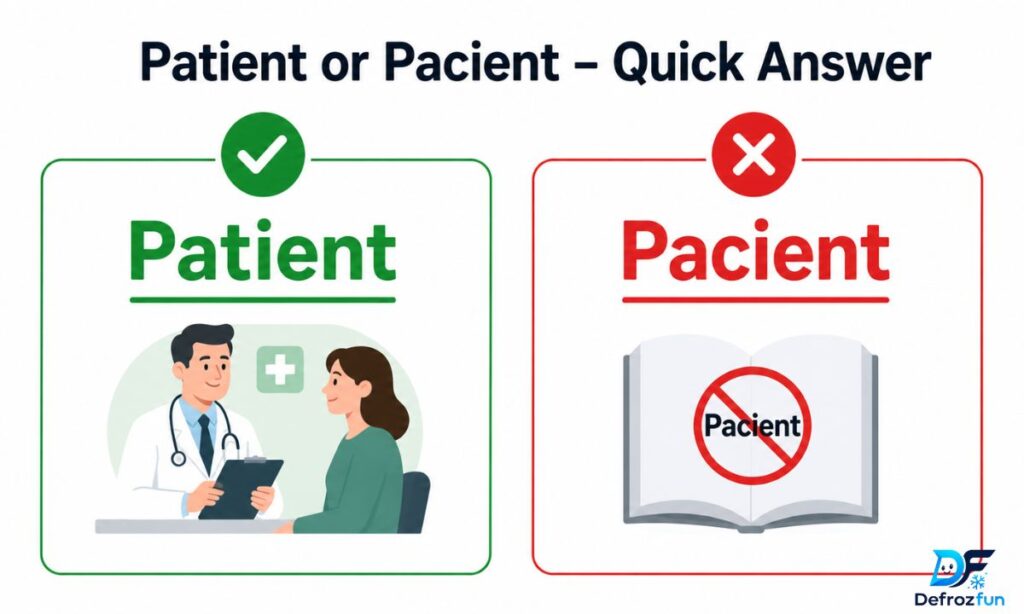
“Patient” is the only correct spelling in English. “Pacient” is a misspelling and does not exist as a standard English word.
It doesn’t matter whether you’re writing a medical report, an academic essay, or a casual email — always use patient.
✅ Correct: The patient is recovering well. ❌ Incorrect: The pacient is recovering well.
The Origin of Patient
Understanding where “patient” comes from helps explain why the spelling is what it is — and why so many people get it wrong.
The word patient traces back to the Latin word patiens, the present participle of the verb pati, meaning “to suffer” or “to endure.” From Latin, it moved into Old French as pacient — and this is the critical point. The Old French spelling used a “c,” which is exactly what trips people up today.
When English borrowed the word in the mid-14th century, it went through a gradual spelling shift. By the 16th century, English had standardized the “ti” spelling, replacing the Latin/French “ci.” This pattern is consistent across many English words borrowed from Latin — think nation (from natio), station (from statio), and patient (from patiens).
So “pacient” isn’t entirely made up — it’s simply an older, non-English form that no longer applies in modern English writing.
Word origin timeline:
| Stage | Form | Language |
| Ancient origin | pati (to suffer/endure) | Latin |
| Classical form | patiens | Latin |
| Medieval borrowing | pacient | Old French |
| Modern standardization | patient | English (14th–16th century) |
British English vs American English Spelling
One common reason people look this up is to check whether there’s a difference between British and American English. The short answer: there is none.
Unlike words such as colour/color or behaviour/behavior, the word patient is spelled identically in every English-speaking country — the United States, the United Kingdom, Canada, Australia, New Zealand, and beyond.
| Region | Correct Spelling |
| American English | patient |
| British English | patient |
| Canadian English | patient |
| Australian English | patient |
This is one of those rare cases where spelling is universal across all dialects of English.
Which Spelling Should You Use?
Always use patient — in every context, every format, and every region.
Whether you’re writing:
- A hospital document or medical record
- An academic paper or research article
- A professional email or business letter
- A school exam or test
- A casual text or blog post
…the correct spelling is always patient. There are no exceptions in English.
Also Read This: Labelling or Labeling – Which Spelling Is Correct?
Common Mistakes with Patient
1. Spelling it “pacient”
The most frequent error. This comes directly from influence by languages like Spanish (paciente), Romanian (pacient), Polish (pacjent), and Portuguese (paciente). If you regularly switch between one of these languages and English, your brain may default to the familiar spelling.
Fix: Remember — English replaced the “c” with a “t.” Think of related English words: patience, patiently, impatient — all use “t,” not “c.”
2. Confusing “patient” (adjective) with “patience” (noun)
These are two different words with two different roles.
| Word | Part of Speech | Example |
| patient | adjective | She is very patient with beginners. |
| patience | noun | You need a lot of patience for this job. |
3. Mixing up “patient” (noun) and “patient” (adjective)
The same word serves two distinct roles — noun and adjective — and both are correct.
- Noun: The patient was admitted to the hospital at noon.
- Adjective: The doctor was patient when explaining the diagnosis.
4. Over-relying on autocorrect
Spell-checkers usually catch “pacient,” but not always — especially in medical software, PDFs, or handwritten notes. Don’t depend solely on technology for critical documents.
Patient in Everyday Examples
Seeing a word in context is the best way to remember it. Here are real-life usage examples for both meanings of “patient.”
As a Noun (a person receiving medical care)
- The patient was discharged after three days in the hospital.
- Dr. Ahmed spent 20 minutes with each patient during rounds.
- Every patient has the right to access their medical records.
- The waiting room had six patients scheduled before noon.
- She became a patient at the clinic after her workplace injury.
As an Adjective (calm, tolerant, not easily frustrated)
- You need to be patient — the results take 48 hours.
- A good teacher must be patient with students who struggle.
- He was remarkably patient despite the long queue.
- Being patient during negotiations often leads to better outcomes.
- Learning a new language requires you to stay patient with yourself.
Patient – Google Trends & Usage Data

The search query “patient or pacient” sees consistent global traffic, with spikes particularly from countries where Romance languages are dominant — including Spain, Romania, Mexico, Brazil, and Portugal. This confirms that the confusion is almost entirely driven by cross-language interference, not genuine ambiguity within English.
Key usage data points:
- “Patient” appears in over 500 million English web pages, per indexed data estimates.
- “Pacient” produces near-zero results in major English-language publications such as The Guardian, BBC, and The New York Times.
- In medical literature, “patient” is one of the most frequently used nouns in clinical writing.
- Google autocorrects “pacient” to “patient” in nearly all English search contexts.
The data is clear: in English, “patient” dominates entirely. “Pacient” simply doesn’t register.
Comparison Table: Patient vs Pacient
| Feature | Patient | Pacient |
| Correct in English? | ✅ Yes | ❌ No |
| Used in medical writing? | ✅ Yes | ❌ No |
| Accepted in British English? | ✅ Yes | ❌ No |
| Accepted in American English? | ✅ Yes | ❌ No |
| Appears in major dictionaries? | ✅ Yes (Merriam-Webster, Oxford) | ❌ No |
| Used in other languages? | Used in English only | Used in Romanian, Polish |
| Origin | Latin patiens → Old French → English | Latin/Old French form, not adopted into English |
| Spell-check result | Accepted | Flagged as error |
Conclusion
The spelling question of patient or pacient has a simple, definitive answer: always use “patient.” The word “pacient” is not English — it’s a holdover from Latin and Old French that other languages preserved, but English did not.
Whether you’re filling out a medical form, writing a school essay, or drafting a professional email, the correct and only accepted spelling is patient — in every English-speaking country, in every context, without exception.
Remember: if “patience” uses a “t,” so does “patient.”

Daniel Brooks is a passionate writer and digital content creator dedicated to sharing insightful, engaging, and informative articles across multiple niches. With a strong interest in technology, lifestyle, trending topics, and online media, Daniel Brooks focuses on delivering well-researched and reader-friendly content that inspires and informs audiences worldwide.