

Likeable or Likable – Quick Answer
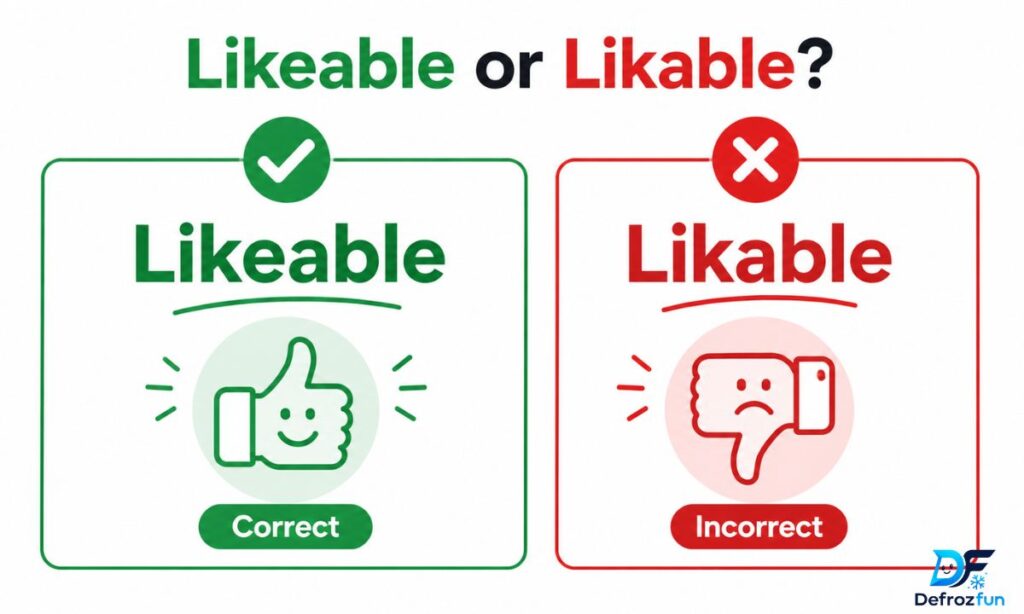
Both spellings are correct. Likable is preferred in American English. Likeable is preferred in British English. The meaning is exactly the same — both describe someone or something that is easy to like, pleasant, or enjoyable. The only real difference is geography, not grammar.
If you have ever typed this word and paused — “wait, is there an ‘e’ in there?” — you are not alone. Millions of people search this exact question every year. The good news is that you cannot be wrong as long as you stay consistent with your regional style.
The Origin of Likeable / Likable
The word traces back to the Old English word lician, meaning “to please.” Over centuries, the suffix -able was added to form an adjective. At that point, the spelling was unified — likeable appeared in early printed texts and remained the dominant form for a long time.
The split happened gradually through the 18th and 19th centuries. American writers and publishers, eager to distinguish American English from its British roots, began simplifying spellings. Dropping the silent middle “e” felt cleaner and more efficient. That movement gave us likable, alongside changes like color (not colour) and traveling (not travelling).
Note: Likeable is the older of the two forms. Americans developed a preference for likable near the end of the 19th century, during a period of deliberate Americanization of the English language.
British English vs American English Spelling
This is the core of the whole debate. Once you understand it, you will never be confused again. English spelling diverged across the Atlantic for political and cultural reasons, not logical ones — that is why we have two valid forms of the same word today.
| Feature | American English | British English |
| Preferred spelling | Likable | Likeable |
| Silent ‘e’ kept? | No | Yes |
| Similar pattern | Lovable, Livable | Loveable, Liveable |
| Style guides | AP, Chicago, APA | Oxford, Guardian |
| Usage in British news | ~1 in 6 times | ~5 in 6 times |
| Usage in American media | Dominant spelling | Appears ~1 in 3 times |
Interestingly, even within their preferred regions, both spellings appear. American publications use “likeable” about a third of the time, and British publications occasionally use “likable.” Language is never perfectly rigid — but knowing the preference helps you write with more authority.
Which Spelling Should You Use?
The answer depends on three things: your audience, your style guide, and your consistency. If you are writing for American readers, use likable. If you are submitting to a UK university or a British publication, go with likeable. If your audience is global or mixed, pick one form and stick with it throughout.
A practical memory trick: likeable has an extra “e” — just like England. That small association makes it easy to remember which spelling belongs where.
What Do Major Style Guides Say?
Most grammar blogs skip this, but it matters for professional writing. The AP Stylebook (American journalism) favors likable. The Chicago Manual of Style follows American spelling conventions, so it also prefers likable. On the other side, the Oxford Style Guide — used by academic and British publishers — uses likeable. When in doubt, check which style guide your platform or institution follows. That is your final answer.
Common Mistakes with Likeable / Likable
The most common error is not choosing the wrong spelling — it is mixing both spellings in the same document. Writers often start with one form and switch midway, especially in longer articles. That inconsistency signals carelessness to editors and readers alike.
Common errors to avoid:
- ✗ She is very likeble. — misspelling, not a real word
- ✗ He’s a likeable person. — avoid in strict American academic writing
- ✓ She has a very likable personality. — correct in US English
- ✓ He is a genuinely likeable character. — correct in UK English
- ✗ “The likable CEO gave a likeable speech.” — mixing spellings in one sentence
Another mistake is treating one spelling as flat-out wrong. Some grammar tools will flag whichever spelling does not match your region setting. That does not mean you made an error — it means your software is configured for a different dialect. Context always wins.
Also Read This: Cosy or Cozy – Which Spelling Is Correct?
Likeable / Likable in Everyday Examples

Seeing a word in context is the fastest way to understand it. Here are natural examples of both spellings used correctly:
| Spelling | Example Sentence | Region / Context |
| Likable | The new manager is likable and easy to approach. | American English / US workplace |
| Likeable | The protagonist is a likeable young woman with real depth. | British English / UK book review |
| Likable | You do not have to be perfect to be likable. | American self-help writing |
| Likeable | The brand has built a very likeable online presence. | British marketing copy |
| Either | Most people find him quite likable / likeable in person. | No regional context — both fine |
Notice that the meaning never changes between sentences. The word functions as an adjective in every case, modifying a person, character, or brand. What shifts is only the spelling — shaped entirely by where and for whom you are writing.
Likeable or Likable in SEO and Digital Writing
This is a section most grammar blogs ignore, yet it matters greatly for anyone publishing online content. When targeting this keyword for SEO, both spellings carry search traffic. American audiences predominantly search “likable,” while British and Australian users lean toward “likeable.” If your website targets a global audience, mentioning both spellings naturally — as this article does — helps search engines match queries from both regions.
Google’s algorithms understand that the two spellings are semantic equivalents. Ranking for one will generally help you appear for the other as well. Still, if your primary audience is in the United States, optimizing for “likable” first makes the most practical sense.
Likeable or Likable – Google Trends & Usage Data
Based on published corpus analysis, “likable” consistently scores higher in American English databases and US search volumes. In British English publishing, “likeable” outpaces “likable” by a ratio of roughly five to one. In Canadian English, both spellings appear with nearly equal frequency — reflecting Canada’s position between the two dominant English traditions.
Search interest in this exact question tends to spike among students, content writers, and professionals editing formal documents. It is a classic “spelling doubt” query: people are not unsure of the word’s meaning, they are unsure of its form. That distinction matters for anyone creating educational content around it.
Key Insights
Both likable and likeable are fully correct English words with identical meanings. American English prefers likable; British English prefers likeable. The safest approach is to know your audience, follow your style guide, and stay consistent throughout your writing. If you are ever unsure, pick one spelling, commit to it, and move on — your readers will understand you perfectly either way.

Daniel Brooks is a passionate writer and digital content creator dedicated to sharing insightful, engaging, and informative articles across multiple niches. With a strong interest in technology, lifestyle, trending topics, and online media, Daniel Brooks focuses on delivering well-researched and reader-friendly content that inspires and informs audiences worldwide.