

“Send” and “sent” trip up even confident English speakers, especially in emails, texts, and reports where tense mistakes stand out fast. The confusion is simple to fix once you know one rule: send is the base (present/future) form, and sent is the past tense and past participle. This guide breaks down the meaning, grammar rules, and real-world examples so you never second-guess yourself again.
Sent vs Send – Quick Answer
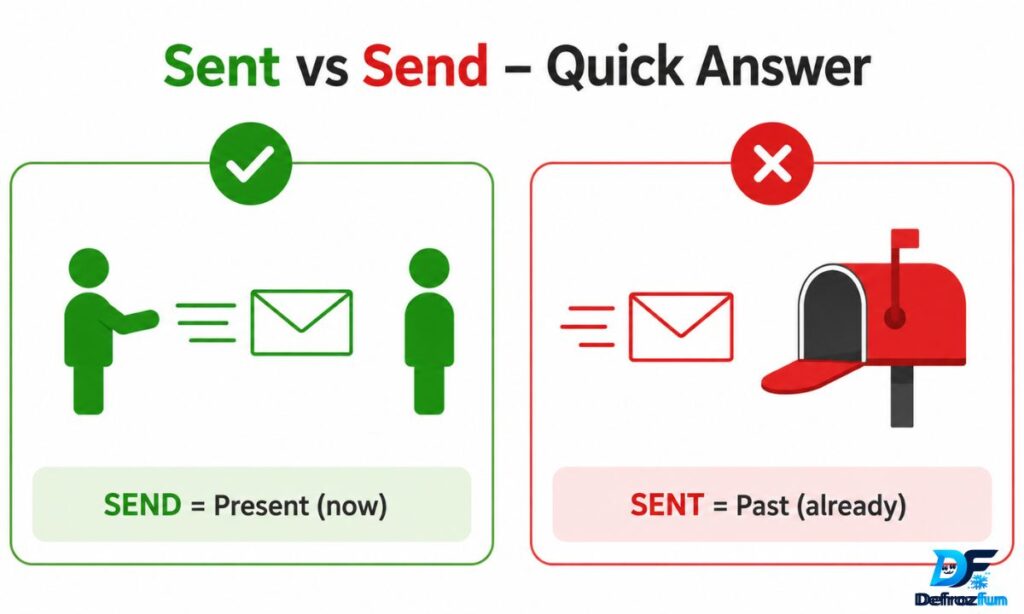
| Word | Type | Used For | Example |
| Send | Base/present form | Present, future, commands | I send emails daily. |
| Sent | Past tense & past participle | Completed actions | I sent the email yesterday. |
In short: send = doing it now or later; sent = already done.
What is the Difference Between Send and Sent?
“Send” is an irregular verb meaning to cause something to go from one place to another — a message, package, or payment. “Sent” is simply its past form, used once the action is complete.
- Send: the action is happening, about to happen, or is habitual.
- Sent: the action has already finished.
Both words come from the same root verb, but the tense changes depending on when the sending happens relative to the moment you’re speaking or writing.
When to Use Send and Sent
Use send when:
- Talking about the present: I send invoices every Friday.
- Talking about the future: She will send the report tomorrow.
- Giving a command or request: Send me the link.
Use sent when:
- Describing a completed past action: He sent the parcel last week.
- Forming present perfect, past perfect, or passive sentences: I have sent it. / It was sent.
Please Send or Sent?
Always say “please send.” After “please,” English uses the base verb form, not the past tense — so “please sent” is incorrect.
✅ Please send the documents today. ❌ Please sent the documents today.
Send: Past Tense and Past Participle
“Send” is an irregular verb, so it doesn’t follow the usual “-ed” pattern.
| Form | Word | Example |
| Base form | send | I send messages daily. |
| Past tense | sent | I sent a message yesterday. |
| Past participle | sent | I have sent the message. |
| Present participle | sending | I am sending the message. |
| Third-person singular | sends | She sends updates weekly. |
How to Use Sent in a Sentence
“Sent” fits naturally into past, perfect, and passive structures:
- I sent the invitation last night.
- She has sent the report already.
- They had sent the package before the deadline.
- The documents were sent by courier.
- He sent her flowers on her birthday.
Send vs Sent Sentences
| Send (Present/Future) | Sent (Past) |
| I send emails every morning. | I sent an email this morning. |
| Please send the file now. | She sent the file an hour ago. |
| We will send the invoice tomorrow. | We sent the invoice yesterday. |
| They always send gifts on Eid. | They sent gifts last Eid. |
| Can you send me your address? | He sent his address last week. |
Send vs Sent Examples
Use these as quick reference points for everyday writing:
- Send — I send updates to the team daily.
- Sent — I sent the update an hour ago.
- Send — Please send your resume by Friday.
- Sent — She has already sent her resume.
- Send — He will send the contract once it’s signed.
- Sent — He sent the contract last night.
Also Read This: Organised or Organized? Key Differences, Correct Usage & Common Mistakes Explained (2026)
I Have Sent or Send?
Use “I have sent” — never “I have send.” Present perfect tense always pairs “have/has/had” with the past participle, which for this verb is “sent.”
✅ I have sent the email. ❌ I have send the email.
Mail Send or Sent?
Both are correct depending on timing:
- Mail send: I will send the mail today (future action).
- Mail sent: I sent the mail yesterday / The mail has been sent (completed action).
There’s no standalone phrase “mail send” as a fixed term — the verb tense still follows the same present/past rule.
I Will Sent or Send?
Only “I will send” is correct. “Will” is followed by the base verb form in every case, so “sent” can never appear after “will.”
✅ I will send the package tomorrow. ❌ I will sent the package tomorrow.
Is “Sended” a Word?
No. “Sended” is not a real word. Because “send” is irregular, it doesn’t take “-ed” like regular verbs (such as “walked” or “talked”). The correct past form is always sent.
❌ I sended the file. ✅ I sent the file.
Pronunciation
- Send is pronounced /send/ — rhymes with “bend” and “trend.”
- Sent is pronounced /sent/ — rhymes with “bent” and “rent.”
The difference is just one consonant sound at the end (d vs. t), so listen carefully in fast speech.
Which Is Correct: Send or Sent?
Both are correct — the right choice depends entirely on tense. Use send for present/future actions and sent for completed past actions.
Which Is Correct: I Already Sent or I Already Send?
“I already sent” is correct. “Already” signals a completed action, so it pairs with the past tense, not the base form.
Can I Say “I Was Sent”?
Yes. “I was sent” is a correct passive construction meaning someone else directed you somewhere. Example: I was sent to collect the documents.
Is It Send or Sent a Photo?
Both work, depending on timing:
- Send a photo — Can you send a photo right now? (present/future request)
- Sent a photo — I sent a photo yesterday. (completed action)
How to Form “Sent”?
“Sent” isn’t formed by adding “-ed” — it’s an irregular past form you simply memorize, similar to “send → sent” patterns like “bend → bent” and “lend → lent.” There’s no formula; the spelling change itself signals the past tense.
Common Mistakes with Sent vs Send
- ❌ I have send the file → ✅ I have sent the file
- ❌ I sended the message → ✅ I sent the message
- ❌ I will sent it tomorrow → ✅ I will send it tomorrow
- ❌ Please sent the invoice → ✅ Please send the invoice
- ❌ She send it yesterday → ✅ She sent it yesterday
Sent vs Send Grammar Rules
| Rule | Applies To | Example |
| Base form after “will,” “can,” “please,” “do/does” | Send | I will send it. |
| Past simple for finished actions | Sent | I sent it yesterday. |
| Past participle after have/has/had | Sent | She has sent it. |
| Passive voice (was/were + past participle) | Sent | It was sent on Monday. |
| Habitual or repeated present actions | Send | He sends/sent — use “sends” for habits in present |
Sent vs Send Quiz
Test yourself — fill in the blank with send or sent:
- I ___ the email yesterday.
- Please ___ the file now.
- She has already ___ the report.
- We will ___ the invoice tomorrow.
- They ___ gifts every year during the holidays.
Answer Key: 1. sent 2. send 3. sent 4. send 5. send
Google Trends & Usage Data
Interest in “send vs sent” stays consistently high because the mistake is common in everyday writing — emails, texts, and workplace messages. Search data shows steady demand for this grammar comparison across English-speaking and ESL audiences in countries including Pakistan, India, the Philippines, and the United States, reflecting how often non-native and native speakers alike second-guess verb tense in fast, informal communication.
Conclusion
The “send vs sent” mix-up comes down to one simple rule: send for present and future actions, sent for anything already completed. Once you internalize that “sent” only ever appears in past, perfect, or passive contexts, the confusion disappears for good. Keep this guide handy for quick checks before you hit send on your next email or message.

Daniel Brooks is a passionate writer and digital content creator dedicated to sharing insightful, engaging, and informative articles across multiple niches. With a strong interest in technology, lifestyle, trending topics, and online media, Daniel Brooks focuses on delivering well-researched and reader-friendly content that inspires and informs audiences worldwide.