

If you’ve ever stopped mid-sentence wondering whether to write analysing or analyzing, you’re not alone. This is one of the most commonly searched grammar questions by students, writers, and professionals worldwide. The good news? Both spellings are correct — but which one you use depends on your audience and location.
Analysing or Analyzing – Quick Answer
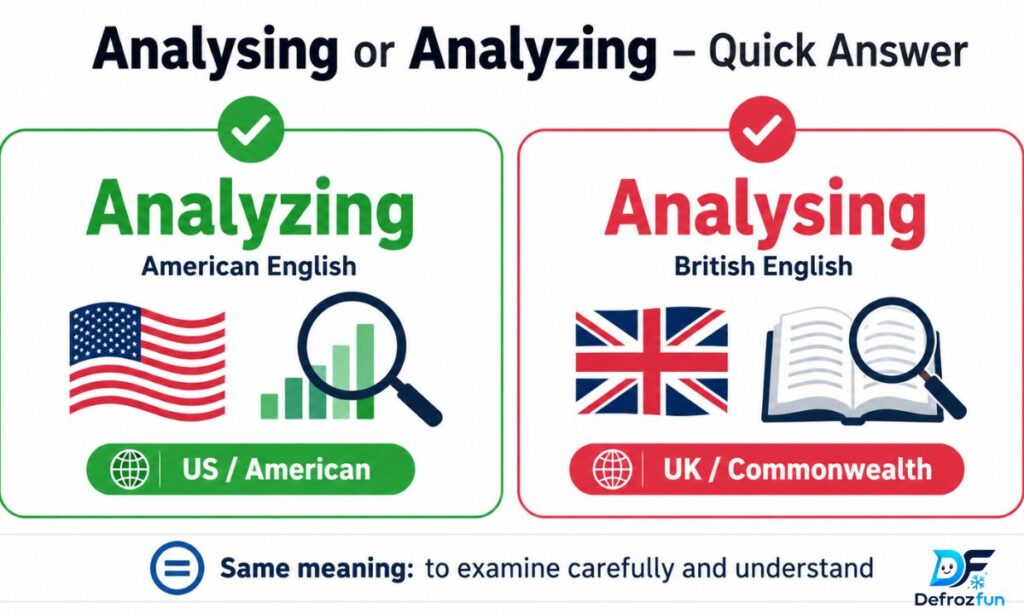
Analyzing = American English ✅
Analysing = British English ✅
Both words are the present participle of the verb analyze/analyse. They carry exactly the same meaning: to examine something carefully in order to understand it. The only difference is regional spelling convention — not grammar, not meaning, not pronunciation.
Rule of thumb: Use analyzing for a US audience. Use analysing for a UK, Australian, or Commonwealth audience.
The Origin of Analysing / Analyzing
To understand why two spellings exist, you need a short history lesson.
The word traces back to the Greek word analusis, meaning “a breaking up” or “a resolving into parts.” It entered the English language around the 16th century via French, which spelled it analyser — with an “s.” So for centuries, analyse was the standard form across all English-speaking regions.
The split happened in the early 19th century, thanks to American lexicographer Noah Webster. He launched a spelling reform movement with the goal of simplifying English and making it easier to learn. Since analyse sounded like a “z” when spoken, he changed it to analyze in American dictionaries.
This single decision created a ripple effect across hundreds of words — and shaped the American English we use today.
Key dates at a glance:
| Period | Event |
| 16th century | Analyse enters English from French |
| Early 1800s | Noah Webster introduces analyze for American English |
| 19th–20th century | British English retains analyse; American English standardizes analyze |
| Today | Both spellings are globally accepted in their respective regions |
British English vs American English Spelling
The analysing/analyzing difference is part of a much larger pattern in English spelling. American English consistently prefers -ize endings, while British English sticks with -ise.
Comparison Table: British vs American Spelling
| British English (-ise / -s) | American English (-ize / -z) |
| Analysing | Analyzing |
| Analyse | Analyze |
| Organise | Organize |
| Realise | Realize |
| Finalise | Finalize |
| Crystallise | Crystallize |
Important note: The noun form analysis stays the same in both varieties of English. Never write analyzis — that is always incorrect, regardless of whether you follow British or American conventions.
Which countries use which spelling?
- Analyzing (American spelling): United States, Canada (generally)
- Analysing (British spelling): United Kingdom, Australia, New Zealand, India, South Africa, and most Commonwealth nations
Which Spelling Should You Use?
The answer comes down to three factors: your audience, your context, and consistency.
1. Match Your Audience
If you’re writing for American readers — use analyzing. If your audience is in the UK or Australia — use analysing. Simple.
2. Follow Your Style Guide
Academic institutions, publishers, and companies often have a preferred style guide:
- American Psychological Association (APA) → analyzing
- Chicago Manual of Style → analyzing
- Oxford Style Guide → analysing
- Cambridge Academic Writing → analysing
3. Prioritize Consistency Above All
Mixing both spellings in a single document — even once — looks unprofessional and undermines your credibility. Pick one and stick to it throughout.
Practical tip: Before starting any document, go to your word processor’s language settings and select either English (United States) or English (United Kingdom). This ensures spell-check flags the wrong variant automatically.
What about global or international content?
If you’re writing for a worldwide audience — such as an SEO blog, a SaaS product, or international marketing content — analyzing (American English) is generally the safer default. American English dominates global tech, digital media, and online content, making it more familiar to a wider range of readers.
Common Mistakes with Analysing / Analyzing
Even native speakers get tripped up. Here are the most frequent errors to avoid:
❌ Mistake 1: Mixing Spellings in the Same Document
This is the most common error. You cannot use British spelling in one paragraph and American spelling in the next.
- Wrong: The team is analyzing the results. After analysing the data…
- Right (US): The team is analyzing the results. After analyzing the data…
- Right (UK): The team is analysing the results. After analysing the data…
❌ Mistake 2: Misspelling the Noun Form
The noun is always analysis — never analyzis or analysisis.
❌ Mistake 3: Confusing the Verb and Noun
- Analyse / Analyze → verb (to do the action)
- Analysis → noun (the result)
- Analyses → plural noun (multiple results)
Example:
She will analyze the report. (verb)
The analysis took three hours. (noun)
Both analyses were accurate. (plural noun)
❌ Mistake 4: Assuming One Spelling Is “Wrong”
Neither spelling is incorrect. Labeling analysing as a mistake in American content, or analyzing as wrong in British content, is a misunderstanding of regional variation — not a grammar correction.
Analysing / Analyzing in Everyday Examples
Seeing both spellings in real-world context helps cement the difference. Here are natural examples from different fields:
Business & Data
- 🇺🇸 The marketing team is analyzing the Q3 campaign results.
- 🇬🇧 The marketing team is analysing the Q3 campaign results.
Academic Writing
- 🇺🇸 Researchers are analyzing patterns in climate data.
- 🇬🇧 Researchers are analysing patterns in climate data.
Healthcare
- 🇺🇸 The lab technician is analyzing the blood samples.
- 🇬🇧 The lab technician is analysing the blood samples.
Technology / AI
- 🇺🇸 The algorithm is analyzing user behavior in real time.
- 🇬🇧 The algorithm is analysing user behaviour in real time.
As you can see, the only change is the single letter — the meaning, sentence structure, and context remain identical.
Analysing / Analyzing – Google Trends & Usage Data
Global search data gives us a clear picture of how people use these two spellings online.
Key Usage Insights
| Metric | Analyzing | Analysing |
| Primary region | United States, Canada | UK, Australia, New Zealand |
| Global online dominance | Higher (due to US-led internet content) | More common in Commonwealth publications |
| Academic journals (US) | Standard | Rare |
| Academic journals (UK/AU) | Acceptable | Preferred |
| Tech & SaaS content | Widely used default | Used in UK-based products |
Why does analyzing appear more in global searches?
American media, technology companies, and digital platforms have a massive global footprint. Most major search engines, software tools, and online publications originate in the US, which means analyzing naturally dominates raw search volume worldwide. However, this is a reflection of US media reach — not linguistic correctness.
In Commonwealth countries, analysing remains the standard in academic, legal, and official writing contexts.
FAQs
Is “analysing” wrong in American English?
Yes, it would be considered a misspelling in American English. US style standards expect analyzing.
Is “analyzing” wrong in British English?
It’s not strictly wrong, but it’s non-standard. British readers may view it as an Americanism. Stick with analysing for UK audiences.
Can I use both spellings in the same document?
No. Mixing spellings looks unprofessional. Pick one variant and use it consistently throughout.
Which spelling is more common globally?
Analyzing appears more frequently online due to the dominance of American English in digital content and global tech.
Does the spelling change the pronunciation?
No. Both analysing and analyzing are pronoun ced identically: /ˈænəlaɪzɪŋ/.
What is the noun form of analyze/analyse?
Always analysis — the same in both American and British English. The plural is analyses.
Does the same rule apply to related words?
Yes. The pattern extends to analyzer/analyser, analyzed/analysed, and analysis (which stays the same in both).
Which spelling should I use for international SEO content?
For global digital content, analyzing (American English) is generally the safer default, as it aligns with US-dominated online search behavior.
Conclusion
The analysing vs. analyzing debate has a clear answer: both are correct, but for different audiences.
- Use analyzing if you’re writing for American readers or global digital content.
- Use analysing if you’re writing for British, Australian, or Commonwealth audiences.
- Whatever you choose — be consistent. Mixing both in one document undermines professionalism and clarity.
The spelling difference does not affect meaning, grammar, or pronunciation. It is purely a regional convention rooted in 19th-century American spelling reform by Noah Webster. Once you know your audience, the choice becomes automatic.

Daniel Brooks is a passionate writer and digital content creator dedicated to sharing insightful, engaging, and informative articles across multiple niches. With a strong interest in technology, lifestyle, trending topics, and online media, Daniel Brooks focuses on delivering well-researched and reader-friendly content that inspires and informs audiences worldwide.