

If you’ve ever stopped mid-sentence wondering whether to type “speach” or “speech,” you’re not alone. This is one of the most common spelling mistakes in English — and the answer is simple once you understand why it happens.
Speach or Speech – Quick Answer
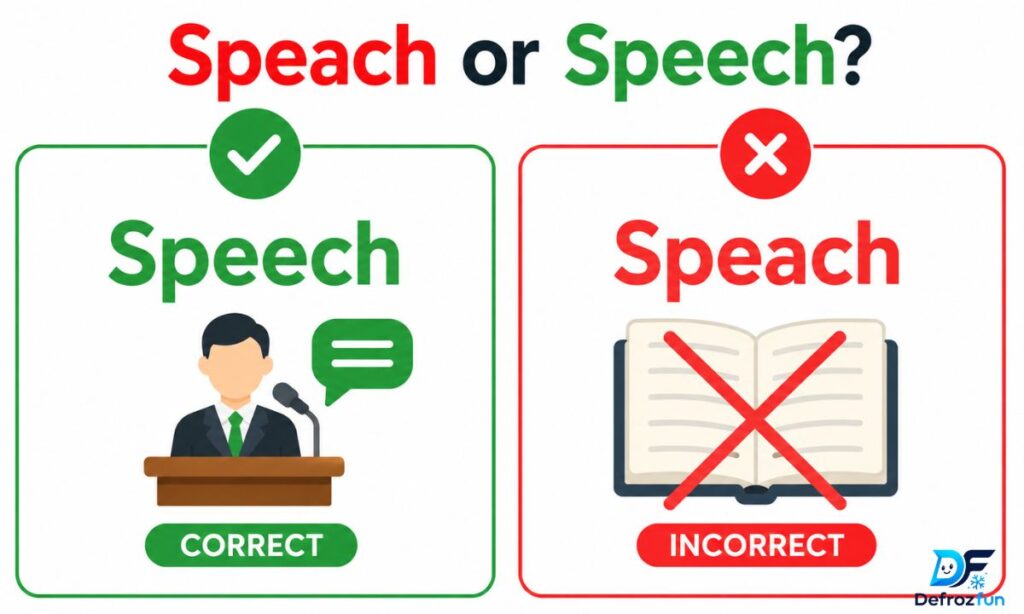
Speech is the correct spelling. “Speach” does not exist in the English language.
It is not listed in any dictionary — not Merriam-Webster, not Oxford, not Cambridge. If you type “speach” in any word processor, the red underline appears immediately. Always use speech.
✅ Correct: She gave a powerful speech at the conference. ❌ Incorrect: She gave a powerful speach at the conference.
The Origin of Speech
To understand why “speech” is spelled with double E and not EA, it helps to look at where the word comes from.
The word speech traces back to Old English “spæc” and later “speche” in Middle English, both meaning “the act of speaking” or “manner of speaking.” Before that, it evolved from Proto-Germanic “sprekanan,” which is also the root of the German word sprechen (to speak) and the Dutch spraak.
Over centuries, the spelling shifted. The “r” in the original root dropped out by the mid-12th century, and the spelling settled into the modern “speech” we use today.
This is why the spelling feels slightly irregular — the word did not follow a straight line from speak to speech. It followed its own historical path.
Why Do People Misspell It as “Speach”?
The misspelling “speach” is extremely common, and the reason is logical:
- The verb speak uses EA (s-p-e-a-k)
- People assume the noun form should follow the same pattern → speach
- But English words don’t always obey consistent spelling rules
Other words like teach → teacher and reach → reached use “EA,” so it feels natural to apply the same pattern to speak → speach. Unfortunately, English doesn’t work that way here.
The correct noun derived from speak is speech — with EE, not EA.
British English vs American English Spelling
One common question is whether “speach” might be correct in British English. The short answer: No.
Both British English and American English agree on this one. There is no regional variation. “Speech” is the only accepted spelling in every English-speaking country — the UK, the US, Canada, Australia, and beyond.
| Variety | Correct Spelling | Incorrect Spelling |
| American English | speech | speach |
| British English | speech | speach |
| Canadian English | speech | speach |
| Australian English | speech | speach |
Unlike words such as colour/color or organise/organize, speech has no regional variant. It is universally “speech.”
Which Spelling Should You Use?
Always use speech — in every context, every format, and every country.
Here’s when you’ll use the word:
- Referring to spoken language: “Human speech develops in early childhood.”
- A formal address to an audience: “The CEO gave a keynote speech.”
- A person’s speaking style: “Her speech was calm and precise.”
- A linguistic term: “Parts of speech include nouns, verbs, and adjectives.”
There is never a situation where “speach” is acceptable. It is always a spelling error.
Common Mistakes with Speech
Beyond the speach/speech confusion, here are other errors people make with this word:
1. Misspelling the plural
- ❌ Speaches
- ✅ Speeches
2. Confusing verb and noun forms
- Verb: speak, spoke, spoken
- Noun: speech, speeches
- There is no verb “to speech” in standard usage
3. Wrong article usage
- ❌ “She made speech at the event.”
- ✅ “She gave a speech at the event.”
4. Mixing up related words
- Speech = the noun (the act of speaking or a formal address)
- Speak = the verb (to utter words)
- Speaker = the person who speaks
Also Read This: Forest or Forrest: Which Spelling Is Correct? (2026)
Speech in Everyday Examples
Here are natural, correct uses of “speech” in real sentences:
- His speech at the graduation ceremony moved the entire audience.
- The child’s speech development was assessed by a specialist.
- Freedom of speech is protected under the First Amendment.
- She rehearsed her speech three times before the presentation.
- The president’s speech was broadcast live across the country.
- Parts of speech are taught in every grammar course.
- The actor won an award and gave a heartfelt speech.
Each of these uses “speech” correctly — as a noun referring to either spoken communication in general, or a specific formal address.
Speech – Google Trends & Usage Data
Google Trends data confirms that “speach” is consistently searched alongside “speech” — but only because users are checking which spelling is right.
Key findings from search data:
- “Speach or speech” is among the top spelling-related queries in English
- Most searches for “making a speach” automatically redirect to results for “making a speech”
- Roughly one in four people has written “speach” at some point, according to spelling analysis across digital platforms
- The misspelling is more common in informal writing — texts, quick emails, and social media posts
This data shows the confusion is widespread, but it also confirms that “speech” is overwhelmingly dominant in formal usage.
Comparison Table: Speech vs Speach
| Feature | Speech | Speach |
| Correct spelling | ✅ Yes | ❌ No |
| Found in dictionary | ✅ Yes | ❌ No |
| Recognized by spell check | ✅ Yes | ❌ No (flagged as error) |
| Used in formal writing | ✅ Yes | ❌ Never |
| Has a definition | ✅ Yes | ❌ No |
| British English accepted | ✅ Yes | ❌ No |
| American English accepted | ✅ Yes | ❌ No |
| Correct plural form | speeches | — |
How to Remember the Correct Spelling
Here are a few memory tricks that actually work:
- Think of “see” — Both see and speech have “ee.” You need to see a good speech.
- Think of “peach” — The word speech contains the word “peach” with an S in front: S + peach → but with ee not ea: sp + ee + ch
- Double E = expression — Use the phrase “English Expression” to remember both E’s in speech.
- Write it 10 times — Muscle memory is one of the most effective spelling tools.
- Use spell check — Modern tools will always catch “speach” and suggest the correct “speech.”
Conclusion
The answer to “speach or speech” is clear: speech is always correct, and speach is always wrong.
The confusion comes from the word’s relationship to speak — but as you now know, the noun followed its own historical path from Old English, landing on a double-E spelling that has been standard for centuries.
Whether you’re writing a graduation speech, studying parts of speech, or simply checking a spelling before hitting send, the rule never changes: it’s speech, not speach.
Bookmark this page, use the memory tricks above, and you’ll never second-guess this word again.

Daniel Brooks is a passionate writer and digital content creator dedicated to sharing insightful, engaging, and informative articles across multiple niches. With a strong interest in technology, lifestyle, trending topics, and online media, Daniel Brooks focuses on delivering well-researched and reader-friendly content that inspires and informs audiences worldwide.