

You’ve probably typed it fast and second-guessed yourself mid-sentence — is it which or wich? You’re far from alone. Millions of students, professionals, and English learners make this exact spelling slip every day, especially on phones, in emails, and on social media. This guide clears it up in plain language, with examples, grammar rules, and easy memory tricks so you never get it wrong again.
Which or Wich – Quick Answer
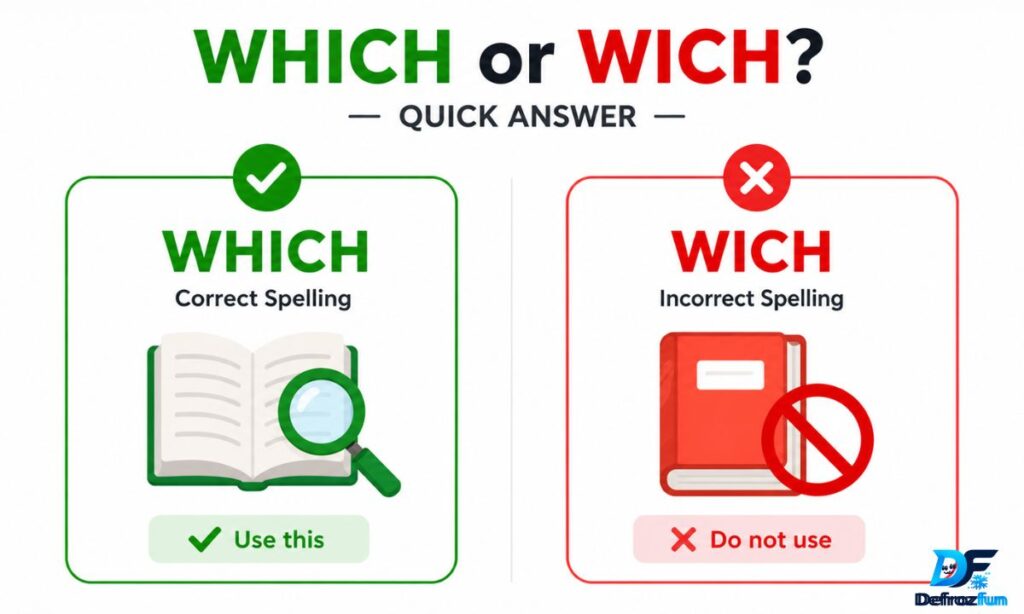
Which is the correct spelling — always.
Wich is not a standard English word. It is a misspelling of which in everyday writing. The only time you’ll see -wich is as a suffix in British place names like Sandwich, Norwich, and Greenwich, where it comes from an entirely different Old English root meaning “settlement” or “harbor.”
| Word | Correct? | Role in English |
| Which | ✅ Yes | Pronoun / determiner used in questions and clauses |
| Wich | ❌ No | Not a standard word; misspelling of which |
| -wich | ✅ (place names only) | Old English suffix in British town names |
Bottom line: In any sentence you write — questions, comparisons, relative clauses — the word you need is which.
The Origin of Which or Wich
The word which traces back to Old English hwilc, meaning “what kind” or “what one.” Back then, the hw- sound was actually pronounced — it was a real, audible sound at the front of the word. Over centuries of language change, that hw- sound gradually softened and the spelling flipped to wh-, but the letter H stayed in the word to honor its roots and separate it from similar-sounding words.
That’s why you see which, what, when, where, and who — they all share that wh- pattern inherited from Old English.
The suffix -wich, on the other hand, comes from the Old English word wīc, meaning a settlement, harbor, or trading post. It has nothing to do with the pronoun which. When people argue that “wich” is valid because of Sandwich or Norwich, they’re mixing up two completely separate word histories.
British English vs American English Spelling
A common question is whether British and American English spell this word differently. The answer is no — both use which.
There is no alternate British spelling. There is no informal American version without the H. The spelling is consistent across all varieties of English worldwide.
| English Variety | Correct Spelling | Notes |
| British English | which | Same as American English |
| American English | which | No variation |
| Australian English | which | No variation |
| Place name suffix | -wich | Only in proper nouns (Norwich, Ipswich) |
The -wich suffix does appear more commonly in British place names because England has more towns with that Old English naming convention. But that is about geography and history — not grammar or spelling rules.
Also Read This: Hide vs Hid: What is the Difference and Meaning? (2026)
Which Spelling Should You Use?
Always use which. No exceptions in standard writing.
Use which when you are:
- Asking a question about choices: Which route is faster?
- Adding extra information in a relative clause: The book, which I borrowed last week, was excellent.
- Pointing to something specific from a group: Which of these colors do you prefer?
- Connecting two ideas in a sentence: The update, which launched yesterday, fixed the bug.
A simple memory trick: Which, What, When, Where, Who — they all start with Wh-. If the other interrogative pronouns have an H, so does which.
Common Mistakes with Which or Wich
Even fluent English speakers make these errors. Here are the most frequent ones:
1. Typing “wich” instead of “which” This happens because the H in which is nearly silent in everyday speech. When people spell by sound, they drop it. Fast typing on touchscreens makes it worse.
Wrong: Wich dress should I wear? Right: Which dress should I wear?
2. Confusing “which” and “that” Both can introduce relative clauses, but they work differently:
- Use which for non-restrictive clauses (extra info, set off by commas): The car, which is red, belongs to my sister.
- Use that for restrictive clauses (essential info, no commas): The car that is red belongs to my sister.
3. Forgetting the comma before “which” In non-restrictive clauses, the comma before which is required. Skipping it changes the meaning of your sentence.
Without comma (restrictive): The app which crashed was deleted. With comma (non-restrictive): The app, which crashed, was deleted.
4. Using “wich” as a shorthand in formal writing Some café or sandwich shop brands stylize their name with ‘wich as a trendy abbreviation for sandwich. That’s branding — never use it in emails, essays, or professional documents.
Which or Wich in Everyday Examples
Seeing the word in real sentences makes the correct spelling stick faster.
Correct usage of “which”:
- Which laptop has the best battery life?
- I’m not sure which option is right for me.
- The project, which started in January, is finally done.
- She couldn’t decide which path to take.
- This is the tool which saves the most time.
Incorrect usage of “wich”:
- ~~Wich color do you like?~~ → Which color do you like?
- ~~I don’t know wich one to pick.~~ → I don’t know which one to pick.
- ~~The file wich I sent is attached.~~ → The file which I sent is attached.
In every single case above, only which is correct. There is no context in standard English writing where wich belongs.
Which or Wich – Google Trends & Usage Data
Search data for “which or wich” reveals a clear pattern. The combined query spikes in countries like India, Pakistan, the Philippines, and the United States — regions with large populations of English learners and students preparing for exams.
Searches tend to peak during academic seasons (exam periods, back-to-school months), which confirms that the confusion is largely driven by spelling anxiety rather than genuine grammatical uncertainty.
Key takeaways from search data:
- The query is dominated by people who already use which in speech but aren’t confident about the spelling
- Volume is high on mobile devices, reflecting quick typing errors
- The top related searches include “which vs that” and “which spelling correct”, showing users are often looking for broader grammar clarity
This data confirms one thing: people know the word — they just need confidence in the spelling.
Which or Wich Comparison Table
| Feature | Which | Wich |
| Correct spelling | ✅ Yes | ❌ No |
| Used in questions | ✅ Yes | ❌ No |
| Used in relative clauses | ✅ Yes | ❌ No |
| Appears in place names | ❌ No | ✅ As suffix (-wich) |
| Found in dictionaries | ✅ Yes | ❌ Not as standalone word |
| Accepted in formal writing | ✅ Yes | ❌ No |
| Part of wh- pronoun family | ✅ Yes | ❌ No |
Conclusion
The answer to which or wich is simple: always use which. It is the only correct spelling in the English language, whether you’re writing a formal report, a quick text, or a blog post. The word wich is a common typing error https://www.collinsdictionary.com/dictionary/english/typing-error caused by the soft H sound — not a real English word with its own meaning.
Remember the pattern: Which, What, When, Where, Who — every interrogative pronoun in English starts with Wh-. That one mental anchor is all you need to spell it right every time. Slow down when typing, trust your spell-checker, and you’ll never confuse which or wich again.

Daniel Brooks is a passionate writer and digital content creator dedicated to sharing insightful, engaging, and informative articles across multiple niches. With a strong interest in technology, lifestyle, trending topics, and online media, Daniel Brooks focuses on delivering well-researched and reader-friendly content that inspires and informs audiences worldwide.